


Agile operational process design example of ppt




Try Before you Buy Download Free Sample Product
 Impress Your
 Audience
 100%
100% Editable
 Save Hours
 of Time


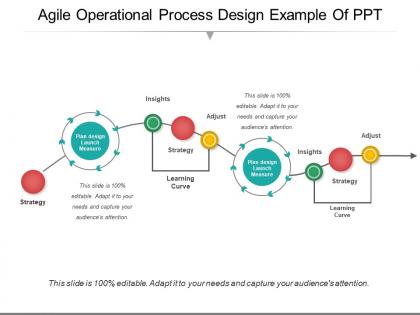
Optimize, manage and monitor business process performance by using our predesigned agile operational process design example of PPT presentation template. This agile process model PPT is one of the best among a wide range of operational process design PPT templates available, as it uses wonderful graphics to highlight each of the operational excellence tools and techniques to be used. Using agile for business process design is very much helpful in achieving operational excellence at workplace. The design template is mainly used by business managers, sales and operation professionals to develop strategic business plan, maintaining operational excellence and organizational agility. You can showcase complete agile operation process including strategy, insights, and control activities with the help of this wonderful operational excellence framework PPT diagram. PPT is perfect for your business needs as it easily describes combined work flow and rules engine with the help of a single diagram. So, don’t give a second thought, just download this powerful agile process model PPT template by clicking on the download button. A great structure a logical flow of events and an attractive design is what you get with our Agile Operational Process Design Example Of Ppt. This is the combination that makes for engaging presentations.
People who downloaded this PowerPoint presentation also viewed the following :
Agile operational process design example of ppt with all 5 slides:
Charge your talk with our Agile Operational Process Design Example Of Ppt. Fast track yourself on the road to success.


FAQs for Agile operational process design
Agile operational process design emphasizes iterative development, cross-functional collaboration, customer feedback integration, adaptive planning, and continuous improvement over traditional linear approaches. These principles enable organizations to respond rapidly to market changes, reduce development cycles, and enhance product quality, with many companies in technology, manufacturing, and financial services finding that agile methodologies deliver faster time-to-market and improved operational efficiency.
Organizations can assess their readiness by evaluating cultural adaptability, leadership commitment, team collaboration capabilities, current process flexibility, and technological infrastructure supporting iterative workflows. Through readiness assessments, companies in manufacturing, healthcare, and financial services identify gaps in cross-functional communication, decision-making speed, and change management capacity, ultimately enabling strategic preparation that streamlines implementation and delivers sustainable operational agility.
Cross-functional teamwork serves as the foundation of Agile operational process design, enabling diverse expertise integration, faster decision-making, reduced silos, and enhanced problem-solving capabilities across departments. These collaborative teams streamline workflows by combining technical, business, and operational perspectives, ultimately delivering improved process efficiency and organizational agility, with many companies finding that cross-functional collaboration accelerates innovation cycles significantly.
Agile methodologies enhance operational workflows by promoting iterative improvements, cross-functional collaboration, and rapid response to changing requirements. Through continuous feedback loops and sprint-based planning, organizations streamline processes, reduce bottlenecks, and accelerate decision-making, with many companies finding that Agile approaches ultimately deliver greater operational flexibility and improved customer responsiveness.
Recommended tools include Jira for project management, Confluence for documentation, Miro for process mapping, Slack for team communication, and Azure DevOps for integration workflows. These platforms streamline collaboration, enhance transparency, and automate workflow tracking, with many organizations finding that strategic tool combinations deliver faster iteration cycles, improved cross-functional coordination, and ultimately greater operational efficiency in increasingly dynamic business environments.
Organizations can measure Agile implementation success through key performance indicators including sprint velocity, customer satisfaction scores, time-to-market reduction, team productivity metrics, and defect rates. These measurements enable companies to track operational efficiency, product quality, and delivery speed, with many finding that regular retrospectives and stakeholder feedback loops ultimately deliver enhanced project outcomes and competitive advantage.
Customer feedback influences Agile operational process design by driving iterative improvements, identifying bottlenecks, and validating process effectiveness through real-time insights. Organizations across retail, healthcare, and financial services use customer input to streamline workflows, enhance service delivery, and accelerate response times, with many finding that feedback-driven process optimization ultimately delivers improved operational efficiency and competitive advantage.
Organizations commonly face resistance to change, inadequate training, misaligned performance metrics, lack of cross-functional collaboration, and insufficient leadership support when transitioning to Agile operational processes. These challenges often manifest in manufacturing, financial services, and healthcare sectors, where traditional hierarchies clash with Agile's collaborative approach, ultimately requiring strategic change management and cultural transformation to deliver enhanced operational efficiency.
Visual management techniques integrate into Agile operational process design through Kanban boards, burndown charts, value stream maps, sprint dashboards, and real-time progress indicators. These tools enhance transparency by making workflow bottlenecks visible, enabling faster decision-making and continuous improvement cycles, while teams can quickly identify inefficiencies and optimize resource allocation for better operational outcomes.
A culture of continuous improvement significantly enhances Agile operations by fostering adaptability, accelerating problem-solving capabilities, and enabling teams to optimize workflows through regular retrospectives and feedback loops. This approach streamlines operational efficiency, reduces waste, and enhances customer responsiveness, with many organizations finding that embedded improvement mindsets ultimately deliver sustained competitive advantage and faster innovation cycles.
Agile operational process design supports remote and hybrid teams by emphasizing iterative collaboration, transparent communication workflows, and flexible sprint structures that accommodate distributed work patterns. Through digital kanban boards, regular virtual stand-ups, and asynchronous feedback loops, organizations streamline coordination across time zones while maintaining project visibility, ultimately delivering faster adaptation and enhanced team productivity regardless of location.
Best practices for integrating Agile principles into existing operational frameworks include cross-functional team formation, iterative process implementation, continuous feedback loops, flexible resource allocation, and stakeholder collaboration enhancement. These approaches streamline operations by reducing cycle times, improving adaptability, and enhancing customer responsiveness, with many organizations finding that gradual integration delivers sustainable transformation while maintaining operational stability.
Organizations can tailor Agile processes by conducting thorough operational assessments, customizing sprint lengths and team structures, adapting ceremonies to existing workflows, and integrating legacy systems gradually. Through strategic customization, companies in manufacturing, healthcare, and financial services streamline operations while maintaining compliance requirements, ultimately delivering faster response times and enhanced operational efficiency across their unique business environments.
Sustaining momentum in Agile process design requires continuous improvement cycles, regular retrospectives, cross-functional team empowerment, and iterative feedback loops that adapt to changing business needs. Organizations streamline operations by establishing clear communication channels, maintaining stakeholder engagement, and fostering a culture of experimentation, ultimately delivering enhanced operational efficiency and competitive advantage.
Leadership fosters Agile mindsets by promoting continuous learning, encouraging experimentation, empowering cross-functional collaboration, and implementing iterative feedback loops. Through regular retrospectives and transparent communication, leaders enable teams to embrace change, reduce hierarchical barriers, and prioritize customer value, with many organizations finding that this cultural shift significantly enhances operational efficiency and team adaptability.
-
Graphics are very appealing to eyes.
-
Informative presentations that are easily editable.