

Ai Powered Sentiment Analysis Dashboard To Assess Potential Consumers Sentiments AI SS





Try Before you Buy Download Free Sample Product
 Impress Your
Audience
 100%
Editable
 Save Hours
of Time


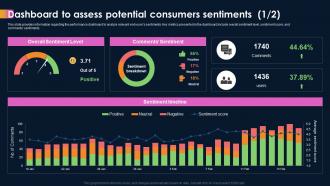
This slide provides information regarding the performance dashboard to analyze relevant end-users sentiments. Key metrics presented in the dashboard include overall sentiment level, sentiment score, and comments sentiments.
People who downloaded this PowerPoint presentation also viewed the following :
Ai Powered Sentiment Analysis Dashboard To Assess Potential Consumers Sentiments AI SS with all 11 slides:
Use our Ai Powered Sentiment Analysis Dashboard To Assess Potential Consumers Sentiments AI SS to effectively help you save your valuable time. They are readymade to fit into any presentation structure.










FAQs for Ai Powered Sentiment Analysis Dashboard To Assess Potential Consumers
You'll mainly see sentiment breakdowns (positive/negative/neutral percentages) and live feeds of mentions coming in. Visual charts show how sentiment changes over time - honestly these trend charts are where I'd start since they give you the fastest snapshot of brand health. There's usually keyword analysis so you can figure out what's actually causing good or bad sentiment, which is clutch when stuff hits the fan. Most have alerts for sudden shifts, plus filtering by date or platform. Oh and source attribution too - tells you if it's coming from Twitter, reviews, whatever. The keyword breakdowns are probably my favorite feature.
Honestly, charts beat staring at spreadsheets any day. Line graphs are perfect for tracking how sentiment changes over time - you'll catch patterns instantly. Heat maps work great too, especially when you want to see which topics people love vs hate (the color coding makes it super obvious). For overall breakdowns, pie charts do the trick. Oh, and bar charts are clutch when you're comparing different products or campaigns side by side. The trick is figuring out what question you're actually trying to answer first. Then just pick whatever chart type tells that story clearest.
Honestly, you can grab data from basically anywhere people share opinions online. Twitter, Facebook, Instagram - all good options. Customer review sites are goldmines too. Don't forget about survey responses, support tickets, and chat logs either. Email campaigns work well, plus forum discussions. The main thing? You need text with enough context to actually analyze emotions properly. Some dashboards even do real-time feeds which is kinda wild to watch tbh. I'd probably start with wherever your customers are most active, then branch out once you see what kind of insights you're actually getting.
So ML basically gets smarter as it processes more data - way better than those old rule-based systems. It picks up on slang, sarcasm, all that stuff that changes constantly. People talk so differently on Twitter vs LinkedIn, you know? The speed is insane too - it can crunch through tons of data and catch weird edge cases that would trip up traditional methods. Honestly, the sarcasm detection alone makes it worth it. Just make sure you're checking how it's performing weekly and throw new data at it monthly to keep it sharp.
Start with accuracy, precision, and recall - they'll show you how well your model's doing overall and per category. F1-score combines precision and recall, which is handy. Honestly, confusion matrices are where you'll spot the real issues, like when your algorithm can't tell neutral from negative (happens more than you'd think). Check confidence scores too so you know when the model's just guessing. Build your dashboard around these first, then add weird domain-specific stuff later once you see what's actually breaking.
Yeah, it can work but honestly accuracy drops pretty hard with other languages. Most models are trained on English data, so you're gonna struggle with stuff like sarcasm or cultural idioms. Japanese politeness nuances? Forget about it. Arabic dialects are a nightmare too. I'd grab language-specific models if you can find decent ones. Also - and this might be obvious - but definitely test with native speakers before you launch anything. Cultural context is actually way trickier than just translating the words. Mixed results are pretty much guaranteed otherwise.
So basically, these dashboards show you what people *actually* think about your stuff in real time - social media, reviews, all that. Way better than waiting weeks for some market research report. You'll catch things immediately, like if your new product is tanking or competitors are getting dragged (honestly pretty entertaining). Set up alerts for big sentiment changes so you're not glued to the screen 24/7. Then you can fix customer issues fast or pivot your marketing when something's not working. It's like having your finger on the pulse without doing all the legwork yourself.
Honestly, sarcasm and context are gonna trip you up the most - AI just doesn't get when someone's being snarky or using weird industry terms. Getting good data is such a nightmare too. You need tons of clean, labeled examples and finding diverse stuff is... ugh, time-consuming. Mixed feelings in longer texts? That'll mess with your accuracy big time. Oh, and keeping it consistent across different topics is harder than it sounds. My take? Pick one specific thing to focus on first. Test it with actual customer messages, not fake data. And yeah, you'll probably need to retrain the model constantly since people change how they talk.
Honestly, just make it super easy for users to flag when your sentiment analysis gets something wrong - that feedback becomes gold for training your models. Run interviews with actual users too, because what you think matters might be totally off from what they actually need (learned this the hard way). Beta groups are clutch for testing new features. The real trick though? Actually show people how you used their feedback to make things better. Nothing kills user engagement faster than asking for input and then... crickets. Oh, and don't overthink the feedback collection process - if it's clunky, nobody'll use it.
So NLP is what actually makes sentiment analysis work - without it, you're just looking at gibberish text. People write weird stuff online, right? Typos everywhere, sarcasm that's impossible to detect, random slang. NLP breaks all that down and figures out what someone's actually trying to say. It identifies the important phrases and context so the system can tell if they're happy, pissed off, or whatever. Oh, and make sure your data's clean before running it - garbage in, garbage out and all that. Trust me, messy data will screw up your sentiment scores completely.
Honestly, sentiment analysis is like having a smoke detector for PR disasters. It'll catch negative vibes way before they blow up into full-blown scandals. You can see in real-time if your messaging is actually working or if people think it's total garbage. I know companies that've spotted brewing controversies just from watching how sentiment shifted around their brand mentions - pretty smart if you ask me. The speed is what makes it worth it though. Why wait weeks for survey results when you can get instant feedback? Set up alerts so when sentiment tanks, your team knows to scramble immediately.
Oh man, sentiment dashboards are seriously a game-changer for marketing stuff. You get to see what people actually think about your campaigns as they're happening - no more shooting in the dark. Which messages are hitting right, what's pissing people off, all that good intel. Honestly the competitor tracking part gets weirdly addictive lol. You can catch trends early too before they explode everywhere. My advice? Set up alerts for when sentiment tanks on important campaigns. That way you're not scrambling later trying to figure out what went wrong.
Hey! So privacy is huge - you can't just analyze people's texts or posts without asking first. Your models will definitely be biased against certain groups (happens literally all the time). Be upfront about what you're actually doing with the data. Don't make big decisions based on sentiment scores alone - they're pretty flawed tbh. Test everything across different demographics. Also document your ethical approach somewhere, even if it's just basic guidelines. The bias thing is probably the biggest issue you'll run into.
Sentiment analysis is seriously helpful for catching angry customers before they blow up. Set up alerts when sentiment scores drop below a threshold - trust me, nothing's worse than missing a furious customer. Your dashboard flags negative stuff in tickets and chats automatically, so you can jump on those first. The cool part is spotting trends too. Like if everyone's complaining about the same checkout bug or whatever, you can actually fix it instead of dealing with the same issue over and over. Way better than playing whack-a-mole with support requests all day.
Honestly, sentiment analysis is about to get crazy good. We're talking real-time emotion detection and multi-modal stuff - like combining text with voice and visual cues. Current tools still can't catch sarcasm to save their lives, but that's finally changing. Dashboards won't just show what happened anymore - they'll actually predict sentiment trends. Better context understanding is coming too, plus industry-specific models that actually make sense. Oh, and automated triggers based on sentiment changes. You should probably start thinking about what kind of predictive insights would actually help your team now.
-
Excellent template with unique design.
-
Good research work and creative work done on every template.