


Air cargo plan for freight services




Try Before you Buy Download Free Sample Product
 Impress Your
 Audience
 100%
100% Editable
 Save Hours
 of Time


Our Air Cargo Plan For Freight Services are topically designed to provide an attractive backdrop to any subject. Use them to look like a presentation pro.
People who downloaded this PowerPoint presentation also viewed the following :
Content of this Powerpoint Presentation
Description:
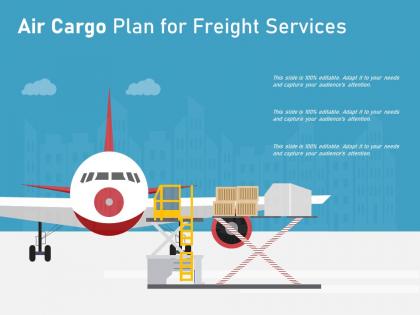
The image depicts a PowerPoint slide titled "Air Cargo Plan for Freight Services," which appears to be part of a business presentation on air freight logistics. The slide features a stylized graphic of an airplane at an airport cargo area with a loading vehicle and cargo pallets nearby, indicating the process of loading or unloading goods.
The airplane is shown head-on with its front cargo hold open, and the cargo is presented in the form of boxes, suggesting the types of goods typically transported via air freight. Red and white striped navigation marks on the ground guide the logistics process around the aircraft.
Use Cases:
The air cargo slide is a versatile visual tool that can be used in industries requiring efficient cargo handling and transportation logistics.
1. Logistics and Shipping:
Use: Planning and optimizing air freight operations.
Presenter: Logistics Manager
Audience: Supply Chain Personnel, Cargo Handlers
2. E-commerce:
Use: Strategy for fast delivery of goods globally.
Presenter: E-commerce Operations Head
Audience: Distribution Partners, Fulfillment Teams
3. Pharmaceutical:
Use: Secure and rapid transport of medical supplies.
Presenter: Supply Chain Director
Audience: Pharma Distributors, Compliance Teams
4. Agriculture:
Use: Exporting perishable products through air freight.
Presenter: Export Manager
Audience: Farmers, Agribusiness Stakeholders
5. Automotive:
Use: Shipment of auto parts for just-in-time manufacturing.
Presenter: Production Logistics Coordinator
Audience: Parts Suppliers, Assembly Plant Managers
6. Electronics:
Use: Managing the distribution of consumer electronics.
Presenter: Distribution Manager
Audience: Retail Distributors, Inventory Managers
7. Aerospace:
Use: Transporting aeronautical components between facilities.
Presenter: Aerospace Logistics Specialist
Audience: Engineers, Procurement Managers
Air cargo plan for freight services with all 2 slides:
Use our Air Cargo Plan For Freight Services to effectively help you save your valuable time. They are readymade to fit into any presentation structure.


FAQs for Air cargo plan
Air cargo's main thing is speed - you're getting stuff in days not weeks. Really good for anything time-sensitive or valuable since there's way less chance of damage or theft. Tracking is solid too, so you actually know where your shipment is (which honestly should be basic but isn't always with other methods). Yeah it costs more, sometimes way more, but you save on inventory costs and get paid faster. If you're shipping perishables, electronics, or just need something there ASAP, the extra cost usually makes sense. Ocean freight's cheaper but if time matters, air's your best option.
Fuel prices are brutal - they're like 20-30% of airline costs, so when oil jumps, your shipping rates jump too. Airlines update their fuel surcharges constantly, sometimes daily if things get crazy. Makes planning your budget super annoying tbh. Yeah, they try hedging and stuff to smooth things out, but most of that volatility still hits you directly through their surcharge formulas. Honestly? Start tracking fuel prices yourself and try to negotiate caps on those surcharges upfront. Otherwise you're just along for the ride when prices go nuts.
Dude, the tech stuff for air cargo is insane now. GPS tracking shows you exactly where your shipment is 24/7. RFID tags tell you if temps are off or if something's damaged - super helpful for avoiding nasty surprises. AI figures out the best routes automatically, which saves both time and money. The automated sorting cuts way down on handling delays too. Oh and most of this plugs right into whatever software you're already using. Honestly feels like cheating sometimes - you can spot problems before they blow up your whole operation. Makes the old paper-based tracking look prehistoric.
So many rules, honestly. IATA dangerous goods regs, customs docs for every country, security screenings - plus temp controls if you're shipping anything sensitive. The documentation side is brutal when you're starting out. But look, it's mostly about safety and keeping stuff moving smoothly through borders. My advice? Find a solid freight forwarder who actually knows this stuff. They're worth every penny because one compliance screw-up can literally strand your cargo somewhere you don't want it stranded. Trust me on that one.
Oh man, where do I start? Fuel costs are absolutely brutal right now - airlines can't keep up with demand so prices just keep climbing. Then you've got all these different regulations depending on which country you're shipping through, it's a nightmare. Customers want to track everything in real-time too, which sounds reasonable but adds another layer of complexity. Airport staffing is terrible everywhere, creates these massive bottlenecks. Weather's the worst though - one storm screws up your whole network for days. Honestly, you just gotta build in backup plans because something's always gonna break.
Oh man, e-commerce is totally crushing air cargo demand right now. People want their stuff in like 1-2 days max, so retailers are basically forced to use air freight constantly. Cross-border shipping especially - nobody's waiting weeks anymore for anything. Traditional slow shipping is pretty much dead at this point, honestly. The whole thing shifted from big bulk cargo to tons of smaller packages flying around constantly. B2C shipments are everywhere now. If you're doing any logistics planning, definitely account for this premium speed trend when you're figuring out capacity stuff. It's wild how fast everything changed.
So picking a cargo airline - route network is probably your biggest factor. How often do they actually fly where you need to go? Some only do certain routes twice weekly which totally screws your schedule. Aircraft type matters too if you're shipping anything temperature-sensitive. Obviously get quotes from like 2-3 different ones. I'd definitely ask about their on-time stats upfront because delayed cargo = nightmare customers, trust me. Their customer service is actually pretty crucial when things inevitably go wrong. Pricing can't be your only deciding factor here.
So the plane type basically controls everything about what you can ship. A320s and smaller planes work well for quick deliveries on short trips, but you're pretty limited on size and weight. Meanwhile, those massive 747 freighters? Total game-changers - they'll haul enormous shipments and weird oversized stuff across continents. You've also got specialty aircraft but honestly that's more niche territory. The trick is just matching what you need to ship with what the plane can actually handle. Don't waste money booking some giant freighter when your package could've just hitched a ride in passenger cargo underneath.
Yeah, air cargo's carbon footprint is pretty brutal - those planes guzzle fuel like crazy. But honestly, the industry's finally getting its act together. Airlines are testing sustainable aviation fuels and optimizing routes to cut emissions. They're also cramming more cargo per flight to reduce total trips needed, which actually makes sense. Ground equipment's going electric too, though that's probably the easier fix. Some companies are even messing around with hydrogen planes, but who knows when that'll actually happen. If you're dealing with shipping stuff, definitely bug your logistics people about what they're doing sustainability-wise and try bundling shipments together.
COVID basically broke everything. Half the cargo space vanished when passenger flights stopped, but demand for medical stuff and online orders went crazy. Shipping costs hit like 10x normal - totally insane. Airlines scrambled to convert passenger planes for cargo and rebuild their whole networks. Honestly, it was chaos for months. Now everyone's obsessed with backup plans because we all realized how easily this stuff falls apart. My advice? Don't put all your eggs in one basket with shipping routes. Have at least 2-3 alternatives ready.
Air cargo security basically comes down to three things. Screen everything properly - X-rays, physical checks, explosive detection, the whole deal. Chain of custody is huge too, so use tamper-proof seals and track everything religiously from start to finish. Only work with shippers you actually know and stick to validated agent programs. The paperwork aspect is honestly such a headache, but you can't skip it. Your team needs to stay current on TSA and IATA regs since they're always changing stuff. I'd start by comparing what you're doing now against industry standards - you'll probably spot some weak points you missed.
Honestly, data analytics just stops you from guessing at everything. You can actually see demand patterns coming and figure out which routes make money vs ones that just look busy. It helps you spot problems before they blow up into expensive disasters too. The pricing and capacity stuff is pretty neat - you'll know where to put resources instead of wasting them. Oh and it flags delays early so you're not always scrambling to fix things. My advice? Don't try to do everything at once. Pick something like route optimization first and go from there.
E-commerce is totally changing everything - way more small, frequent shipments now. Warehouses are going full automation mode. AI's handling route optimization and demand forecasting, which honestly makes sense given how unpredictable shipping got after 2020. Sustainable aviation fuels aren't just PR anymore either. Cold chain stuff for pharma and food is huge right now. Instead of those massive mega-hubs, companies are switching to smaller regional ones. Digital platforms make booking so much cleaner than dealing with old-school brokers. Bottom line - you'll need flexible operations and solid tech integration. The whole "cross your fingers and ship it" approach just doesn't work anymore.
Look, seasonal spikes are brutal - you're talking 40-60% volume jumps during Q4, Chinese New Year, all that chaos. Everyone's fighting for the same warehouse space and aircraft, so costs go through the roof. I learned this the hard way my first year in logistics. You've gotta plan 3-4 months out minimum - extra leases, overtime budget, expanded storage. Track your historical patterns religiously because December will sneak up on you. Building buffer capacity costs way less than panicking and paying emergency rates when you're scrambling for solutions.
So logistics hubs are basically where airlines collect cargo from tons of different places, then sort everything and send it out to final destinations. Way more efficient than trying to fly direct everywhere. Memphis and Louisville are huge for this - FedEx and UPS pretty much own those airports. Not the most exciting cities, but they're perfectly positioned geographically. The whole point is you can fill up planes better and cut costs per shipment. When you're mapping out routes, just focus on which hubs actually cover the trade lanes you care about. Makes the math work way better.
-
Much better than the original! Thanks for the quick turnaround.
-
Excellent template with unique design.
-
Best way of representation of the topic.
-
Graphics are very appealing to eyes.
-
Out of the box and creative design.