


Aircraft safety and audit report powerpoint layout




Try Before you Buy Download Free Sample Product
 Impress Your
 Audience
 100%
100% Editable
 Save Hours
 of Time


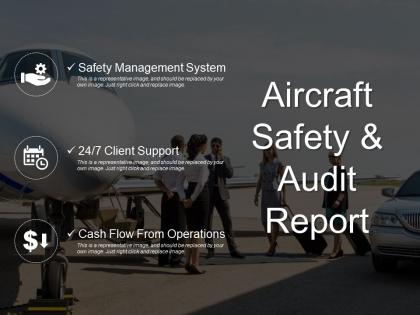
Capture a wider audience through your engaging vision, include our, aircraft safety and audit report PowerPoint layout, in your business meetings. Use this PPT layout to reflect on new business activities. We have shown three stages here to develop on aircraft safety and audit report. A bright image of an aircraft is shown here with respect to the topic. Three topics included here are, safety management system, 27/7 client support, cash flow from operations. We have shown engaging color patterns and icons here to make this PPT design more interactive. Guide your teammates and fresh interns to walk along with each new step of your business process. Include your key points and get your ideas across through the help of a PowerPoint template by editing the text boxes shown here. Cover up various segments, highlight the key components with accuracy and download our, aircraft safety and audit report PowerPoint layout. Delve into all the facts involved with our Aircraft Safety And Audit Report Powerpoint Layout. It helps investigate the issue.
People who downloaded this PowerPoint presentation also viewed the following :
Aircraft safety and audit report powerpoint layout with all 5 slides:
Accessorise your thoughts with our Aircraft Safety And Audit Report Powerpoint Layout. Give them the extra glow they deserve.


FAQs for Aircraft safety and audit
So basically you want to spot safety issues before they bite you. Check if you're actually following all the regs - there's always some obscure rule you forgot about. See if your safety procedures work in real life, not just on paper. Don't forget maintenance programs and how well your incident reporting actually functions. Training quality matters too, obviously. Honestly the paperwork part is brutal but whatever. Main thing? Take whatever you find and fix the worst stuff first. Better to catch problems during an audit than after something goes wrong.
Most places do them yearly at minimum, but honestly every 6 months is way smarter for risk management. Really depends on how much you're flying though - commercial ops with heavy usage obviously need way more frequent checks than someone who flies recreationally like twice a month. Insurance companies and your aviation authority will probably have their own requirements you'll need to follow anyway. Some operators go overboard with audits but better safe than sorry, right? Oh and definitely set a recurring reminder or you'll totally forget - trust me on that one.
Oh man, aircraft audits are no joke! They'll dig into your maintenance records, crew certifications, and all your operational procedures. Your safety management systems get checked too - honestly, auditors are obsessed with documentation so make sure that stuff's organized beforehand. They also look at incident reporting, emergency protocols, and the actual physical condition of your aircraft. Equipment functionality, airworthiness standards - basically everything gets scrutinized. My biggest advice? Have your paperwork ready and accessible. Trust me, it'll save you hours of scrambling around looking for random certificates while some auditor taps their pen impatiently.
So compliance is basically your roadmap for the whole audit setup. You've gotta structure everything around whatever regs hit your operation - FAA Part 145, EASA, whatever applies. Your checklist should mirror those regulatory requirements since that's exactly what inspectors will scrutinize anyway. I'd organize sections for maintenance procedures, documentation, personnel quals, and quality systems following how the regs lay them out. Compliance becomes your framework. Everything else just builds from there. Start by mapping current processes against applicable regulations, then create your audit structure to check each requirement systematically. Pretty straightforward once you think about it that way.
Look at your maintenance records, incident reports, flight data - all that stuff becomes like a roadmap showing you where problems might pop up. Instead of wandering around randomly during your audit, the data points you toward the sketchy areas that actually need attention. You're basically playing detective, connecting patterns across tons of information that would be impossible to spot just eyeballing things. Honestly, it's way smarter than the old-school approach of checking everything equally. Short version: let the numbers tell you where to focus your time, because you can't inspect every single thing with the same intensity anyway.
Honestly, tech has been a game-changer for safety audits. Drones are perfect for those sketchy hard-to-reach spots on aircraft. Digital checklists sync instantly, so no more version confusion (thank god). Predictive analytics catches problems before they blow up on you. AR headsets overlay maintenance histories right on the parts - feels futuristic but actually works. The automated data collection piece eliminates all those stupid mistakes we make when rushing paperwork. My advice? Start with digitizing your checklists first. It's super straightforward and you'll see immediate improvements in both speed and accuracy.
Honestly, resource limits are gonna be your biggest pain. Operations teams hate audits - they think you're just slowing them down. Good luck getting people to sit for interviews when everyone's "swamped." Missing documentation is brutal too, like trying to find maintenance records from 2015 that somehow vanished. Then when you actually find problems that need fixing? Suddenly nobody wants to spend money or change how they do things. Start building relationships early though - once people see safety improvements actually help their day-to-day work, they'll stop fighting you on everything.
Commercial audits are brutal compared to private ones. FAA inspectors basically live at commercial operations - they're checking crew training, maintenance logs, everything. Private aircraft? Just basic airworthiness stuff mostly. Commercial operators have to document every single flight too, which is honestly insane when you think about it. Private owners get way more flexibility there. It's like the difference between getting grilled by the IRS versus doing your own simple tax return. If you're dealing with commercial audits, clear your calendar. Multiple inspectors, tons of paperwork, the whole nine yards.
Look, you really can't beat having different experts on the same audit team. Pilots will catch operational stuff that mechanics miss, while mechanics spot maintenance problems pilots might overlook. Safety officers know all the regulatory weirdness. It's like having multiple pairs of eyes - each person sees things through their own specialty lens. Without this mix, you get that dangerous assumption where everyone thinks someone else is covering the "other" areas. Oh, and definitely map out who's focusing on what beforehand. Otherwise it gets messy fast. Trust me, cockpit ergonomics to ground procedures - you'll cover way more ground this way.
Set up debrief sessions after flights and get anonymous reporting going - that's where the real honesty happens. Pilots won't speak up if they're worried about getting in trouble. Focus groups work great too, just keep them casual. Create some basic forms for safety observations and near-misses, but honestly? The old-timer pilots usually have the best insights since they've dealt with everything. Here's the key part though - actually do something with their feedback and tell them what changed. Nothing kills participation faster than feeling ignored.
Audit findings can ground your aircraft immediately or force you to redo maintenance schedules and add extra inspections. Most of the time they're catching potential issues before they blow up into real problems - even the ones that feel petty. You'll need to update procedures to stay compliant (or face penalties, which nobody wants). Staff retraining usually follows when they spot knowledge gaps. Honestly, I've learned to see findings as free consulting rather than someone nitpicking my work. Just tackle them methodically so the same stuff doesn't keep popping up.
Honestly, audits are like calling BS on the whole "safety first" thing if you're not actually walking the walk. Your team notices when you put real time into checking processes - it shows you're serious about this stuff. They're also great for catching those dangerous habits everyone's gotten used to over the years. The real trick though? Don't just file the results away somewhere. Actually do something with what you find, then tell everyone about the wins. That's when people start caring instead of just going through the motions because they have to.
Honestly, get third-party auditors with zero financial connections to your company - that's what actually matters for real objectivity. Document everything using standardized checklists so people can trace your steps later. I've watched audits completely fall apart when transparency wasn't built in from the start. Use multiple auditors to cross-check each other's work, and make sure stakeholders can easily access the results. The whole point is avoiding even the hint of conflicts of interest. Oh, and set up these protocols before you start - don't wing it mid-audit.
So basically, international standards from organizations like ICAO are like the foundation that your domestic audits build on top of. Your national aviation authority takes those global safety frameworks and adapts them into local regulations. Think of it as a universal playbook that each country tweaks for their specific needs. When you're doing domestic audits, you're checking local compliance but also making sure everything aligns with international benchmarks - which honestly makes cross-border operations way smoother. I'd definitely get familiar with both the international standards and how your country specifically uses them in their audit processes.
So you'll want to get formal aviation safety training - usually through Flight Safety Foundation or whatever your local aviation authority is (FAA if you're in the US). Most places want you certified in safety management systems, risk assessment, that kind of stuff. The paperwork's honestly brutal at first but you adapt. Interview skills and audit techniques are huge too since you're documenting literally everything. Oh, and report writing - can't forget that one. A lot of companies make you do annual refresher training which is kind of annoying but whatever. I'd start by asking your organization what certifications they actually accept because some are picky about internal vs third-party credentials.
-
Design layout is very impressive.
-
Awesome use of colors and designs in product templates.