


Amazon Marketing Strategy Amazon Digital Marketing Strategy Channels




Try Before you Buy Download Free Sample Product
 Impress Your
 Audience
 100%
100% Editable
 Save Hours
 of Time


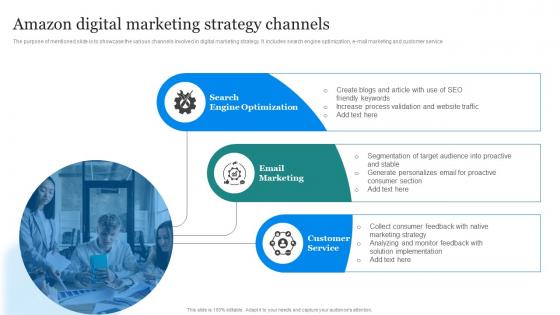
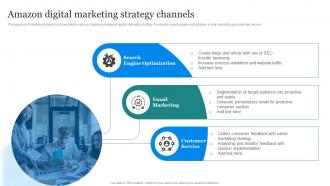
The purpose of mentioned slide is to showcase the various channels involved in digital marketing strategy. It includes search engine optimization, e mail marketing and customer service
People who downloaded this PowerPoint presentation also viewed the following :
Amazon Marketing Strategy Amazon Digital Marketing Strategy Channels with all 6 slides:
Use our Amazon Marketing Strategy Amazon Digital Marketing Strategy Channels to effectively help you save your valuable time. They are readymade to fit into any presentation structure.





FAQs for Amazon Marketing Strategy Amazon Digital
Amazon's marketing strategy centers on customer-centricity, data-driven personalization, seamless omnichannel experiences, competitive pricing algorithms, and extensive marketplace ecosystem integration. These components streamline customer acquisition by leveraging advanced analytics, automation, and strategic partnerships, with many retailers finding that Amazon's approach ultimately delivers faster conversion rates, enhanced customer loyalty, and significant operational efficiency gains.
Amazon leverages data analytics through machine learning algorithms, purchase history analysis, browsing behavior tracking, predictive modeling, and real-time personalization engines. These technologies streamline customer experiences by delivering targeted product recommendations, dynamic pricing strategies, and personalized marketing campaigns, with retail organizations increasingly finding that data-driven personalization ultimately enhances customer loyalty and significantly boosts conversion rates.
Amazon leverages social media through targeted advertising campaigns, influencer partnerships, user-generated content showcases, customer service interactions, and product launch announcements across platforms like Instagram, Twitter, and Facebook. These strategies enable enhanced brand visibility, direct customer communication, and community building, with many retailers finding that integrated social approaches ultimately deliver stronger customer loyalty and increased conversion rates.
Amazon Prime membership significantly influences customer loyalty by creating switching costs, offering exclusive benefits like free shipping and streaming services, and fostering habitual purchasing patterns through convenience. Prime members typically spend more annually, shop more frequently across product categories, and exhibit higher retention rates, with many businesses finding that subscription-based loyalty models ultimately deliver sustained revenue growth and competitive market positioning.
Customer reviews and ratings serve as Amazon's primary social proof mechanism, driving purchase decisions, improving search rankings, and building brand credibility through authentic user experiences. These elements create powerful word-of-mouth marketing that significantly enhances conversion rates, with many retailers finding that products with higher ratings and substantial review volumes achieve better visibility and sales performance, ultimately delivering competitive advantage in an increasingly crowded marketplace.
Amazon's affiliate marketing through Amazon Associates drives sales by leveraging external websites, bloggers, and content creators to promote products through commission-based referrals. This strategic approach expands Amazon's reach beyond its platform, enables cost-effective customer acquisition, and generates millions of product recommendations across diverse online channels, while affiliates earn commissions, ultimately creating a scalable network that significantly boosts sales volume and market penetration.
Amazon employs comprehensive SEO strategies including keyword optimization, content marketing, technical SEO improvements, local search optimization, and strategic link building. Through sophisticated algorithms and data analytics, Amazon enhances product discoverability, streamlines user experience, and maximizes conversion rates, while continuously optimizing content across multiple touchpoints, ultimately delivering superior search rankings and competitive advantage in the increasingly crowded e-commerce landscape.
Amazon strategically allocates marketing investments by prioritizing digital channels like search, display, and video advertising while selectively using traditional media for brand awareness and major product launches. Through data-driven attribution models, targeted programmatic buying, and performance analytics, Amazon optimizes spend across channels, with many retailers finding that this balanced approach delivers measurable ROI and broader market reach.
Amazon's fulfillment network supports marketing goals by enabling faster delivery promises, reducing shipping costs, and ensuring consistent customer experiences across regions. This infrastructure allows Amazon to market Prime membership more effectively, compete on delivery speed, and maintain customer loyalty through reliable service, ultimately delivering operational efficiency and competitive advantage in an increasingly demanding e-commerce landscape.
Amazon's affiliate program creates a complex dynamic where the company simultaneously partners with and competes against third-party sellers through promotional channels and data insights. While affiliates drive traffic that can benefit all sellers, Amazon leverages affiliate-generated data to identify successful products for its private label expansion, with many third-party sellers finding that popular items face increased competition from Amazon's own brands.
Amazon's marketplace model creates both opportunities and challenges for new brands, requiring strategic adaptation in pricing, visibility, customer acquisition, and brand differentiation within Amazon's ecosystem. While new entrants gain access to Amazon's massive customer base and fulfillment infrastructure, they must navigate intense competition, reduced direct customer relationships, and Amazon's algorithm-driven discovery mechanisms, ultimately requiring brands to balance marketplace success with building independent brand equity and customer loyalty.
Amazon leverages seasonal promotions and events like Prime Day, Black Friday, and holiday sales to create urgency, clear inventory, and boost membership subscriptions through exclusive deals and limited-time offers. These strategic events drive massive traffic spikes, increase customer acquisition, and enhance brand loyalty, with many retailers finding that similar promotional calendars significantly accelerate revenue growth and market penetration.
Amazon has pioneered personalized recommendation engines, one-click purchasing, voice commerce through Alexa, predictive analytics for inventory management, and dynamic pricing algorithms. These technologies revolutionize retail by enhancing customer experiences, streamlining operations, and increasing conversion rates, with many retailers finding that implementing similar AI-driven personalization and seamless checkout processes delivers significant competitive advantages and improved customer loyalty.
Amazon's global marketing strategy adapts to local consumer behaviors, regulatory environments, cultural preferences, payment methods, and competitive landscapes while maintaining core brand consistency. In markets like India, Amazon emphasizes cash-on-delivery and regional language support, while in Europe, it focuses on sustainability messaging and GDPR compliance, ultimately delivering localized customer experiences that drive market penetration and competitive advantage.
Amazon faces brand dilution risks, customer confusion, quality control complexities, competitive positioning challenges, and marketplace credibility concerns while expanding across diverse categories. Through strategic brand architecture, rigorous seller vetting, and consistent customer experience standards, Amazon maintains its core promise of convenience and reliability, with many sectors finding that the company's focus on operational excellence and customer-centric policies ultimately delivers trust and market leadership.
-
“Superb. What a great finding. Thankful for SlideTeam. We were paying people to make slides which went all in vain. We are so happy to have found you.”
-
“Detailed and great to save your time.”