


Analyzing non destructive testing methods welding ppt powerpoint presentation gallery sample




Try Before you Buy Download Free Sample Product
 Impress Your
 Audience
 100%
100% Editable
 Save Hours
 of Time


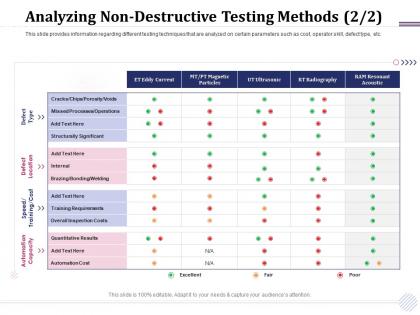
This slide provides information regarding different testing techniques that are analyzed on certain parameters such as cost, operator skill, defect type, etc.
People who downloaded this PowerPoint presentation also viewed the following :
Analyzing non destructive testing methods welding ppt powerpoint presentation gallery sample with all 2 slides:
Use our Analyzing Non Destructive Testing Methods Welding Ppt Powerpoint Presentation Gallery Sample to effectively help you save your valuable time. They are readymade to fit into any presentation structure.

FAQs for Analyzing non destructive testing methods welding ppt powerpoint
The most commonly used NDT methods in welding include visual inspection, dye penetrant testing, magnetic particle inspection, ultrasonic testing, and radiographic examination. These methods enable manufacturers in aerospace, automotive, and oil industries to detect weld defects, ensure structural integrity, and maintain quality standards, ultimately delivering safer products and regulatory compliance while minimizing costly repairs.
Ultrasonic testing works by transmitting high-frequency sound waves through welds, measuring how these waves reflect off internal discontinuities like cracks, porosity, and incomplete fusion to assess structural integrity. Through specialized transducers and digital displays, welding inspectors can detect subsurface defects, measure flaw sizes, and determine depth locations, with industries like aerospace, oil and gas, and construction finding that UT delivers precise defect characterization and reliable quality assurance for critical welded joints.
Radiographic testing offers superior penetration capabilities, permanent record creation, high sensitivity to internal defects, and comprehensive volumetric inspection that other NDT methods cannot match. Through X-ray or gamma-ray imaging, manufacturers in aerospace, petrochemical, and nuclear industries achieve precise flaw detection, regulatory compliance documentation, and quality assurance standards, ultimately delivering enhanced structural integrity and reduced long-term maintenance costs.
Magnetic particle testing detects discontinuities by magnetizing ferromagnetic welds and applying iron particles that cluster around magnetic flux leakage caused by cracks, porosity, or inclusions. This method enables welders to identify surface defects in structural steel, pipeline joints, and pressure vessels while streamlining quality control processes, ultimately delivering enhanced safety standards and reduced failure risks across manufacturing industries.
Dye penetrant testing limitations include inability to detect subsurface defects, effectiveness only on clean surfaces, requirement for accessible defect openings, and challenges with porous materials or complex geometries. While PT excels at identifying surface cracks in manufacturing and aerospace applications, many welding professionals combine it with ultrasonic or radiographic methods to ensure comprehensive quality assessment, ultimately delivering more reliable structural integrity.
Acoustic emission testing improves flaw detection in welded structures by continuously monitoring stress waves released during crack growth, material deformation, and structural changes in real-time. This technology enables engineers to identify developing defects before they become critical failures, particularly in pressure vessels, pipelines, and bridge structures, ultimately delivering enhanced safety monitoring and reduced maintenance costs.
Visual inspection (VT) serves as the foundational NDT method, providing initial surface defect detection and guiding the selection of subsequent advanced testing techniques like ultrasonic, radiographic, or magnetic particle testing. This strategic combination enables welding professionals to streamline assessment workflows by identifying critical areas requiring deeper analysis, ultimately delivering comprehensive quality assurance while minimizing testing costs and inspection time.
NDT method selection depends on material properties, weld geometry, defect types expected, accessibility constraints, and cost considerations. For example, ultrasonic testing works well for thick steel structural welds detecting internal flaws, while penetrant testing suits thin aluminum welds for surface cracks, with many fabricators finding that combining multiple methods delivers comprehensive quality assurance and enhanced structural integrity.
Technological advancements shaping NDT in welding include artificial intelligence integration, automated ultrasonic systems, digital radiography, phased array technologies, and real-time monitoring sensors. These innovations streamline inspection processes by enhancing detection accuracy, reducing inspection times, and enabling predictive maintenance capabilities, with manufacturing and aerospace industries finding that automated systems ultimately deliver improved weld quality and operational efficiency.
Environmental factors significantly influence NDT method selection through considerations like temperature extremes, humidity levels, surface contamination, accessibility constraints, and safety requirements in the work environment. Offshore welding operations often favor magnetic particle testing over liquid penetrant methods due to salt exposure, while confined spaces in manufacturing facilities increasingly rely on ultrasonic testing, with many inspection teams finding that environmental adaptability ultimately determines inspection accuracy and operational efficiency.
Radiographic testing safety considerations include radiation protection protocols, proper equipment shielding, controlled access zones, personal dosimetry monitoring, and compliance with regulatory standards. These safety measures streamline operations by minimizing exposure risks, ensuring worker protection, and maintaining regulatory compliance, with many manufacturing and construction organizations finding that comprehensive safety protocols ultimately deliver enhanced operational efficiency and reduced liability concerns.
Digital radiography enhances weld inspection efficiency by providing immediate image results, eliminating film processing delays, and enabling real-time analysis with advanced software tools. Through digital sensors and computer processing, welding operations in aerospace, oil and gas, and construction sectors achieve faster defect detection, reduced inspection costs, and improved documentation capabilities, ultimately delivering higher quality assurance standards.
Training and certification ensure NDT personnel possess the technical expertise, standardized procedures, and quality assurance knowledge necessary for accurate weld evaluation and defect detection. Certified professionals deliver consistent, reliable results across industries like aerospace, oil and gas, and construction, ultimately reducing structural failures, minimizing costly rework, and maintaining regulatory compliance in safety-critical applications.
International standards like AWS D1.1, ASME BPVC, and ISO 3834 dictate specific NDT requirements, testing frequencies, and acceptance criteria for welded structures across industries. These codes ensure consistent quality and safety protocols, with aerospace, petrochemical, and construction sectors finding that standardized approaches streamline certification processes, enhance structural reliability, and ultimately deliver regulatory compliance while maintaining competitive advantage in global markets.
Emerging NDT trends include AI-powered defect recognition, real-time digital radiography, automated ultrasonic systems, drone-based inspections, and machine learning algorithms for pattern analysis. These technologies streamline weld assessments by reducing inspection times, enhancing defect detection accuracy, and enabling predictive maintenance capabilities, with many manufacturing and construction firms finding that automated systems ultimately deliver faster project completion and improved structural integrity.
-
Much better than the original! Thanks for the quick turnaround.
-
Great product with effective design. Helped a lot in our corporate presentations. Easy to edit and stunning visuals.
-
Innovative and attractive designs.