


Ansoff Matrix For Product And Market Expansion Pricing Data Analytics Techniques




Try Before you Buy Download Free Sample Product
 Impress Your
 Audience
 100%
100% Editable
 Save Hours
 of Time


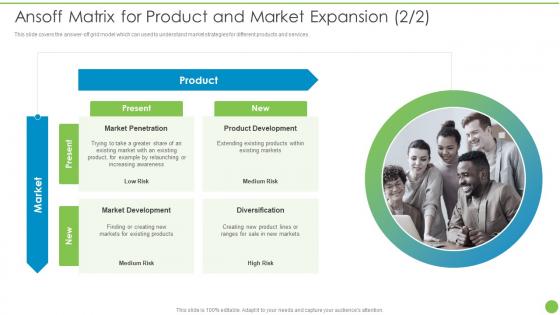
This slide covers the answer off grid model which can used to understand market strategies for different products and services.
People who downloaded this PowerPoint presentation also viewed the following :
Ansoff Matrix For Product And Market Expansion Pricing Data Analytics Techniques with all 6 slides:
Use our Ansoff Matrix For Product And Market Expansion Pricing Data Analytics Techniques to effectively help you save your valuable time. They are readymade to fit into any presentation structure.





FAQs for Ansoff Matrix For Product And Market Expansion Pricing
The Ansoff Matrix is a strategic planning framework that identifies four growth strategies: market penetration, market development, product development, and diversification, helping businesses evaluate expansion opportunities based on existing versus new products and markets. This matrix enables marketing teams to systematically assess risk levels, allocate resources strategically, and develop targeted campaigns, with many organizations finding that it streamlines decision-making while delivering sustainable growth and competitive advantage.
The Ansoff Matrix's four strategies differ by risk level and growth approach: market penetration focuses on selling existing products to current markets, product development creates new products for existing customers, market development targets new markets with current products, while diversification involves both new products and new markets. These strategies progress from lowest risk (market penetration) to highest risk (diversification), with companies like McDonald's using market penetration through promotions, Apple employing product development with new iPhone models, and Amazon pursuing diversification across multiple industries.
The Ansoff Matrix is highly applicable to small businesses and startups, offering a structured framework for evaluating growth opportunities through market penetration, market development, product development, and diversification strategies. Small companies particularly benefit from this strategic tool by systematically assessing risk levels before expansion, with many startups finding that it helps prioritize limited resources while identifying the most viable paths for scaling their operations.
Apple exemplifies successful Ansoff Matrix implementation through market penetration with iPhone upgrades, product development via Apple Watch and AirPods, market development by expanding globally, and diversification into services like Apple Pay and streaming. These strategic approaches enabled Apple to streamline revenue growth, enhance customer loyalty, and ultimately deliver sustained competitive advantage across multiple sectors, with many technology companies finding that this balanced portfolio approach significantly accelerates long-term market dominance.
The Ansoff Matrix helps businesses assess risk by categorizing growth strategies from lowest to highest risk: market penetration, market development, product development, and diversification. This framework enables organizations to evaluate potential returns against associated uncertainties, with many companies finding that understanding these risk gradients allows for better resource allocation, strategic planning, and ultimately more informed decision-making when pursuing expansion opportunities.
The Ansoff Matrix guides product launch decisions by clarifying whether you're pursuing market penetration, market development, product development, or diversification strategies, each requiring different resource allocation, risk management approaches, and go-to-market tactics. This strategic framework enables companies to align their launch investments, marketing channels, and competitive positioning with their chosen growth quadrant, ultimately delivering more focused campaigns and higher success rates.
Organizations can use the Ansoff Matrix to systematically explore four strategic avenues: market penetration through competitive pricing, product development by introducing variants, market development by targeting new demographics, and diversification into adjacent sectors. This framework enables companies in saturated industries like telecommunications, retail, and banking to identify untapped segments, innovative offerings, and strategic partnerships, ultimately delivering sustainable growth and competitive differentiation.
Market research provides critical insights for each Ansoff Matrix quadrant by identifying customer preferences, competitive landscapes, market trends, and growth opportunities across existing and new markets. Through comprehensive data analysis, organizations can assess market penetration potential, evaluate product development viability, and minimize risks when pursuing market development or diversification strategies, ultimately enabling data-driven decisions that enhance strategic success.
Businesses balance risk and opportunity in the Ansoff Matrix by carefully evaluating market knowledge and product capabilities across each quadrant, starting with lower-risk market penetration before progressing to diversification. Through strategic resource allocation and phased implementation, companies like retail chains expanding geographically or tech firms developing new products can minimize exposure while maximizing growth potential, ultimately delivering sustainable competitive advantage.
Common pitfalls include oversimplifying market dynamics, underestimating resource requirements for new ventures, failing to conduct thorough competitive analysis, and neglecting implementation timelines. Many organizations find that rushing into diversification without adequate market research or attempting multiple strategies simultaneously spreads resources too thin, ultimately compromising execution quality and strategic outcomes across all growth initiatives.
The Ansoff Matrix complements SWOT analysis by translating strategic insights into specific growth directions, with SWOT identifying internal strengths and external opportunities while Ansoff provides actionable pathways through market penetration, development, or diversification. Together, these frameworks enable organizations to match their capabilities with market realities, ultimately delivering more informed strategic decisions and sustainable competitive advantage.
The Ansoff Matrix adapts to digital transformation by integrating online channels across all four quadrants, with market penetration leveraging e-commerce platforms, product development incorporating digital features, market development targeting online segments, and diversification exploring digital business models. Companies like traditional retailers use this framework to systematically transition from brick-and-mortar operations to omnichannel strategies, ultimately delivering enhanced customer experiences and competitive advantage.
Organizations should evaluate Ansoff Matrix strategies using revenue growth rates, market share expansion, customer acquisition costs, return on investment, and profitability margins for each quadrant. These metrics enable companies to assess penetration success, development effectiveness, and diversification outcomes, with many enterprises finding that tracking customer lifetime value, competitive positioning, and operational efficiency ultimately delivers strategic insights for optimizing future growth initiatives.
Ansoff Matrix principles integrate into long-term planning by systematically evaluating market penetration, product development, market development, and diversification strategies across multiple planning horizons. Organizations use this framework to balance risk portfolios, allocate resources strategically, and sequence growth initiatives, with many finding that structured diversification timing ultimately delivers sustainable competitive advantage and minimizes market concentration risks.
Economic changes significantly influence Ansoff Matrix strategies, with market penetration becoming more cost-effective during downturns while diversification requires greater caution due to increased risk exposure. During economic expansion, organizations often pursue market development and product development more aggressively, while recession periods typically favor market penetration strategies, with many companies finding that economic volatility demands more flexible strategic planning and risk assessment across all four quadrants.
-
Based on my personal experience, I would recommend other people to subscribe to SlideTeam. No one can be disappointed here!
-
I've been looking for a good template source for some time. I'm happy that I discovered SlideTeam. Excellent presentations must try!