


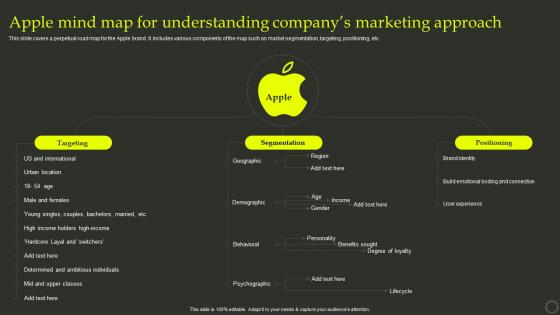
Apple Mind Map For Understanding Companys Marketing Approach Effective Positioning Strategy Product




Try Before you Buy Download Free Sample Product
 Impress Your
 Audience
 100%
100% Editable
 Save Hours
 of Time


This slide covers a perpetual road map for the Apple brand. It includes various components of the map such as market segmentation, targeting, positioning, etc.
People who downloaded this PowerPoint presentation also viewed the following :
Apple Mind Map For Understanding Companys Marketing Approach Effective Positioning Strategy Product with all 6 slides:
Use our Apple Mind Map For Understanding Companys Marketing Approach Effective Positioning Strategy Product to effectively help you save your valuable time. They are readymade to fit into any presentation structure.





FAQs for Apple Mind Map For Understanding Companys Marketing Approach Effective
Apple's branding strategy centers on premium positioning, minimalist design aesthetics, emotional storytelling, ecosystem integration, and carefully controlled brand experiences. These elements work together by creating perceived exclusivity, fostering deep customer loyalty, and commanding premium pricing, with many technology companies finding that Apple's approach ultimately delivers sustained competitive advantage and remarkable profit margins.
Apple leverages consumer psychology through scarcity marketing, aspirational positioning, emotional storytelling, and premium pricing strategies that create perceived exclusivity. These approaches tap into consumers' desires for status, belonging, and innovation, with many tech companies finding that Apple's focus on lifestyle integration rather than technical specifications drives deeper brand loyalty, ultimately delivering higher customer lifetime value and market differentiation.
Apple leverages storytelling by creating emotional narratives around life moments, aspirational lifestyles, and personal transformation rather than focusing solely on product features. Through campaigns like "Shot on iPhone" and holiday commercials, Apple connects technology to human experiences, family connections, and creative expression, ultimately positioning their devices as enablers of meaningful moments and personal achievement.
Apple maintains exclusivity through limited initial releases, premium pricing strategies, invitation-only events, and carefully controlled product availability that creates anticipation and demand. The company leverages minimalist advertising, selective retail partnerships, and strategic scarcity across product launches, with many tech companies finding that this approach ultimately delivers higher perceived value and stronger brand loyalty in increasingly competitive markets.
Product design serves as Apple's primary marketing vehicle, creating distinctive aesthetics, intuitive functionality, and premium materials that communicate brand values before any advertising begins. This design-first approach enables Apple to command premium pricing, generate organic word-of-mouth marketing, and maintain competitive differentiation across consumer electronics markets, with many technology companies finding that exceptional design ultimately delivers stronger brand loyalty and market positioning.
Apple leverages social media strategically through curated product showcases, user-generated content campaigns, and exclusive behind-the-scenes content to create authentic connections with customers. This approach enhances brand loyalty by fostering community engagement, enabling direct customer feedback, and amplifying product launches, with many technology companies finding that consistent social presence ultimately drives higher customer retention and advocacy.
Apple's premium pricing strategy reinforces its positioning as a luxury technology brand, creating perceived exclusivity, higher profit margins, and aspirational appeal among consumers. This approach enables Apple to maintain brand differentiation, justify continuous innovation investments, and sustain customer loyalty, with many competitors finding that premium positioning ultimately delivers stronger market influence and financial performance.
Apple adapts its marketing strategy through localized messaging, region-specific pricing models, cultural customization, and targeted distribution channels. The company leverages local partnerships, culturally relevant advertising campaigns, and market-specific product positioning, with many international markets finding that Apple's blend of global brand consistency and regional adaptation delivers enhanced customer engagement and competitive market penetration.
The Apple ecosystem creates powerful retention through seamless device integration, shared services, and switching costs that make leaving expensive and inconvenient. By connecting iPhones, Macs, iPads, and services like iCloud seamlessly, Apple delivers unified experiences that increase customer lifetime value, reduce churn rates, and ultimately build competitive moats that competitors struggle to replicate.
Apple's marketing strategy incorporates sustainability through campaigns highlighting carbon neutrality goals, recycled materials in products, renewable energy commitments, and supply chain environmental standards. The company leverages these initiatives as competitive differentiators, with marketing emphasizing responsible innovation, circular economy practices, and environmental stewardship, ultimately delivering brand loyalty while appealing to increasingly environmentally-conscious consumers across global markets.
Apple leverages customer feedback through App Store reviews, social media monitoring, customer surveys, and direct support interactions to inform both marketing messaging and product iterations. This feedback loop enables Apple to refine user experiences, address pain points in subsequent product releases, and craft marketing campaigns that resonate with actual user needs, ultimately delivering more targeted products and compelling brand narratives.
Apple's direct sales model offers enhanced customer experience control, higher profit margins, comprehensive product education, and streamlined brand messaging, while third-party retailers provide broader market reach and reduced operational costs. While direct sales enable premium positioning and deeper customer relationships, relying solely on this approach can limit accessibility, with many technology companies finding that strategic combination of both channels ultimately delivers optimal market penetration and revenue growth.
Apple's marketing strategy has evolved by embracing personalized digital experiences, leveraging augmented reality showcases, integrating social media storytelling, and utilizing data-driven customer insights across all touchpoints. Through advanced analytics and immersive technologies, Apple delivers targeted campaigns, interactive product demonstrations, and seamless omnichannel experiences, while maintaining its premium brand positioning, ultimately strengthening customer loyalty and competitive advantage in an increasingly digital marketplace.
Brands can learn Apple's mastery of anticipation-building through strategic secrecy, minimalist storytelling, and focused product narratives that emphasize user benefits over technical specifications. Companies across industries, from automotive to consumer electronics, increasingly adopt Apple's approach of creating experiential launches, limiting product lines for clearer messaging, and positioning products as lifestyle enhancements rather than mere tools, ultimately delivering stronger brand loyalty and premium pricing power.
Apple strategically partners with tech reviewers, creative professionals, and industry thought leaders who authentically showcase products in real-world applications, enhancing credibility through genuine expertise rather than traditional celebrity endorsements. This approach enables Apple to reach targeted audiences across photography, music production, and business sectors, while maintaining brand authenticity and driving organic conversations that ultimately deliver enhanced visibility and consumer trust.
-
“As you have innovative ideas and they are all customizable, this saves a huge chunk of your time to prepare well-read presentations.”
-
The design is clean-cut, modern, and sleek, keeping the users' needs in mind. The multiple uses make this product worth every penny!