


Artificial intelligence applications finance ppt powerpoint presentation file shapes cpb




Try Before you Buy Download Free Sample Product
 Impress Your
 Audience
 100%
100% Editable
 Save Hours
 of Time


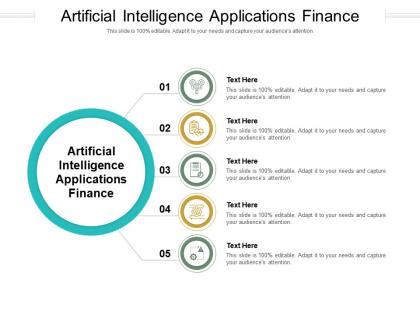
Our Artificial Intelligence Applications Finance Ppt Powerpoint Presentation File Shapes Cpb are topically designed to provide an attractive backdrop to any subject. Use them to look like a presentation pro.
People who downloaded this PowerPoint presentation also viewed the following :
Artificial intelligence applications finance ppt powerpoint presentation file shapes cpb with all 2 slides:
Use our Artificial Intelligence Applications Finance Ppt Powerpoint Presentation File Shapes Cpb to effectively help you save your valuable time. They are readymade to fit into any presentation structure.

FAQs for Artificial intelligence applications finance ppt powerpoint presentation
AI applications in financial risk management include credit scoring algorithms, fraud detection systems, market risk modeling, regulatory compliance monitoring, and portfolio optimization tools. These technologies enhance decision-making by analyzing vast datasets, identifying patterns in real-time, and automating risk assessments, with many financial institutions finding that AI-driven approaches significantly reduce operational costs while improving accuracy.
AI enhances fraud detection by analyzing transaction patterns, identifying anomalies in real-time, and learning from historical data to predict suspicious activities. Through machine learning algorithms, financial institutions streamline threat assessment, reduce false positives, and accelerate response times, with banks increasingly finding that automated systems deliver faster fraud resolution while significantly minimizing financial losses.
Machine learning enables algorithmic trading through pattern recognition, predictive analytics, real-time market analysis, and automated decision-making systems that process vast datasets at unprecedented speeds. These technologies enhance market efficiency by reducing bid-ask spreads, improving price discovery, and minimizing human bias, with investment firms and hedge funds finding that machine learning algorithms deliver faster execution and more consistent returns.
Natural language processing enhances financial analysis by extracting insights from earnings calls, regulatory filings, news articles, and social media posts to gauge market sentiment and identify investment opportunities. Through sentiment analysis algorithms, banks and investment firms can predict stock movements, assess credit risks, and automate compliance monitoring, ultimately delivering faster decision-making and more accurate market predictions.
AI in lending raises concerns around algorithmic bias, data privacy, transparency in decision-making, and fairness in credit assessments. While these technologies streamline loan processing and risk evaluation, financial institutions increasingly implement bias testing, explainable AI models, and diverse data sets to ensure equitable outcomes, ultimately delivering both operational efficiency and responsible lending practices.
AI enhances banking customer service through chatbots, predictive analytics, sentiment analysis, personalized recommendations, and automated query resolution. These technologies streamline operations by providing 24/7 support, anticipating customer needs, and delivering tailored financial products, with many banks finding that AI-driven personalization increases customer satisfaction while significantly reducing operational costs and response times.
AI-driven robo-advisors present both challenges and opportunities for traditional financial advisory services, streamlining portfolio management, reducing costs, and democratizing investment access while pushing human advisors toward higher-value relationship management. While robo-advisors excel at automated rebalancing and basic asset allocation, many financial institutions find that combining both approaches delivers personalized guidance with operational efficiency, ultimately enhancing client experiences across different investment scales.
Regulatory frameworks significantly shape AI adoption in finance by establishing compliance requirements, data protection standards, and algorithmic transparency mandates that financial institutions must navigate carefully. While these regulations can slow initial implementation, they ultimately enhance trust and market stability, with many banks and investment firms finding that proactive regulatory alignment delivers competitive advantage and sustainable AI integration across lending, trading, and risk management operations.
Financial institutions face challenges including legacy system compatibility, data quality inconsistencies, regulatory compliance requirements, cybersecurity vulnerabilities, and staff training needs when integrating AI. While these obstacles present initial complexity, many banks and investment firms find that strategic implementation approaches, phased rollouts, and comprehensive change management ultimately deliver enhanced operational efficiency, improved risk assessment capabilities, and significant competitive advantages in an increasingly digital financial landscape.
AI-powered predictive analytics enhances investment decision-making by analyzing vast datasets, identifying market patterns, and forecasting potential risks and returns with greater accuracy than traditional methods. Through machine learning algorithms, investment firms can process real-time market data, economic indicators, and historical trends simultaneously, enabling more informed portfolio optimization and strategic asset allocation decisions.
AI enhances operational efficiency in finance through automated transaction processing, intelligent document analysis, real-time fraud detection, algorithmic trading, and predictive risk assessment. These technologies streamline operations by reducing manual workloads, accelerating loan approvals, and minimizing processing errors, with many financial institutions finding that AI-driven automation delivers faster customer services and significantly lower operational costs.
Financial organizations ensure AI transparency and accountability through comprehensive model documentation, regular algorithmic audits, explainable AI implementation, stakeholder reporting protocols, and robust governance frameworks. These practices enable banks and investment firms to demonstrate decision-making rationale, comply with regulatory requirements, and build customer trust, while ultimately delivering competitive advantage through responsible AI deployment that enhances operational efficiency and risk management capabilities.
Big data serves as the foundational fuel for AI systems in financial services, enabling more accurate risk assessments, fraud detection, personalized recommendations, and algorithmic trading decisions. By processing vast datasets from transaction histories, market trends, and customer behaviors, financial institutions can enhance predictive analytics, streamline compliance monitoring, and deliver increasingly sophisticated automated services that reduce operational costs while improving customer experiences.
AI enhances market prediction through machine learning algorithms, natural language processing, predictive analytics, real-time data analysis, and pattern recognition technologies. These systems streamline economic forecasting by processing vast datasets, identifying market volatility patterns, and analyzing sentiment from news sources, with investment firms and banks finding significantly improved accuracy in risk assessment and portfolio optimization.
Machine learning algorithms, natural language processing, robotic process automation, predictive analytics, and blockchain integration are revolutionizing financial services through enhanced decision-making capabilities. These technologies streamline operations by automating loan approvals, detecting fraudulent transactions, and personalizing customer interactions, with many banks and investment firms finding that AI ultimately delivers faster services, reduced operational costs, and significantly improved customer experiences.
No Reviews