


AI Revolutionising Finance Powerpoint Ppt Template Bundles




Try Before you Buy Download Free Sample Product
 Impress Your
 Audience
 100%
100% Editable
 Save Hours
 of Time


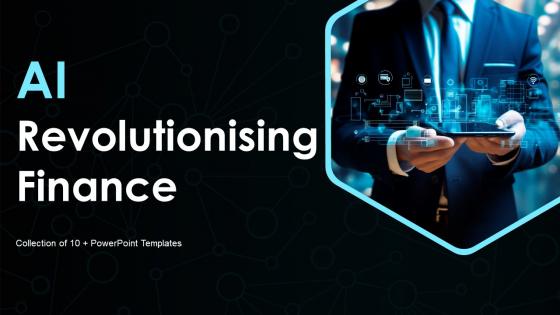
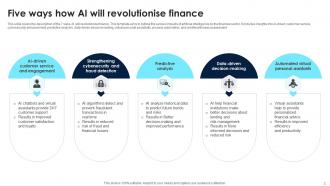
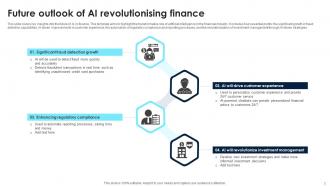
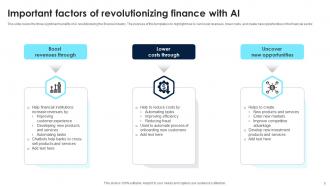
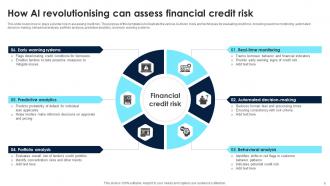
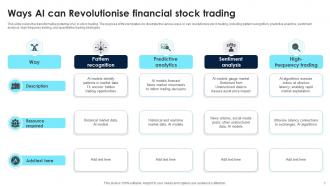
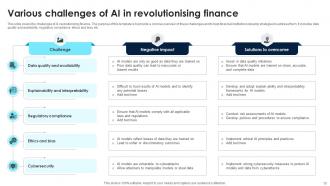
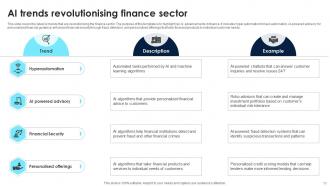
The AI revolution is dramatically transforming the financial industry by leveraging artificial intelligence and machine learning to enhance various aspects of financial services. From risk assessment and fraud detection to algorithmic trading and customer service, AI technologies are enabling faster and more data driven decision making. They analyze vast datasets, recognize patterns, and automate complex tasks, ultimately increasing efficiency, reducing costs, and improving the accuracy of financial operations. This template includes a dynamic presentation that delves into the seven transformative ways AI is set to revolutionize the finance sector, along with an exploration of the future outlook and the role of AI in detecting financial fraud. Real life use cases and insights on AIs ability to assess financial credit risk and its applications in stock trading are presented. Key statistics are provided to underscore the impact of AI in finance, while the template addresses challenges with actionable solutions. It concludes with an overview of current AI trends in the financial sector, all complemented by visually informative icons. Lastly, it includes a succinct summary of these essential components.
People who downloaded this PowerPoint presentation also viewed the following :
AI Revolutionising Finance Powerpoint Ppt Template Bundles with all 22 slides:
Use our AI Revolutionising Finance Powerpoint Ppt Template Bundles to effectively help you save your valuable time. They are readymade to fit into any presentation structure.












FAQs for AI Revolutionising Finance Powerpoint
**INPUT**: What are the most significant applications of AI in risk management within the finance sector? **OUTPUT**: Significant AI applications in financial risk management include fraud detection systems, credit scoring algorithms, market volatility prediction, regulatory compliance monitoring, and portfolio optimization tools. These technologies streamline risk assessment by analyzing vast datasets, identifying patterns in real-time, and automating decision processes, with many banks and financial institutions finding enhanced accuracy and reduced operational costs. [Word count: 56 words]
Machine learning transforms credit scoring by analyzing vast datasets, incorporating alternative data sources like social media and transaction patterns, and providing real-time risk assessments with greater accuracy than traditional models. Through advanced algorithms, financial institutions streamline loan approvals, reduce default rates, and expand credit access to previously underserved populations, while minimizing human bias and operational costs.
AI enhances fraud detection through real-time transaction monitoring, pattern recognition algorithms, behavioral analytics, machine learning models, and predictive risk scoring systems. These technologies streamline identification by analyzing spending patterns, flagging anomalies instantly, and reducing false positives, with many banks finding that automated systems deliver faster response times and significantly lower fraud losses.
Natural language processing enables financial institutions to automatically analyze vast volumes of news articles, earnings reports, regulatory filings, and market commentary to extract sentiment, identify trends, and assess potential market impacts. Through NLP algorithms, banks and investment firms can process thousands of documents simultaneously, detecting emerging risks, gauging market sentiment, and making faster investment decisions, ultimately delivering competitive advantages in increasingly data-driven markets.
AI-driven algorithms optimize trading strategies through pattern recognition, sentiment analysis, and predictive modeling, enabling faster execution and reduced human error. These systems analyze vast datasets, execute high-frequency trades, and adapt to market volatility in real-time, with investment firms increasingly finding that automated strategies deliver enhanced returns while minimizing emotional decision-making risks.
AI in financial decision-making raises concerns about algorithmic bias, data privacy, transparency in automated decisions, accountability for AI-driven outcomes, and fairness in credit scoring and lending practices. While these challenges require careful oversight, many financial institutions find that implementing robust governance frameworks, regular bias audits, and explainable AI models ultimately delivers more consistent, equitable services and stronger regulatory compliance.
Financial institutions ensure AI transparency through explainable AI frameworks, algorithmic auditing, clear documentation of decision-making processes, and regulatory compliance reporting. Banks and credit unions increasingly implement model interpretability tools, provide customers with plain-language explanations of automated decisions, and maintain detailed audit trails, ultimately delivering greater trust and regulatory adherence while enhancing customer confidence in AI-driven financial services.
AI enhances personal finance management through personalized budgeting recommendations, automated expense categorization, intelligent spending alerts, predictive financial planning, and conversational chatbots for instant support. These technologies streamline financial oversight by delivering tailored insights, proactive notifications, and seamless account management, with many users finding significantly improved financial awareness and decision-making capabilities.
Integrating AI with legacy systems in traditional banks presents challenges including data compatibility issues, security vulnerabilities, regulatory compliance complexities, integration costs, and staff training requirements. While these systems often lack modern APIs and real-time processing capabilities, many financial institutions find that strategic phased implementations enable gradual modernization, ultimately delivering enhanced operational efficiency and competitive advantage.
Predictive analytics powered by AI influences investment strategies by analyzing vast market datasets, identifying hidden patterns, and forecasting potential risks and opportunities with greater accuracy than traditional methods. Through machine learning algorithms, investment firms can optimize portfolio allocation, predict market volatility, and execute data-driven decisions, ultimately delivering enhanced returns and competitive advantage in increasingly complex financial markets.
AI significantly enhances regulatory compliance and reporting by automating data collection, ensuring accuracy, and providing real-time monitoring of regulatory requirements. Through machine learning algorithms, financial institutions streamline compliance processes, reduce manual errors, and generate comprehensive reports faster, while predictive analytics helps identify potential violations before they occur, ultimately delivering greater transparency and regulatory confidence.
AI personalizes financial products through behavioral analysis, transaction pattern recognition, spending habit assessment, and risk profiling algorithms. Banks and fintech companies leverage machine learning to customize credit offerings, investment recommendations, and insurance plans, with many institutions finding that personalized approaches increase customer satisfaction while reducing acquisition costs and improving retention rates.
Big data serves as the foundation for AI effectiveness in finance by providing vast datasets for pattern recognition, risk assessment, predictive modeling, and real-time decision making. Through comprehensive data analysis, financial institutions can detect fraud more accurately, automate loan approvals, and personalize customer experiences, while ultimately delivering faster services and competitive advantages in an increasingly data-driven marketplace.
AI contributes to sustainable finance by analyzing ESG data, assessing climate risks, optimizing green portfolios, and identifying sustainable investment opportunities through predictive modeling. These technologies enable financial institutions to integrate environmental factors into lending decisions, automate ESG compliance reporting, and deliver more transparent sustainable investment products, ultimately enhancing both profitability and environmental responsibility.
Future AI trends in financial services include hyper-personalized banking experiences, real-time fraud prevention, automated investment management, conversational AI advisors, and blockchain-integrated smart contracts. These technologies will revolutionize customer interactions by delivering instant loan approvals, predictive financial planning, and seamless cross-platform integration, with many institutions finding that strategic AI adoption ultimately drives operational efficiency and competitive advantage.
-
“Easy to use. I always wanted to have a quick search for products and SlideTeam has helped me have it.”
-
Thank you SlideTeam for such an excellent service.