

Asking questions design sample of ppt




Try Before you Buy Download Free Sample Product
 Impress Your
 Audience
 100%
100% Editable
 Save Hours
 of Time


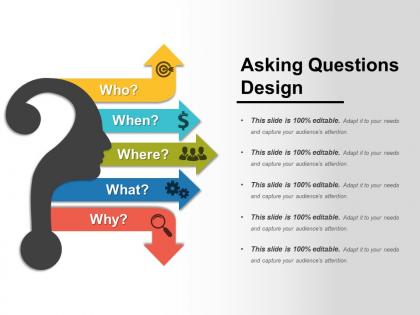
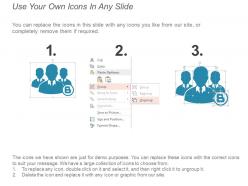
Get this Asking Questions Design sample of PPT to build a shared sense of understanding, purpose and action in your business. The three steps of analyzing the problem and reaching out for the solution can be demonstrated using this PowerPoint template. Describe the nature of the problem. Assessment of the subject in the discussion becomes visually appealing and readily comprehensive using this asking questions PPT icon. To convey any solution to your problem, this PPT slide can be used. Show the questionnaire in a visually appealing yet understandable manner. With this PPT slide, find answers to complex questions. Focus on finding solutions to your queries using this PPT template. Emphasize on the effective functioning of your company through this business PPT template. This PPT slide has creative visuals and well-researched content. Our professionals at SlideTeam have crafted this slide with appropriate diagrams, layouts, icons and more.
People who downloaded this PowerPoint presentation also viewed the following :
Asking questions design sample of ppt with all 5 slides:
Handle it with elan with our Asking Questions Design Sample Of Ppt. See their eyes fill with admiration.

FAQs for Asking questions design
Effective question design includes clear, specific wording, logical sequencing, audience-appropriate complexity, strategic timing, and actionable focus areas. These elements work together by eliminating ambiguity, building understanding progressively, and encouraging meaningful participation, with many presenters finding that well-structured questions ultimately drive deeper engagement and more valuable discussions.
Engaging questions combine specificity with relevance, using open-ended formats that connect to audience experiences, current challenges, and practical applications. Incorporate scenario-based inquiries, comparative choices, and hypothetical situations that require critical thinking, while ensuring questions relate directly to participants' roles and industries, ultimately fostering meaningful dialogue and deeper engagement.
Audience analysis enables effective question formulation by understanding demographics, knowledge levels, communication preferences, cultural contexts, and specific needs or pain points. Through comprehensive audience research, organizations can craft targeted questions that resonate with their specific segments, whether surveying customers, employees, or stakeholders, ultimately delivering higher response rates and more actionable insights.
Visual design enhances question impact by using bold typography, strategic color contrast, whitespace for emphasis, animated reveals, and consistent formatting that draws audience attention. Through compelling visual hierarchy, presenters create memorable question moments that encourage deeper audience engagement, facilitate clearer understanding, and ultimately drive more meaningful responses and interactive discussions.
Techniques for crafting open-ended questions include using exploratory prompts like "How might we," scenario-based inquiries, hypothetical situations, comparative analysis questions, and experience-driven approaches that invite personal insights. These methods enhance engagement by encouraging diverse perspectives, deeper critical thinking, and collaborative problem-solving, with many facilitators finding that well-structured open questions ultimately drive more innovative solutions and meaningful dialogue.
Rhetorical questions engage audiences by prompting internal reflection and emphasizing key points, while direct questions seek specific information or responses. In presentations, rhetorical questions create dramatic effect, build suspense, and guide thinking toward desired conclusions, whereas direct questions facilitate interaction, gather feedback, and encourage participation, with many speakers finding that strategic combination of both enhances audience engagement and message retention.
Questions can be structured through sequential frameworks, rhetorical prompts, audience polling, transition queries, and progressive revelation techniques. These approaches guide presenters by creating natural information hierarchies, maintaining audience engagement through interactive moments, and establishing logical bridges between topics, ultimately delivering clearer messaging and enhanced comprehension, with many organizations finding that strategic questioning transforms passive presentations into dynamic, memorable experiences.
Common pitfalls include overly complex or leading questions, yes/no questions that limit engagement, multiple questions bundled together, and questions without clear context or purpose. These design flaws can confuse audiences, reduce participation, and undermine presentation effectiveness, while well-crafted questions enhance audience interaction, facilitate meaningful dialogue, and ultimately deliver stronger communication outcomes.
Tailor questions by incorporating visual elements for visual learners, interactive discussions for auditory learners, hands-on activities for kinesthetic learners, and analytical frameworks for logical learners. This multi-modal approach enhances engagement across diverse audiences, with many presenters finding that combining question formats, real-world scenarios, and varied response methods ultimately delivers broader participation and improved comprehension outcomes.
Interactive question strategies for virtual presentations include polls during key transitions, breakout room discussions, chat-based Q&A sessions, real-time surveys, and gamified quizzes. These approaches enhance audience engagement by creating participation touchpoints, facilitating peer interaction, and maintaining attention spans, with many presenters finding that strategic question placement significantly improves retention and creates more dynamic virtual experiences.
**INPUT**: How can I use questions to summarize key points and reinforce learning at the end of a presentation? **OUTPUT**: Use reflective questions that prompt audiences to connect main concepts, such as "What strategic advantages does this approach deliver for your organization?" or "Which implementation methods align best with your current objectives?" These summary questions enhance retention by encouraging active recall, enable presenters to gauge comprehension levels, and create meaningful dialogue that transforms passive listeners into engaged participants, ultimately delivering stronger learning outcomes. [Word count: 58 words]
Methods for gathering feedback on question effectiveness include audience surveys, focus groups, response analysis, peer review sessions, and behavioral observation during presentations. These approaches enable presenters to evaluate question clarity, engagement levels, and comprehension rates, with many organizations finding that systematic feedback collection significantly enhances communication effectiveness and audience interaction quality.
Cultural context significantly influences question perception through communication styles, power dynamics, directness preferences, and social hierarchies that vary across societies. In many Asian cultures, indirect questioning preserves face and shows respect, while Western business environments often favor direct approaches, with organizations increasingly adapting their questioning strategies to enhance cross-cultural communication and deliver more effective global collaboration outcomes.
Timing significantly impacts question effectiveness by controlling audience engagement, maintaining presentation flow, and maximizing information retention throughout your delivery. Strategic question placement during introductions builds rapport, mid-presentation queries sustain attention and gauge comprehension, while conclusion questions reinforce key messages, with many presenters finding that well-timed interactive moments ultimately enhance audience participation and presentation outcomes.
Incorporate storytelling by framing questions within scenarios, using character-driven examples, creating emotional hooks, and building narrative tension that leads audiences toward discovery. These techniques transform static Q&As into engaging journeys, with many presenters finding that story-based questions increase audience retention, encourage deeper participation, and create memorable connections that drive meaningful discussions and strategic insights.
-
Awesome presentation, really professional and easy to edit.
-
Presentation Design is very nice, good work with the content as well.