


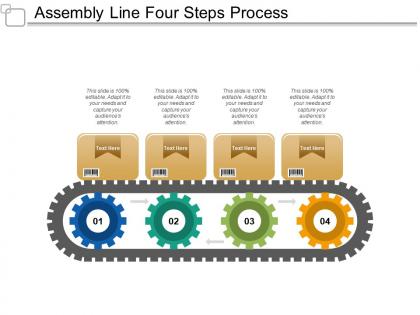
Assembly line four steps process




Try Before you Buy Download Free Sample Product
 Impress Your
 Audience
 100%
100% Editable
 Save Hours
 of Time


The assembly line Template puts forth a four-stage process which engulfs features like an assembly line, manufacturing process, and production system. The Template is a great stage to present the steps involved in the product manufacturing process. The design for an assembly line is determined by analyzing the steps necessary to manufacture each product component as well as the final product. All movement of material is simplified, with no cross flow, backtracking, or repetitious procedure. Work assignments, numbers of machines, and production rates are programmed so that all operations along the line are compatible. The assembly line production and manufacturing Template is completely handy and the texts to be written on the Slide can be easily accessed by you or anyone using this Template in order to make it more feasible and reliable for you. The manufacturing procedure can be easily imparted to the viewing audience with the use of this amazing Template. Save the Slide to please the audience and to gain positive reviews from them and that too in no time. Our Assembly Line Four Steps Process draw in the crowds. Their brilliance is a definite attraction.
People who downloaded this PowerPoint presentation also viewed the following :
Assembly line four steps process with all 5 slides:
Handle the dialogue with our Assembly Line Four Steps Process. Control the flow of any conversation.



FAQs for Assembly line
You'll need workstations for each specific task, plus conveyor systems to move stuff between them. Think relay race but with tools instead of batons - honestly that comparison is weirdly perfect. Workers at each station, obviously, and quality checkpoints scattered throughout. Don't forget supervisors watching the flow and someone managing inventory so you don't run out of parts mid-assembly. The real trick is balancing everything so one station doesn't become a nightmare bottleneck that kills your whole timeline. Map out every assembly step first, then build your stations around that sequence.
So lean manufacturing cuts out all the waste from your production process - it's pretty effective honestly. Map out what you're doing now first, then spot the biggest time-wasters. Those are your quick wins. Your throughput improves because you're ditching unnecessary steps and those inventory buffers that just sit around. Plus defects get caught right away instead of at the final inspection, which saves you tons of headaches. The continuous improvement part isn't just corporate BS either - your team actually starts fixing bottlenecks systematically. Way better than just accepting that "this is how we've always done it."
Look, assembly lines today run on automation - robotic arms, sensors that spot defects instantly, conveyors that speed up or slow down automatically. It's actually crazy how advanced some factories are now. The repetitive stuff gets handled way faster than any human could manage. Workers don't disappear though, they just move into cooler jobs like programming robots and maintenance. Oh, and quality control too. Start with your biggest slowdowns if you're thinking about upgrading. That's where you'll see the biggest impact right away.
Your assembly line setup basically controls everything - how fast work moves between stations and whether people are wasting time. Poor layout? You'll get bottlenecks everywhere and workers walking miles just to grab materials. It's honestly like watching money walk out the door. Map out your current workflow first and spot where people are stuck waiting or doing unnecessary trips. Balance the workload so no station becomes the slow kid holding everyone up. Materials should flow naturally from step to step without weird detours.
Honestly, bottlenecks are gonna be your worst enemy - one slow station kills everything downstream. Equipment breaking down is brutal too, stops the whole line dead. Quality issues force you to redo work which sucks. Workers get exhausted and start making dumb mistakes or just can't maintain pace anymore. Late shipments totally mess up your rhythm. Balancing station times sounds easy but it's actually pretty hard to nail. My advice? Walk around constantly, ask your people what's bugging them - they know better than anyone. Track cycle times religiously so you catch problems early.
Honestly, don't wait until the end to check stuff - that's a nightmare. Put inspection points right into your production line at the spots where things usually go wrong. Get your operators doing basic quality checks while they work (they know what looks off anyway). Automated sensors help tons if you can swing it. Statistical process control sounds fancy but it just tracks patterns so you catch problems before they blow up. Oh, and make quality everyone's thing, not just the QC team's problem. Start with your biggest pain points first - you'll see results way faster.
Honestly, start with OEE and cycle time - those two will tell you the most right off the bat. Takt time's huge too since it shows if you're actually keeping up with what customers want. I'd throw in defect rates and first-pass yield because quality issues will drive you nuts if you don't catch them early. Downtime tracking is painful but necessary - hits your profits hard when machines aren't running. WIP levels help spot bottlenecks before they become disasters. Don't go crazy tracking everything though. Pick like 2-3 that actually matter for your setup first, then add more later.
So each industry just adapts the basic idea to fit what they're doing. Cars use tons of robots for welding and painting stuff. Food companies focus on speed and keeping everything clean - like conveyor belts going through hot and cold zones. Electronics gets crazy precise with clean rooms (those phone components are insanely tiny). Fast food places? They're basically burger assembly lines. Even some hospitals do it for moving patients around, which is kinda weird when you think about it. You just need to figure out where things get stuck and build your process around fixing those spots first.
Hey! So cobots are definitely where I'd start - they're way easier to roll out than full automation and people can actually work with them safely. Digital twins are getting really popular too, basically you can test stuff virtually without shutting down your whole line. The predictive maintenance tech is probably where companies see the biggest ROI since it stops breakdowns before they happen. IoT sensors are pretty much standard now, giving you live data on everything. Oh and AI quality control is solid but honestly feels a bit overhyped sometimes. Real talk though - cobots first, then build from there.
Oh man, ergonomics is everything for assembly lines. When workstations actually fit people, cycle times drop and you get way fewer screwups. Bad ergonomics? Workers get tired, hurt their backs, start moving weird to compensate - kills your speed. I saw one place boost productivity like 15-20% just by fixing chair heights and where they kept tools. Honestly seems obvious but so many places ignore it. The trick is asking your actual workers what sucks - they'll tell you exactly where the problems are. Don't just guess from an office somewhere.
Safety training's gotta come first - lifting techniques, emergency stuff, all that. Then you train them on the actual processes and equipment they'll be using. The work gets pretty repetitive, not gonna lie, but people adapt faster than you'd think. Most places pair new workers with experienced ones for hands-on training, plus some classroom time for safety protocols. Oh, and quality standards are huge - can't forget those. I'd start with a solid orientation covering everything, then do refresher sessions every few months so people don't get sloppy.
Yeah, supply chain issues will absolutely wreck your assembly line. When suppliers can't deliver on time, your whole production stops - it's brutal. I've watched teams frantically hunt for backup suppliers while everything's on fire, which honestly never ends well. You'll get hit with major downtime, crazy expensive rush shipping costs, and then your customers start getting pissed about late deliveries. My advice? Get multiple suppliers lined up for your critical stuff and keep some safety stock around. Trust me, it's way cheaper than dealing with a full shutdown later.
Honestly, preventive maintenance is everything - skip it and you're screwed. Get your operators trained to catch weird noises or heat changes since they're out there all day anyway. Check and lube moving parts regularly, track vibration levels. I'd start with auditing what you've got now, then build your maintenance schedule around that. Document everything too. Here's the thing though - replacing parts before they break costs way less than emergency repairs when everything goes to hell. Trust me on this one.
Start by mapping out your current process to spot where you're wasting stuff - materials, energy, whatever. Lean manufacturing is your friend here: cut overproduction, go just-in-time with deliveries, ditch waste wherever you find it. Energy-efficient equipment pays off big time, plus predictive maintenance saves you from those brutal 2am breakdown calls (been there). Modular setups are smart since you can reconfigure without tossing perfectly good equipment. Oh, and track everything - material usage, power consumption, waste output. Sounds boring but you can't fix what you don't measure, right?
Dude, start with ergonomics - get adjustable workstations and anti-fatigue mats. Those repetitive strain injuries are brutal. Make sure you've got emergency stops everywhere and solid lockout/tagout training. But honestly? The real magic happens when workers actually feel safe calling out problems. I've seen too many places where people stay quiet because they're scared of getting in trouble. Do regular safety walks and just ask people straight up - what hurts? What feels sketchy? Their answers will tell you exactly where to spend your money first. Way better than guessing.
-
Informative presentations that are easily editable.
-
Qualitative and comprehensive slides.