


Augmented Reality In Metaverse Training Ppt




Try Before you Buy Download Free Sample Product
 Impress Your
 Audience
 100%
100% Editable
 Save Hours
 of Time


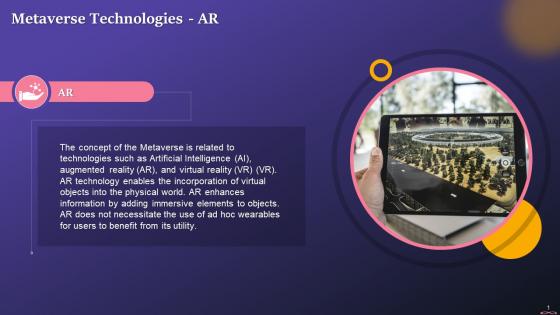
This slide depicts information regarding augmented reality AR in metaverse. It emphasizes that AR technology allows virtual objects to be integrated into the physical world. It even augments information by incorporating immersive elements into objects. AR does not require users to use ad hoc wearables to benefit from its utility.
People who downloaded this PowerPoint presentation also viewed the following :
Augmented Reality In Metaverse Training Ppt with all 16 slides:
Use our Augmented Reality In Metaverse Training Ppt to effectively help you save your valuable time. They are readymade to fit into any presentation structure.














FAQs for Augmented Reality In
AR in metaverse training environments delivers immersive skill development, real-time performance feedback, risk-free practice scenarios, enhanced knowledge retention, and scalable learning experiences. These technologies streamline workforce development by enabling hands-on simulations, reducing training costs, and accelerating competency building, with manufacturing, healthcare, and aviation sectors finding that AR-enhanced training ultimately delivers faster onboarding and improved operational outcomes.
Augmented reality enhances learner engagement and retention by creating immersive, interactive experiences that blend digital content with real-world environments, enabling hands-on practice and immediate feedback. Through AR-powered simulations, organizations in healthcare, manufacturing, and retail deliver personalized learning pathways, real-time performance analytics, and collaborative exercises, ultimately improving knowledge retention rates while reducing traditional training costs and timeframes.
Industries leveraging AR metaverse training include healthcare, manufacturing, aviation, retail, and education, with implementations ranging from surgical simulations to assembly line procedures. Through immersive virtual environments, hospitals conduct medical training, manufacturers streamline worker onboarding, and airlines enhance pilot preparation, ultimately delivering safer operations, reduced training costs, and accelerated skill development across organizations.
Successful AR metaverse training requires high-performance processors, advanced graphics cards, reliable internet connectivity, compatible headsets or mobile devices, and robust cloud infrastructure for data processing. These technical components work together to deliver seamless immersive experiences, with many organizations finding that investing in scalable hardware and bandwidth ultimately enhances training effectiveness and employee engagement across multiple locations.
AR training simulations significantly outperform traditional methods by delivering immersive, hands-on experiences, real-time feedback, and risk-free practice environments that enhance knowledge retention and skill development. These interactive technologies enable organizations to reduce training costs, accelerate competency development, and improve safety outcomes, with many companies in manufacturing, healthcare, and aviation finding that AR simulations deliver measurably better learning results than classroom-based approaches.
Machine learning enables personalized AR metaverse training by analyzing learner behavior, adapting content difficulty, tracking performance patterns, and customizing scenarios in real-time. Through intelligent algorithms, organizations can deliver tailored experiences that adjust to individual learning styles, predict knowledge gaps, and optimize skill development pathways, ultimately enhancing training effectiveness and accelerating competency acquisition across diverse professional environments.
**INPUT**: What specific skills can be effectively taught using augmented reality in the metaverse? **OUTPUT**: Augmented reality in the metaverse effectively teaches technical skills, soft skills, safety procedures, medical training, and complex problem-solving abilities. These immersive technologies enhance learning by providing hands-on simulations, real-time feedback, and risk-free practice environments, with industries like healthcare, manufacturing, and aviation finding significantly improved retention rates and faster skill acquisition. [Word count: 54 words]
User interaction with AR training modules significantly enhances learning outcomes by providing immersive, hands-on experiences that improve knowledge retention, skill development, and practical application. Through interactive simulations, healthcare professionals practice complex procedures, manufacturing workers master equipment operations, and retail employees enhance customer service skills, with many organizations finding that engaged learners demonstrate 40% better performance retention and faster competency achievement.
Companies measure AR metaverse training ROI through reduced training costs, improved skill retention rates, decreased time-to-competency for new employees, and enhanced safety outcomes. Organizations across healthcare, manufacturing, and aviation increasingly track performance metrics like error reduction, faster onboarding cycles, and lower travel expenses, with many finding that immersive training delivers measurable productivity gains and competitive advantages.
Businesses can address AR training accessibility by implementing voice commands, gesture alternatives, customizable visual settings, multilingual support, and adaptive learning pathways. These inclusive design features enable organizations to accommodate diverse physical abilities, learning styles, and cultural backgrounds, while partnering with accessibility consultants ensures compliance with disability standards, ultimately delivering equitable training experiences and broader talent development across all employee populations.
Best practices for designing AR training content include intuitive user interfaces, realistic 3D models, progressive skill-building modules, clear audio-visual instructions, and seamless gesture-based interactions. These approaches enhance learning retention by providing hands-on simulations, reducing cognitive overload, and enabling personalized pacing, with many organizations finding that immersive AR training delivers faster skill acquisition and improved performance outcomes.
Collaborative AR environments in the metaverse foster teamwork by enabling real-time shared problem-solving, interactive group simulations, and immersive communication exercises that mirror workplace dynamics. These platforms enhance collaboration through synchronized virtual tasks, cross-functional project scenarios, and immediate feedback systems, with organizations in healthcare, manufacturing, and corporate training finding that trainees develop stronger interpersonal skills and strategic coordination abilities.
Ethical considerations for AR training include data privacy protection, ensuring equitable access across diverse employee groups, preventing algorithmic bias in performance assessments, maintaining transparency about monitoring capabilities, and safeguarding employee consent regarding immersive data collection. Organizations implementing these solutions must balance innovation with worker rights, establishing clear policies around biometric data usage, virtual harassment prevention, and psychological safety, with many companies finding that proactive ethical frameworks ultimately enhance employee trust and training effectiveness.
Virtual feedback and assessment tools integrate into AR training through real-time biometric monitoring, gesture recognition systems, task completion analytics, and AI-powered performance scoring algorithms. These technologies enable immediate corrective guidance, progress tracking, and competency validation, with healthcare institutions and manufacturing facilities finding that instant feedback loops significantly accelerate skill acquisition while reducing training costs.
Emerging trends in AR metaverse training include AI-powered personalized learning paths, haptic feedback integration, collaborative virtual workspaces, cross-platform compatibility, and advanced analytics for performance tracking. Organizations across healthcare, manufacturing, and retail are increasingly adopting these technologies to deliver immersive skill development, reduce training costs, and accelerate employee onboarding, ultimately gaining competitive advantages through enhanced workforce capabilities.
-
Unique and attractive product design.
-
Their designing team is so expert in making tailored templates. They craft the exact thing I have in my mind…..really happy.