


Automation Cycle Frameworks To Standardize Testing Process




Try Before you Buy Download Free Sample Product
 Impress Your
 Audience
 100%
100% Editable
 Save Hours
 of Time


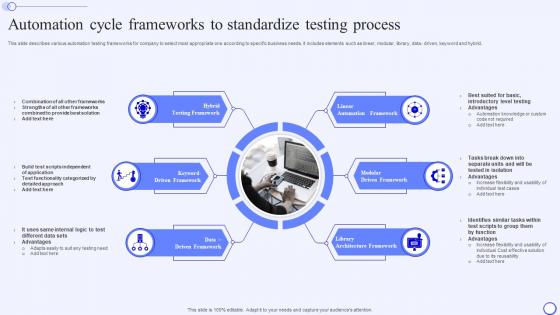
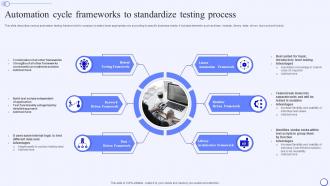
This slide describes various automation testing frameworks for company to select most appropriate one according to specific business needs. It includes elements such as linear, modular, library, data driven, keyword and hybrid.
People who downloaded this PowerPoint presentation also viewed the following :
Automation Cycle Frameworks To Standardize Testing Process with all 6 slides:
Use our Automation Cycle Frameworks To Standardize Testing Process to effectively help you save your valuable time. They are readymade to fit into any presentation structure.





FAQs for Automation Cycle Frameworks To
Key components of an effective automation cycle framework include process identification and assessment, automation design and development, testing and validation, deployment and monitoring, and continuous optimization. These components work together by streamlining operations, reducing manual errors, and enhancing scalability, with many organizations finding that systematic frameworks deliver faster implementation timelines, improved ROI, and sustainable competitive advantage.
Automation cycle frameworks vary significantly across industries, with manufacturing focusing on production optimization and quality control, IT emphasizing system integration and performance monitoring, and finance prioritizing compliance and risk management. While manufacturing leverages robotics and IoT sensors for operational efficiency, financial institutions deploy automated workflows for fraud detection and regulatory reporting, ultimately delivering industry-specific competitive advantages through tailored technological approaches.
Continuous improvement serves as the optimization engine within automation cycle frameworks, enabling organizations to refine processes, enhance performance metrics, and adapt to evolving business requirements through regular assessment and iteration. This systematic approach allows companies to identify bottlenecks, reduce operational costs, and scale automated solutions more effectively, with many enterprises finding that iterative refinements deliver increasingly competitive advantages over time.
Organizations measure automation cycle framework success through key performance indicators like process efficiency improvements, cost reduction percentages, error rate decreases, and implementation timeline adherence. These metrics enable companies to track ROI across departments, with many financial services and manufacturing firms finding that comprehensive measurement frameworks deliver 30-40% operational improvements while identifying optimization opportunities.
**INPUT**: What technologies are most commonly integrated into automation cycle frameworks? **OUTPUT**: Automation cycle frameworks commonly integrate robotic process automation (RPA), artificial intelligence (AI), machine learning algorithms, workflow orchestration platforms, and business process management systems. These technologies work together by streamlining repetitive tasks, enhancing decision-making capabilities, and optimizing operational workflows, with many organizations finding that strategic integration delivers faster processing times and significant cost reductions. [Word count: 56 words]
Agile methodology significantly enhances automation cycle frameworks by promoting iterative development, continuous integration, and rapid feedback loops throughout the automation lifecycle. This approach enables development teams to adapt frameworks dynamically, incorporate stakeholder feedback more effectively, and deliver incremental improvements, with many organizations finding that agile practices reduce development time while increasing automation reliability and scalability.
Companies face challenges including resistance to change, integration complexities with legacy systems, skill gaps in automation technologies, initial investment costs, and process standardization difficulties. While these obstacles can slow implementation, organizations in manufacturing, finance, and healthcare find that strategic planning, employee training, and phased rollouts ultimately deliver streamlined operations and competitive advantage.
Cross-functional teams improve automation cycle frameworks by combining diverse expertise, identifying comprehensive process requirements, and ensuring seamless integration across departments. Through collaborative planning and shared accountability, teams from IT, operations, and business units deliver faster implementation timelines, reduced bottlenecks, and enhanced user adoption, ultimately creating more robust automation solutions.
Employee training significantly impacts automation implementation by ensuring workforce readiness, reducing resistance to change, enabling effective human-machine collaboration, and maximizing technology adoption rates. Through comprehensive upskilling programs, organizations streamline transitions, enhance operational efficiency, and maintain productivity, with many companies finding that well-trained employees become automation advocates, ultimately delivering faster implementation timelines and superior business outcomes.
Automation cycle frameworks contribute to digital transformation by systematically identifying processes for automation, implementing technologies like RPA and AI, and continuously optimizing workflows for maximum efficiency. These frameworks enable organizations to streamline operations, reduce manual errors, and accelerate service delivery, with many companies finding that structured automation approaches ultimately deliver enhanced customer experiences and significant competitive advantage.
Organizations should evaluate automation tools based on scalability, integration capabilities, security features, user-friendliness, and total cost of ownership. These criteria enable businesses to streamline operations, enhance productivity, and maintain competitive advantage, with many enterprises finding that strategic tool selection ultimately delivers faster implementation timelines and superior ROI across departments.
Automation cycle frameworks enhance compliance and regulatory requirements by standardizing processes, maintaining detailed audit trails, and ensuring consistent adherence to regulatory protocols across all operational stages. Through automated monitoring and reporting, organizations in banking, healthcare, and manufacturing can minimize human error, accelerate compliance documentation, and deliver real-time regulatory oversight, ultimately reducing compliance costs while strengthening risk management capabilities.
Best practices for documenting an automation cycle framework include creating detailed process maps, establishing clear governance protocols, maintaining version control systems, defining stakeholder roles and responsibilities, and implementing comprehensive testing procedures. These documentation strategies streamline implementation by ensuring consistency, enabling knowledge transfer, and facilitating scalability, with many organizations finding that thorough documentation accelerates deployment timelines while minimizing operational risks.
Organizations ensure scalability in their automation cycle frameworks by establishing modular architectures, implementing standardized processes, and maintaining robust governance structures that adapt across departments and business units. Through cloud-based platforms and API-driven integrations, companies streamline resource allocation, enhance operational efficiency, and deliver consistent automation outcomes, with many enterprises finding that strategic standardization ultimately enables rapid expansion while minimizing implementation complexity.
Future trends influencing automation cycle frameworks include artificial intelligence integration, low-code/no-code platforms, edge computing capabilities, hyperautomation strategies, and intelligent process orchestration. These advancements streamline framework adaptability, enhance real-time decision-making, and enable seamless scaling across industries, with organizations increasingly finding that adaptive frameworks deliver faster implementation timelines and sustained competitive advantage.
-
The design is clean-cut, modern, and sleek, keeping the users' needs in mind. The multiple uses make this product worth every penny!
-
The quality of PowerPoint templates I found here is unique and unbeatable. Keep up the good work and continue providing us with the best slides!