


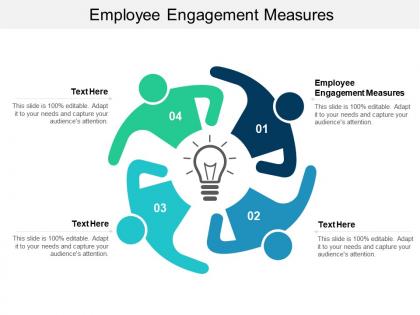
Employee engagement measures ppt powerpoint presentation slides graphics cpb




Try Before you Buy Download Free Sample Product
 Impress Your
 Audience
 100%
100% Editable
 Save Hours
 of Time


Our Employee Engagement Measures Ppt Powerpoint Presentation Slides Graphics Cpb can be excellent game-changers. Add another dimension to your efforts.
People who downloaded this PowerPoint presentation also viewed the following :
Employee engagement measures ppt powerpoint presentation slides graphics cpb with all 5 slides:
Do not let convention tie down your thoughts. Emancipate them with our Employee Engagement Measures Ppt Powerpoint Presentation Slides Graphics Cpb.

FAQs for Employee engagement measures ppt powerpoint presentation
**INPUT**: What are the most effective methods for measuring employee engagement in a hybrid work environment? **OUTPUT**: Effective methods include pulse surveys, digital collaboration analytics, virtual focus groups, one-on-one check-ins, and performance tracking tools that monitor both productivity and wellbeing indicators. These approaches enable organizations to capture real-time sentiment, assess remote team dynamics, and identify engagement gaps across distributed workforces, with many companies finding that combining quantitative metrics with qualitative feedback ultimately delivers more accurate insights and targeted retention strategies. **Word count: 60 words**
Employee engagement directly correlates with organizational productivity through increased output, reduced turnover, enhanced quality, and improved innovation rates. Highly engaged teams demonstrate 23% higher profitability and 18% higher productivity, with companies like Google and Microsoft finding that engaged employees drive superior customer satisfaction, faster project completion, and stronger financial performance across all business units.
Leadership plays a pivotal role in shaping employee engagement through clear communication, recognition programs, professional development opportunities, and creating psychological safety within teams. Effective leaders foster engagement by providing meaningful feedback, empowering decision-making autonomy, and aligning individual goals with organizational vision, ultimately delivering higher retention rates and improved performance across departments.
Companies can use employee feedback to enhance engagement initiatives by conducting regular surveys, implementing suggestion systems, creating focus groups, and establishing open-door policies for direct communication. Through these feedback mechanisms, organizations identify specific pain points, tailor recognition programs, and adjust workplace policies, with many companies finding that responsive leadership and transparent communication ultimately deliver higher retention rates and improved productivity.
Organizations should track engagement survey scores, retention rates, absenteeism patterns, internal promotion rates, and participation in voluntary programs or initiatives. These metrics work together to provide comprehensive insights, with many companies finding that combining quantitative data like turnover statistics with qualitative feedback delivers clearer pictures of workforce satisfaction and organizational health trends.
Different generations value engagement distinctly, with Baby Boomers prioritizing job security and recognition, Gen X focusing on work-life balance and autonomy, Millennials seeking purpose and career development, and Gen Z emphasizing flexibility and social impact. These varying perspectives enable organizations to create tailored engagement strategies that address each generation's unique motivations, ultimately delivering higher retention rates, improved productivity, and stronger workplace culture across diverse teams.
Company culture significantly impacts employee engagement scores by shaping workplace satisfaction, retention rates, and productivity levels through shared values, communication practices, and recognition systems. Organizations with strong, positive cultures typically see 40% lower turnover and higher performance metrics, with many companies finding that authentic leadership and inclusive environments ultimately deliver sustained competitive advantage and improved business outcomes.
Technology facilitates employee engagement measurement through pulse surveys, sentiment analysis tools, performance analytics, feedback platforms, and real-time dashboards that track participation and satisfaction metrics. These digital solutions enable HR teams to identify engagement gaps, automate personalized interventions, and deliver data-driven insights that enhance workplace culture, ultimately reducing turnover while improving productivity and employee retention across organizations.
Common pitfalls include unclear objectives, overly lengthy questionnaires, poor timing, lack of follow-up action, and inadequate communication about survey purposes. Organizations often struggle with survey fatigue, generic questions that don't reflect company culture, and failure to share results transparently, with many finding that consistent action planning and regular feedback loops ultimately drive meaningful engagement improvements.
Organizations ensure inclusive employee engagement measures by implementing multi-channel feedback systems, anonymous reporting options, demographic-based analysis, culturally sensitive survey designs, and regular focus groups across diverse employee segments. Through strategic combination of quantitative metrics and qualitative insights, companies can identify engagement disparities, address specific group needs, and create targeted interventions, ultimately delivering more equitable workplace experiences and stronger organizational performance.
Employee recognition programs directly enhance engagement levels by fostering appreciation, reinforcing positive behaviors, and creating emotional connections to organizational goals. Through strategic recognition initiatives, companies across industries like healthcare, retail, and financial services streamline motivation while reducing turnover, with many organizations finding that consistent acknowledgment ultimately delivers higher productivity and stronger workplace culture.
Effective remote employee engagement strategies include regular virtual check-ins, flexible scheduling, digital collaboration tools, virtual team-building activities, and clear communication channels. These approaches enhance connection and productivity by fostering meaningful interactions, maintaining work-life balance, and creating shared experiences, with many organizations finding that consistent recognition programs and professional development opportunities ultimately deliver higher retention rates and improved performance.
Employee engagement is crucial for talent retention and recruitment, directly impacting turnover rates, hiring costs, and organizational reputation. Companies with highly engaged employees experience 40% lower turnover, reduce recruitment expenses significantly, and attract top talent more easily through positive employer branding, with many organizations finding that engaged workforces become powerful recruitment tools through employee advocacy and referrals.
Industry-specific factors significantly influence employee engagement measures through varying regulatory requirements, work environments, customer interaction levels, and operational demands. Healthcare prioritizes patient safety metrics and burnout prevention, while technology sectors emphasize innovation opportunities and flexible work arrangements, with manufacturing focusing on safety protocols and skills development, ultimately requiring tailored engagement strategies that align with each industry's unique challenges and workforce expectations.
Best practices for communicating employee engagement results include transparent reporting, two-way dialogue sessions, actionable improvement plans, regular progress updates, and celebrating positive outcomes. These approaches enhance trust and participation by demonstrating leadership's commitment to addressing concerns, while many organizations find that transparent communication increases subsequent survey response rates and creates stronger buy-in for engagement initiatives.
No Reviews