B2B Digital Marketing Process Flow Chart To Improve Business Reputation
Try Before you Buy Download Free Sample Product
Audience
Editable
of Time
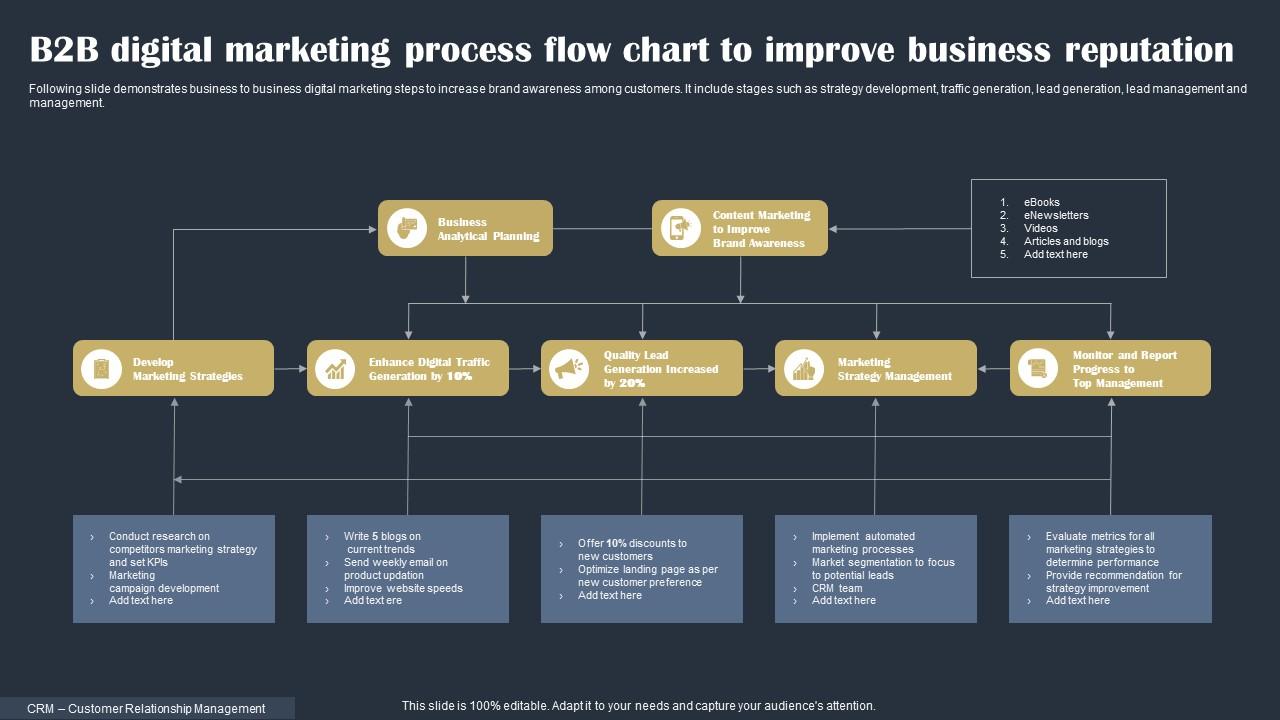
Following slide demonstrates business to business digital marketing steps to increase brand awareness among customers. It include stages such as strategy development, traffic generation, lead generation, lead management and management.
People who downloaded this PowerPoint presentation also viewed the following :
B2B Digital Marketing Process Flow Chart To Improve Business Reputation with all 6 slides:
Use our B2B Digital Marketing Process Flow Chart To Improve Business Reputation to effectively help you save your valuable time. They are readymade to fit into any presentation structure.
FAQs for B2B Digital Marketing Process Flow Chart To
The key stages in a B2B digital marketing process flow chart include lead generation, lead qualification, nurturing, conversion, and retention optimization. These interconnected stages streamline marketing operations by automating prospect identification, scoring potential clients, and delivering targeted content, with many organizations finding that this systematic approach reduces acquisition costs while enhancing customer lifetime value.
Businesses can effectively identify their B2B target audience through market research, customer data analysis, industry segmentation, competitor analysis, and stakeholder interviews. These methods enable organizations to understand buyer personas, decision-making processes, and pain points across sectors like manufacturing, healthcare, and financial services, ultimately delivering more targeted campaigns and higher conversion rates.
Content marketing serves as the foundation of B2B digital marketing, driving lead generation, nurturing prospects, and establishing thought leadership through blogs, whitepapers, case studies, and webinars. This strategic approach enables organizations to educate potential clients, build trust throughout longer sales cycles, and ultimately convert prospects into customers, with many financial services and technology companies finding that quality content significantly enhances their competitive positioning.
Marketing automation tools enhance B2B digital marketing workflows by streamlining lead nurturing, personalizing customer journeys, and automating repetitive tasks like email campaigns and social media posting. These platforms enable marketing teams to score leads more effectively, trigger targeted content based on buyer behavior, and seamlessly integrate with CRM systems, ultimately delivering faster conversions and improved ROI across complex B2B sales cycles.
B2B lead generation best practices include targeted content marketing, search engine optimization, social media engagement, email campaigns, and marketing automation platforms. These strategies streamline prospect identification by delivering valuable resources, nurturing relationships through personalized touchpoints, and qualifying opportunities efficiently, with many organizations finding that integrated approaches ultimately enhance conversion rates and accelerate sales cycles.
Businesses measure B2B digital marketing effectiveness through key performance indicators like lead generation rates, conversion metrics, customer acquisition costs, marketing qualified leads, and return on investment tracking. Advanced analytics platforms enable companies to monitor engagement across multiple touchpoints, with many organizations finding that integrated measurement approaches deliver deeper insights into campaign performance and ultimately enhance strategic decision-making.
Educational content like whitepapers, case studies, webinars, and industry reports proves most effective for nurturing B2B leads, alongside personalized email sequences and product demonstrations. These content types enhance credibility by addressing specific pain points, showcase expertise through real-world applications, and guide prospects through decision-making processes, ultimately delivering higher conversion rates and stronger client relationships.
Social media integrates into the B2B digital marketing process by serving as a content distribution channel, lead generation platform, and relationship building tool throughout the customer journey. It amplifies thought leadership content, enables targeted advertising to decision-makers, and facilitates direct engagement with prospects, while many organizations find that LinkedIn and industry-specific platforms deliver the highest conversion rates for B2B audiences.
Aligning sales and marketing teams in B2B strategies eliminates silos, ensures consistent messaging, and creates seamless lead handoffs that significantly improve conversion rates. This strategic collaboration enables organizations to streamline the customer journey, reduce acquisition costs, and accelerate deal closure, with many companies finding that aligned teams generate substantially higher revenue growth.
Data analytics influences B2B decision-making by providing insights into customer behavior, campaign performance, lead quality, and ROI metrics across multiple touchpoints. Through predictive modeling and real-time tracking, marketing teams can optimize budget allocation, personalize content strategies, and identify high-converting channels, ultimately delivering faster sales cycles and improved customer acquisition costs.
Common pitfalls include inadequate lead qualification criteria, disconnected sales and marketing alignment, insufficient data integration between platforms, and lack of clear attribution models. These challenges often result in wasted resources and missed opportunities, with many B2B organizations finding that poor workflow automation and inconsistent messaging across touchpoints ultimately diminish conversion rates and customer experience quality.
Customer feedback enhances B2B marketing processes by identifying pain points, refining messaging strategies, optimizing customer journey touchpoints, and improving lead qualification criteria. Through systematic feedback collection from surveys, interviews, and engagement analytics, organizations streamline their marketing funnels, develop more targeted content, and deliver personalized experiences, ultimately reducing acquisition costs while increasing conversion rates.
Top tools supporting B2B digital marketing flow charts include HubSpot, Salesforce, Marketo, Pardot, and ActiveCampaign for comprehensive campaign management. These platforms streamline lead generation, nurturing, and conversion tracking by automating email sequences, scoring prospects, and integrating with CRM systems, with many organizations finding that strategic tool combinations enhance operational efficiency and deliver measurable ROI across their entire marketing funnel.
SEO fundamentally transforms B2B digital marketing processes by increasing organic visibility, generating qualified leads, and establishing thought leadership through strategic content optimization. Through targeted keyword research and technical optimization, B2B companies streamline customer acquisition costs, enhance brand credibility, and accelerate sales cycles, with many organizations finding that strong SEO foundations ultimately deliver sustained competitive advantage.
Personalization enhances B2B digital marketing by delivering targeted content, customized product recommendations, individualized email campaigns, dynamic website experiences, and account-based messaging strategies. Through advanced analytics and segmentation, organizations streamline lead nurturing, accelerate sales cycles, and improve conversion rates, with many enterprises finding that personalized approaches ultimately deliver higher engagement and stronger customer relationships.
-
Excellent products for quick understanding.
-
Love the template collection they have! I have prepared for my meetings much faster without worrying about designing a whole presentation from scratch.