


B2b Market Segment Powerpoint Ppt Template Bundles





Try Before you Buy Download Free Sample Product
 Impress Your
 Audience
 100%
100% Editable
 Save Hours
 of Time


Our B2b Market Segment Powerpoint Ppt Template Bundles are topically designed to provide an attractive backdrop to any subject. Use them to look like a presentation pro.
People who downloaded this PowerPoint presentation also viewed the following :
B2b Market Segment Powerpoint Ppt Template Bundles with all 16 slides:
Use our B2b Market Segment Powerpoint Ppt Template Bundles to effectively help you save your valuable time. They are readymade to fit into any presentation structure.

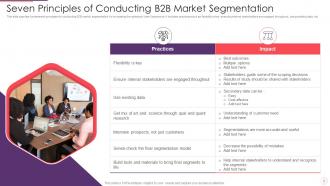
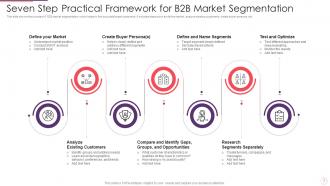
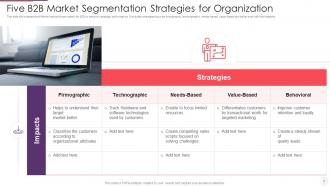





FAQs for B2b Market Segment Powerpoint
Successful B2B market segments exhibit identifiable purchasing patterns, shared operational challenges, similar budget cycles, measurable growth potential, and accessible decision-making structures. These characteristics enable organizations to deliver targeted solutions that address specific industry needs, whether in healthcare systems requiring compliance tools or manufacturing firms seeking automation technologies, ultimately driving higher conversion rates and stronger client relationships.
Businesses effectively identify B2B market segments through comprehensive market research, customer data analysis, industry trend assessment, competitive landscape evaluation, and stakeholder interviews. These strategic approaches enable organizations to uncover specific pain points, purchasing behaviors, and growth opportunities across sectors like manufacturing, healthcare, and financial services, ultimately delivering targeted solutions and enhanced competitive positioning.
Buyer persona development enables precise B2B market segmentation by identifying decision-makers' roles, pain points, purchasing behaviors, industry challenges, and communication preferences within target segments. These detailed profiles help organizations tailor messaging, select appropriate channels, and customize solutions for specific segments like healthcare procurement teams or manufacturing executives, ultimately delivering more relevant experiences and higher conversion rates.
Industry trends significantly impact B2B market segmentation by driving technological adoption, changing buyer behaviors, regulatory requirements, and competitive dynamics across sectors. Companies increasingly segment markets based on digital transformation readiness, sustainability priorities, and remote work capabilities, with many organizations finding that traditional demographic segmentation gives way to behavioral and technological preference-based approaches, ultimately delivering more targeted solutions and competitive advantage.
**INPUT**: What tools and methodologies are most effective for B2B market segmentation? **OUTPUT**: Effective B2B market segmentation tools include CRM analytics, firmographic databases, behavioral tracking software, survey platforms, and predictive modeling systems. These methodologies streamline targeting by analyzing company size, industry verticals, and purchasing behaviors, with many organizations finding that strategic combinations deliver enhanced lead qualification, improved conversion rates, and ultimately stronger competitive advantage. [Word count: 54 words]
Businesses leverage data analytics to refine B2B market segments by analyzing customer behavior patterns, purchasing histories, engagement metrics, and demographic data to identify distinct buyer personas. Through predictive analytics and machine learning algorithms, companies can uncover hidden market opportunities, optimize resource allocation, and create targeted campaigns that resonate with specific segments, ultimately delivering higher conversion rates and stronger customer relationships.
B2B market segmentation faces challenges including complex buying processes, multiple decision-makers, lengthy sales cycles, diverse organizational needs, and limited customer data availability. These complexities require sophisticated approaches, with many companies finding that traditional demographic segmentation proves insufficient, ultimately necessitating behavioral and firmographic analysis to deliver meaningful insights and competitive advantage.
B2B buyer behaviors vary significantly across market segments based on decision-making complexity, purchasing cycles, and stakeholder involvement. Enterprise segments typically involve longer evaluation periods and multiple decision-makers, while SMB buyers prioritize cost-effectiveness and faster implementation, with industries like healthcare requiring extensive compliance considerations compared to retail's focus on scalability and immediate ROI.
Companies can differentiate their B2B offerings through specialized solutions, industry-specific expertise, superior customer service, innovative technology integration, and strategic partnerships within targeted segments. By focusing on unique value propositions, manufacturing firms enhance operational efficiency, healthcare providers streamline patient management, and financial institutions deliver faster compliance solutions, ultimately creating competitive advantages that drive customer loyalty and market share growth.
Customer feedback is crucial in B2B market segmentation as it reveals actual pain points, purchasing behaviors, usage patterns, and unmet needs that may not appear in traditional demographic data. Through direct client insights, surveys, and usage analytics, businesses can identify distinct customer clusters, refine their value propositions, and develop targeted solutions, ultimately enabling more precise market positioning and enhanced customer satisfaction across different segments.
Best practices for tailored B2B marketing strategies include comprehensive segment analysis, persona-driven messaging, customized content formats, multi-channel approach optimization, and performance tracking mechanisms. These approaches streamline engagement by addressing specific pain points, delivering relevant solutions, and utilizing preferred communication channels, with many organizations finding that segmented strategies deliver higher conversion rates, improved customer relationships, and ultimately enhanced competitive advantage in increasingly complex markets.
Businesses can measure B2B segmentation effectiveness through customer acquisition costs, conversion rates, customer lifetime value, retention metrics, and revenue growth per segment. Through advanced analytics and CRM integration, companies track engagement patterns, deal velocity, and profit margins across segments, with many organizations finding that well-defined segments deliver 15-20% higher conversion rates and significantly improved resource allocation efficiency.
Technology adoption transforms traditional B2B market segmentation by enabling real-time behavioral analysis, predictive modeling, advanced analytics, and dynamic customer profiling beyond static demographics. These technologies streamline segmentation through automated data collection, cross-platform integration, and AI-driven insights, with many financial services and manufacturing organizations finding that technology-based segments deliver more targeted marketing campaigns and enhanced customer experiences.
Segmentation enhances B2B customer retention by enabling personalized service delivery, targeted communication strategies, and tailored product offerings that address specific client needs and industry challenges. Through strategic segmentation, companies identify high-value accounts, anticipate customer pain points, and develop customized retention programs, ultimately delivering stronger relationships and reducing churn across manufacturing, healthcare, and financial services sectors.
Emerging B2B market segmentation trends include intent-based targeting, behavioral clustering, account-based marketing refinement, technographic profiling, and real-time dynamic segmentation powered by AI analytics. These approaches enable businesses to identify high-value prospects more precisely, personalize engagement strategies across complex buying committees, and optimize resource allocation, with many organizations finding significantly improved conversion rates and shortened sales cycles.
-
The presentations are very helpful. I am always able to get appropriate templates for the different topics related to my profession.
-
Every time I ask for something out-of-the-box from them and they never fail in delivering that. No words for their excellence!