


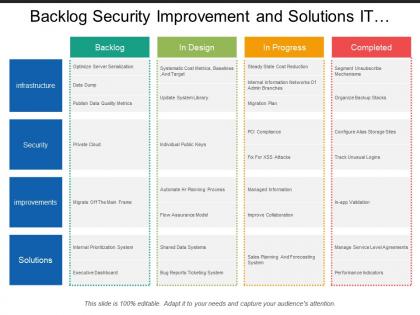
Backlog security improvement and solutions it swimlane




Try Before you Buy Download Free Sample Product
 Impress Your
 Audience
 100%
100% Editable
 Save Hours
 of Time


Handle ingrained beliefs with our Backlog Security Improvement And Solutions It Swimlane. Bring folks around to accepting a few changes.
People who downloaded this PowerPoint presentation also viewed the following :
Backlog security improvement and solutions it swimlane with all 5 slides:
Groups develop with our Backlog Security Improvement And Solutions It Swimlane. They will definitely act in collaboration.





FAQs for Backlog security improvement and
Effective backlog security solutions include vulnerability assessment automation, threat prioritization algorithms, code scanning integration, risk-based scheduling mechanisms, and continuous monitoring dashboards. These technologies streamline development workflows by identifying critical security gaps early, accelerating remediation cycles, and maintaining compliance standards, with many software organizations finding that strategic backlog management ultimately delivers faster release cycles and enhanced product security.
Organizations can prioritize security tasks by implementing risk-based assessment frameworks, categorizing vulnerabilities by severity and business impact, establishing clear security criteria for sprint planning, and integrating threat modeling into backlog refinement processes. Through strategic prioritization matrices, teams streamline security integration, enhance development workflows, and ultimately deliver more secure products while maintaining development velocity, with many software organizations finding this approach significantly reduces security debt.
Automation streamlines backlog security management by prioritizing vulnerabilities based on risk scores, automatically scheduling patches, and generating remediation workflows. Through automated scanning and assessment tools, organizations accelerate threat response, reduce manual oversight burdens, and maintain consistent security protocols, with many enterprises finding that automation delivers faster vulnerability resolution and enhanced operational efficiency.
Backlogs should be reviewed for security threats during each sprint planning session, with comprehensive security audits conducted monthly or quarterly depending on organizational risk tolerance. Through automated scanning tools and manual code reviews, development teams can identify vulnerabilities, assess threat vectors, and prioritize security fixes, ultimately delivering more secure applications while maintaining development velocity.
Key metrics include vulnerability resolution time, backlog reduction rates, security debt quantification, compliance adherence levels, and threat exposure duration. These measurements enable organizations to track remediation efficiency, prioritize critical fixes, and demonstrate ROI to stakeholders, with many enterprises finding that systematic metric tracking accelerates security improvements while reducing overall risk exposure.
Teams ensure backlog item alignment with security policies through regular security reviews, policy integration checkpoints, and cross-functional collaboration between security and development teams. Many organizations implement automated policy scanning tools and security-first sprint planning sessions, with security architects participating in backlog grooming to identify compliance gaps early, ultimately delivering faster, more secure releases while maintaining regulatory adherence.
Common challenges include balancing security requirements with development velocity, prioritizing security tasks against feature demands, managing technical debt from security shortcuts, and ensuring cross-team security knowledge. These integration hurdles often result in delayed releases, incomplete security implementations, and fragmented protection strategies, with many development teams finding that strategic security-first planning ultimately delivers faster, more secure deployments and reduced remediation costs.
Risk assessments influence backlog security prioritization by identifying vulnerabilities based on threat likelihood, potential business impact, and exploitability scores. Through comprehensive risk analysis, organizations can strategically sequence security fixes, addressing high-impact vulnerabilities first while balancing resource constraints, ultimately delivering enhanced protection and operational continuity across critical systems.
Security backlog management tools include SIEM platforms, vulnerability scanners, ticketing systems, risk assessment frameworks, and automated prioritization software. These technologies streamline operations by centralizing threat data, automating routine tasks, and providing real-time analytics, with many organizations finding that integrated platforms significantly reduce response times while enhancing overall security posture.
Organizations can reduce backlog size through prioritization frameworks, automated triage systems, resource scaling, stakeholder communication protocols, and continuous workflow optimization. These strategies work by streamlining task allocation, accelerating resolution times, and improving operational efficiency, with many companies finding that strategic backlog management ultimately delivers faster service delivery and enhanced competitive advantage.
Regulatory requirements significantly enhance backlog security practices by mandating data encryption, access controls, audit trails, and compliance documentation throughout development cycles. Financial services, healthcare, and government sectors increasingly integrate automated compliance checks, vulnerability scanning, and risk assessment protocols into their backlogs, ultimately streamlining regulatory adherence while maintaining secure development workflows.
Backlog security solutions significantly enhance SDLC by integrating vulnerability assessments, automated security testing, and compliance checks directly into development workflows, reducing remediation costs and accelerating delivery timelines. These tools streamline security integration across planning, coding, and deployment phases, with many software teams finding that early vulnerability detection minimizes post-release patches while ultimately delivering more secure applications and faster time-to-market.
Cross-functional teams collaborate effectively on backlog security through shared prioritization frameworks, regular security review sessions, and integrated communication channels that align development, security, and operations perspectives. By establishing clear security criteria, conducting joint threat assessments, and implementing collaborative tools, organizations streamline vulnerability management while maintaining development velocity, ultimately delivering more secure products with reduced time-to-resolution.
**INPUT**: What best practices exist for documenting security backlog items? **OUTPUT**: Security backlog documentation best practices include clear vulnerability descriptions, risk severity ratings, affected system components, remediation steps, and estimated effort requirements. These structured approaches streamline prioritization by enabling teams to quickly assess impact, allocate resources effectively, and track resolution progress, with many organizations finding that standardized templates ultimately deliver faster incident response and improved security posture. **Word count: 58 words**
Emerging technologies like artificial intelligence, machine learning, blockchain, and cloud computing revolutionize security backlog solutions by automating threat detection, enhancing vulnerability assessment, and streamlining incident response workflows. These technologies enable organizations to prioritize security tasks more effectively, reduce manual processing time, and deliver faster threat resolution, with many enterprises finding that automated backlog management significantly improves their overall security posture.
-
Presentation Design is very nice, good work with the content as well.
-
Understandable and informative presentation.