


Baiting As A Social Engineering Technique Training Ppt




Try Before you Buy Download Free Sample Product
 Impress Your
 Audience
 100%
100% Editable
 Save Hours
 of Time


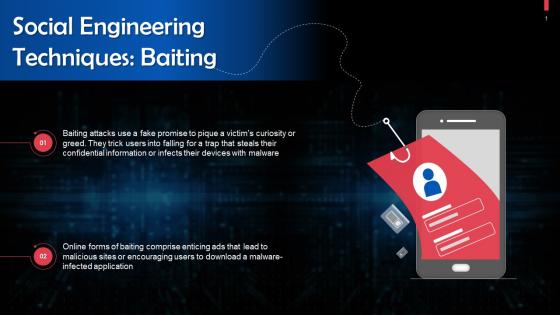
This slide contains details about baiting, a social engineering technique. Baiting attacks use a fake promise to pique a victim s curiosity or greed. They trick users into falling for a trap that steals their confidential information or inflicts their devices with malware.
People who downloaded this PowerPoint presentation also viewed the following :
Baiting As A Social Engineering Technique Training Ppt with all 20 slides:
Use our Baiting As A Social Engineering Technique Training Ppt to effectively help you save your valuable time. They are readymade to fit into any presentation structure.












FAQs for Baiting As A Social Engineering
Baiting in marketing presents both ethical challenges and transparency considerations, including potential customer deception, trust erosion, misleading advertising practices, and regulatory compliance issues. While some organizations find strategic value in attention-grabbing tactics, increasingly discerning consumers and stricter advertising standards require businesses to balance engagement goals with authentic messaging, ultimately delivering sustainable customer relationships over short-term gains.
Psychological principles enhance baiting effectiveness through scarcity perception, loss aversion, and social proof mechanisms that trigger immediate response behaviors. These cognitive biases create urgency and emotional engagement, with retailers, streaming services, and financial institutions finding that strategic psychological triggers increase conversion rates, reduce decision fatigue, and ultimately deliver higher customer acquisition and competitive advantage.
Compelling baiting offers utilize personalized value propositions, limited-time exclusivity, social proof validation, curiosity-driven headlines, and strategic scarcity messaging. These techniques work by targeting specific audience pain points, leveraging psychological triggers like FOMO, and presenting clear benefit statements, with many organizations finding that authentic, audience-specific offers significantly outperform generic campaigns.
Baiting significantly influences consumer behavior by creating artificial urgency, manipulating price perceptions, and exploiting psychological triggers like scarcity and social proof. Through misleading advertisements, limited-time offers, and bait-and-switch tactics, retailers can drive impulsive purchasing decisions, redirect customers toward higher-margin products, and ultimately increase conversion rates, though such practices risk damaging long-term brand trust and customer relationships.
Baiting in digital marketing presents risks including brand reputation damage, regulatory compliance violations, customer trust erosion, legal liability exposure, and potential platform penalties. While clickbait tactics may initially drive traffic, they often result in high bounce rates, decreased engagement, and long-term audience alienation, with many organizations finding that authentic content strategies ultimately deliver stronger ROI and sustainable growth.
Baiting can be effectively integrated into social media campaigns through strategic controversy generation, polarizing content creation, emotional trigger deployment, and audience segmentation tactics. Through carefully crafted provocative posts, brands generate increased engagement, viral sharing potential, and expanded reach across platforms, while maintaining authentic brand voice, ultimately delivering higher visibility and audience growth.
**INPUT**: What metrics should be tracked to measure the success of a baiting strategy? **OUTPUT**: Success metrics for baiting strategies include click-through rates, engagement duration, conversion rates, lead quality scores, and cost per acquisition. These measurements enable organizations to evaluate campaign effectiveness by tracking user behavior, optimizing content performance, and calculating ROI, with many marketing teams finding that combining engagement metrics with conversion data delivers comprehensive insights for strategic refinement.
Baiting tactics vary significantly between industries, with e-commerce businesses primarily using fake promotions, counterfeit product listings, and fraudulent discount schemes to capture payment information, while service-oriented sectors like healthcare and finance employ appointment scams, fake consultations, and bogus service offerings. These industry-specific approaches exploit sector vulnerabilities and customer expectations, ultimately requiring tailored cybersecurity strategies that address each industry's unique operational frameworks and customer interaction patterns.
Storytelling in baiting messages creates emotional engagement by weaving relatable narratives, personal anecdotes, urgent scenarios, and credible contexts that bypass logical skepticism. These techniques exploit psychological triggers through familiar characters, compelling plot structures, and emotional appeals, with attackers finding that story-driven approaches significantly increase victim response rates and successful manipulation outcomes.
Baiting enhances customer engagement by offering valuable free resources, exclusive previews, limited-time promotions, and personalized incentives that capture attention and encourage interaction. Through strategic content marketing and targeted offers, businesses across retail, hospitality, and financial services build stronger relationships, increase repeat purchases, and foster long-term loyalty, ultimately delivering higher customer lifetime value.
**INPUT**: What legal considerations must be taken into account when implementing baiting tactics? **OUTPUT**: Legal considerations for baiting tactics include data protection compliance, employee consent requirements, incident documentation standards, jurisdictional regulations, and liability frameworks. These safeguards ensure organizations maintain ethical boundaries while conducting security tests, with many enterprises finding that proper legal oversight enables comprehensive threat assessment while protecting both employee rights and business interests.
Baiting can be adjusted through customized content themes, delivery channels, psychological triggers, and contextual scenarios tailored to specific age groups, professional roles, and behavioral patterns. For instance, younger demographics might receive social media-based attacks while professionals face industry-specific email campaigns, with organizations finding that demographic-aware security training significantly enhances awareness and reduces successful exploitation rates.
Common mistakes include using overly obvious bait that appears suspicious, failing to track employee interactions properly, neglecting comprehensive security awareness training, and implementing baiting tests without clear follow-up protocols. Many organizations find that successful baiting programs require balancing realistic scenarios with educational outcomes, ensuring employees understand the learning objectives rather than feeling penalized, ultimately creating stronger security cultures through positive reinforcement.
Baiting strategies evolve by leveraging real-time analytics, personalized content creation, and dynamic targeting algorithms to match shifting consumer behaviors and preferences. Through adaptive AI systems and behavioral tracking, companies can continuously refine their approach across digital platforms, social media, and traditional channels, ultimately delivering more relevant experiences while maintaining competitive advantage in increasingly dynamic markets.
Successful baiting cases include corporate USB drops in parking lots leading to network compromises, fake software updates capturing credentials, malicious email attachments disguising as invoices, and infected promotional materials at conferences. These social engineering tactics work by exploiting curiosity and trust, with cybersecurity firms finding that employees fall for baiting attempts at rates exceeding 30%, ultimately highlighting critical security awareness gaps.
-
Great combination of visuals and information. Glad I purchased your subscription.
-
SlideTeam is my one-stop solution for all the presentation needs. Their templates have beautiful designs that are worth every penny!