


Banking With Voice Assistants And Ambient Omnichannel Banking Services Implementation




Try Before you Buy Download Free Sample Product
 Impress Your
 Audience
 100%
100% Editable
 Save Hours
 of Time


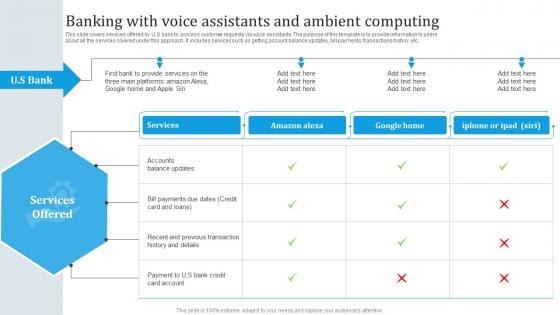
This slide covers services offered by U.S bank to process customer requests via voice assistants. The purpose of this template is to provide information to users about all the services covered under this approach. It includes services such as getting account balance updates, bill payments, transactions history, etc.
People who downloaded this PowerPoint presentation also viewed the following :
Banking With Voice Assistants And Ambient Omnichannel Banking Services Implementation with all 6 slides:
Use our Banking With Voice Assistants And Ambient Omnichannel Banking Services Implementation to effectively help you save your valuable time. They are readymade to fit into any presentation structure.





FAQs for Banking With Voice Assistants And Ambient Omnichannel
Voice banking is a technology that allows customers to conduct financial transactions and access banking services through voice commands using smartphones, smart speakers, or phone systems. Through natural language processing and speech recognition, banks enable account inquiries, bill payments, money transfers, and customer support interactions, while implementing voice biometrics for security, ultimately delivering faster, more convenient banking experiences that operate seamlessly across multiple channels.
Voice banking services benefit elderly customers, visually impaired individuals, busy professionals, and customers with mobility limitations who need convenient account access. Banks, credit unions, and financial institutions increasingly adopt these solutions to enhance customer experiences, reduce call center costs, and provide 24/7 accessibility, ultimately delivering competitive advantage in today's digital banking landscape.
Voice banking requires smartphones with voice assistants, smart speakers like Amazon Alexa or Google Home, mobile banking apps with voice capabilities, and secure voice recognition software. These technologies work together by enabling natural language processing, biometric voice authentication, and encrypted transaction processing, with many banks finding that customers appreciate the convenience of hands-free account management and faster service access.
Voice banking enhances financial accessibility by eliminating physical barriers, enabling hands-free navigation, and providing intuitive audio interfaces that accommodate visual, mobility, and dexterity limitations. Through speech recognition technology, individuals with disabilities can check balances, transfer funds, and pay bills independently, with many banks finding that voice-enabled services significantly improve customer autonomy and satisfaction.
Voice banking employs multi-layered security measures including voice biometrics, encryption protocols, fraud detection algorithms, secure authentication processes, and real-time transaction monitoring. These technologies enhance protection by analyzing unique vocal patterns, encrypting data transmissions, and detecting suspicious activities, with many financial institutions finding that voice recognition ultimately delivers stronger security than traditional PIN-based systems.
Voice banking applications seamlessly integrate with budgeting apps, investment platforms, expense trackers, personal financial management software, and accounting systems through APIs and open banking protocols. This strategic combination enables users to access comprehensive financial data through voice commands, streamline account management across multiple platforms, and ultimately deliver enhanced operational efficiency and superior customer experiences.
Current voice banking systems face limitations including accuracy challenges with accents and background noise, security vulnerabilities in voice authentication, limited transaction complexity, integration difficulties with existing banking infrastructure, and regulatory compliance concerns. While these present challenges, many financial institutions are addressing them through advanced AI algorithms, multi-factor authentication, and enhanced natural language processing, ultimately delivering more secure and user-friendly voice banking experiences.
Voice banking technologies are typically updated every 6-12 months through software patches, security enhancements, algorithm improvements, and feature expansions to address evolving cyber threats and customer expectations. These regular updates ensure optimal security, improve speech recognition accuracy, and maintain competitive advantage, with many financial institutions finding that consistent technological refreshes ultimately deliver better customer experiences and operational reliability.
Artificial intelligence enhances voice banking through natural language processing, machine learning algorithms, predictive analytics, voice recognition technology, and automated decision-making systems. These AI capabilities streamline customer interactions by enabling conversational banking experiences, reducing transaction times, and improving service accuracy, with many financial institutions finding that AI-powered voice systems ultimately deliver faster customer service and significant operational efficiency gains.
Voice banking streamlines personal finance management by enabling hands-free account inquiries, bill payments, transaction monitoring, and budget tracking through simple voice commands. This technology enhances financial accessibility and convenience, allowing users to manage expenses while multitasking, set spending alerts, and receive real-time balance updates, ultimately delivering faster financial decision-making and improved money management habits.
Voice banking presents ethical considerations including consent and data privacy, voice authenticity and potential misuse, equitable access across diverse populations, and long-term data security. While these technologies enable individuals to preserve their unique vocal identity for future communication needs, institutions must balance innovation with responsible implementation, ensuring transparent consent processes, robust security measures, and inclusive access policies that protect users while delivering transformative communication solutions.
Voice banking adoption varies significantly across demographics, with younger users embracing conversational interfaces more readily while older customers often prefer traditional channels initially. However, accessibility features attract seniors and disabled users, while professionals value hands-free convenience, and tech-savvy millennials drive feature adoption, ultimately creating diverse usage patterns that banks leverage to enhance customer experiences across all segments.
JPMorgan Chase's voice-activated account inquiries, Bank of America's Erica virtual assistant, and Capital One's Alexa integration represent successful voice banking implementations across major financial institutions. These deployments streamline customer interactions by enabling balance checks, transaction histories, and payment scheduling through natural speech, with many banks finding that voice interfaces reduce call center volumes while enhancing customer convenience and engagement.
Voice banking enables financial institutions to enhance customer engagement by providing 24/7 account access, personalized financial insights, and seamless transaction capabilities through smart speakers and mobile devices. Banks like JPMorgan Chase and Bank of America leverage voice technology to streamline routine inquiries, deliver proactive spending alerts, and facilitate hands-free payments, ultimately creating more convenient customer experiences while reducing operational costs.
Voice banking trends include enhanced AI personalization, multi-language support, advanced fraud detection, seamless omnichannel integration, and predictive financial advisory services. These developments enable banks to deliver faster customer interactions, reduce operational costs, and provide 24/7 accessibility, with many financial institutions finding that voice technology ultimately enhances competitive advantage in an increasingly digital banking landscape.
-
Thrilled to see several customizable templates catering various verticals and industries.
-
Really like the color and design of the presentation.