


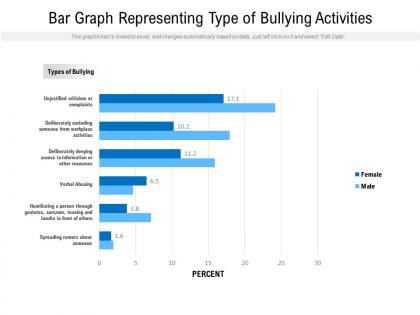
Bar graph representing type of bullying activities




Try Before you Buy Download Free Sample Product
 Impress Your
 Audience
 100%
100% Editable
 Save Hours
 of Time


Our Bar Graph Representing Type Of Bullying Activities are explicit and effective. They combine clarity and concise expression.
People who downloaded this PowerPoint presentation also viewed the following :
Bar graph representing type of bullying activities with all 2 slides:
Give your audience a fulfilling experience. They will find our Bar Graph Representing Type Of Bullying Activities elevating.

FAQs for Bar graph representing type
So there's basically four types - physical stuff like hitting or shoving, verbal (name-calling, threats), social bullying where kids exclude someone or spread rumors, and cyberbullying online. Honestly? The social exclusion can mess kids up just as much as getting punched. What makes cyberbullying so brutal is it doesn't stop when school ends - follows them home 24/7. Most bullies don't stick to just one method either. They'll post something embarrassing AND get their friends to ignore the kid at lunch. Watch for patterns, not just one-off incidents.
Honestly, the quiet changes are what get me - kids who suddenly stop participating or seem anxious around certain classmates. Watch for the obvious stuff too like unexplained injuries or torn backpacks. Academic performance can tank out of nowhere. I'd say pay extra attention during lunch and recess since that's prime bullying time. Sometimes the "joking around" isn't actually jokes, you know? And if you notice certain kids always getting left out of groups, that's telling. Oh, and grades dropping randomly - that's usually my first clue something's wrong at school.
Ugh, social media makes bullying so much worse now. Kids can't even escape at home anymore - bullies have 24/7 access through apps and group chats. They'll screenshot private convos, blast embarrassing stuff publicly, or just freeze someone out of group messages. People say things online they'd never say to your face, which is honestly just cowardly. The whole thing can go viral in like five minutes too. Oh, and definitely save screenshots of everything if this is happening to you. Schools actually have cyberbullying policies now that cover stuff happening off-campus. Report it to the platform AND the school - don't just suffer in silence.
So there's this thing called the "3 D's" that actually works pretty well. You can be direct if it feels safe - just say "hey, that's not cool" or ask the person being harassed to come with you somewhere. Distraction is honestly my favorite though, like just walk up and ask for directions or start some random conversation. It totally breaks the moment without any confrontation. If things seem sketchy or dangerous, just delegate - find a teacher, security guard, whoever's around with authority. Trust your instincts about what feels right in the moment, you know?
Start with buddy systems - pairing kids across different grades actually works really well. Circle time discussions about feelings help too, plus books with diverse characters. Mix up your classroom setup so cliques don't naturally form. Honestly, the literature part is probably my favorite because kids get so into the stories. Train your staff to use inclusive language and jump in when they spot exclusion. The biggest thing though? Don't make these one-time events. Build empathy talks into your daily routine or it won't stick.
Oh man, bullying really screws kids up mentally - we're talking anxiety, depression, self-esteem issues that stick around for years. Their grades tank because they're too worried about getting harassed to focus on schoolwork. Makes sense they'd start skipping class, right? The stress actually changes how their brains develop, which is honestly terrifying when you think about it. Makes it way harder for them to learn and remember stuff. If you're noticing these warning signs, document everything and get them connected with counseling ASAP. Early help can turn things around.
Yeah, so basically all schools have to follow federal laws like Title IX and Section 504 - that's the anti-discrimination stuff. Every state also has their own anti-bullying laws now, though honestly some are way better than others. Schools can actually get in legal trouble if they don't handle reported incidents properly. I'd start by checking what your specific district's policy says, then look up your state's rules since they're all different. Oh and if the school's being useless about it, you can always file a complaint directly with the Department of Education.
Honestly, just make sure they feel safe talking to you without getting lectured. Ask stuff like "how was your day?" instead of going straight to "are you getting bullied?" - that'll shut them down fast. Listen first before you try to fix everything (I'm terrible at this lol). Let them tell you how they want help instead of assuming. Write down what happened with dates in case you need it later. The biggest thing? Tell them they did the right thing by speaking up. Kids need to know you're actually on their side, not just trying to solve their problems for them.
Honestly? Bullying really screws up your social development long-term. You get used to controlling people instead of actually connecting with them - like you skip learning how to have normal conversations and negotiations. Most former bullies I've known either stay aggressive as adults or flip completely and become total pushovers in relationships. They missed out on developing empathy and communication skills the rest of us figured out naturally. It's fixable though! Takes real self-awareness and maybe some therapy, but people can definitely unlearn these patterns if they're willing to put in the work.
Honestly, peer support programs are game-changers because kids actually listen to other kids way more than adults. When students get trained to spot warning signs and step in, you're basically turning bystanders into allies instead of just witnesses. The reporting thing is massive too - it stops being "snitching" and becomes normal. Natural leaders at your school can really drive this whole thing forward with their friends. Once a few popular kids start calling out bullying behavior, it creates this social pressure where being mean isn't cool anymore. It's like peer pressure but actually working for good instead of against it.
Honestly, conflict resolution is such a game changer. Kids learn to actually talk through problems instead of letting things blow up into bullying drama. Role-playing works great - just throw some scenarios at them and watch what happens. They start figuring out how to speak up for themselves without being jerks about it. Plus they get better at listening, which is half the battle anyway. The cool thing is these skills stick with them way past school. I mean, adults could use this stuff too half the time! Bottom line: fewer kids end up as bullies or targets.
Track surveys with students, teachers, and parents about safety and bullying incidents. Disciplinary records are key too - plus attendance rates since kids skip when they're getting bullied. Focus groups give you the real tea beyond just numbers. Compare everything to your baseline data from before the program started, otherwise you're flying blind. Honestly, quarterly reviews work best for me - that's when you can actually see patterns and tweak what isn't working. The qualitative stuff matters just as much as the hard data.
School counselors are your go-to for bullying stuff. They'll meet with everyone involved to figure out what's happening and support the kids getting picked on. Plus they coordinate with parents, teachers, all that. Don't try handling it yourself - these situations get messy fast. Loop them in early! They've got the training for conflict resolution and trauma stuff that honestly makes a huge difference. I learned this the hard way my first year teaching. They're swamped but it's literally what they're there for.
Honestly, tech can be a game-changer for stopping bullying if you're smart about it. Anonymous reporting systems work really well - kids are way more likely to speak up when they don't have to put their name on it. Some schools have these apps now where students can report stuff instantly, which is pretty cool. AI can catch harmful language as it happens too. My friend's school does this and it actually works. You want to get ahead of problems instead of just reacting after someone gets hurt. Set up digital safe spaces and use whatever monitoring tools you already have. Oh, and don't forget teaching kids about digital citizenship - that part's huge.
Ugh, bullying absolutely destroys attendance rates. Kids who get bullied miss school like 2-3x more than other kids and way more likely to just drop out completely. They start avoiding classes where their bully is, then it snowballs into skipping whole days or weeks. Honestly breaks my heart seeing smart kids just... fall apart like that. Performance tanks obviously, creates this terrible cycle. Oh and if you notice sudden attendance drops? Don't just assume it's laziness - ask what's actually happening at school beyond grades.
No Reviews