


Best Practices For Test Automation Strategy




Try Before you Buy Download Free Sample Product
 Impress Your
 Audience
 100%
100% Editable
 Save Hours
 of Time


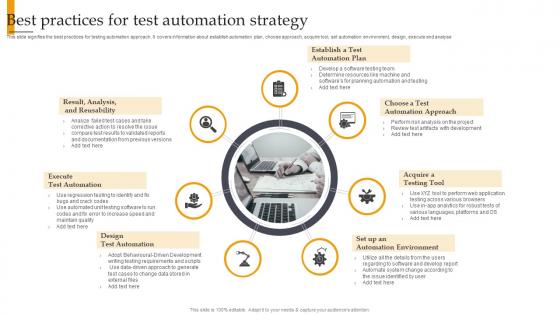
This slide signifies the best practices for testing automation approach. It covers information about establish automation plan, choose approach, acquire tool, set automation environment, design, execute and analyse.
People who downloaded this PowerPoint presentation also viewed the following :
Best Practices For Test Automation Strategy with all 6 slides:
Use our Best Practices For Test Automation Strategy to effectively help you save your valuable time. They are readymade to fit into any presentation structure.





FAQs for Best Practices For
Key factors include test case selection, tool evaluation, framework design, team skill assessment, and maintenance planning. These elements work together by identifying high-value automation candidates, selecting scalable tools, and establishing sustainable processes, with many organizations finding that strategic automation delivers faster release cycles, reduced testing costs, and improved software quality.
Determining the right test automation tools requires evaluating project requirements, team expertise, application technology stack, budget constraints, and long-term maintenance needs. Organizations should assess tool compatibility with existing systems, scalability potential, and learning curve requirements, with many finding that pilot testing multiple solutions across different scenarios ultimately delivers the most informed decision and sustainable automation framework.
Aligning test automation with agile practices involves integrating continuous testing into sprint cycles, implementing test-driven development approaches, and establishing automated regression suites that execute with each code commit. This strategic combination enables development teams to maintain faster release velocities, reduce manual testing bottlenecks, and deliver higher-quality software iterations, with many organizations finding that automated testing frameworks ultimately enhance their competitive responsiveness.
Common pitfalls include automating unstable tests, lacking clear strategy and goals, insufficient maintenance planning, poor tool selection, and inadequate team training. These challenges often derail automation efforts by creating brittle test suites, unreliable results, and increased maintenance overhead, with many organizations finding that strategic planning and continuous refinement ultimately deliver sustainable automation success.
Test automation effectiveness is measured through key metrics including test execution time reduction, defect detection rates, test coverage percentages, maintenance costs, and return on investment calculations. Organizations typically track automated test pass/fail ratios, time-to-feedback improvements, and resource allocation efficiency, with many finding that combining these metrics delivers comprehensive insights into automation value and strategic testing outcomes.
Test case selection serves as the foundation of effective automation strategy, determining which tests deliver maximum ROI through criteria like repetition frequency, execution time, and business criticality. Strategic selection focuses on high-value scenarios such as regression suites, smoke tests, and data-driven validations, while balancing automation costs with maintenance overhead, ultimately enabling organizations to achieve faster release cycles and improved software quality.
Maintainability and scalability in automated test scripts are ensured through modular design patterns, comprehensive documentation, version control systems, standardized coding practices, and regular refactoring cycles. These approaches streamline script management by reducing code duplication, enabling easier updates, and facilitating team collaboration, with many development organizations finding that strategic automation frameworks ultimately deliver faster release cycles and significantly lower long-term maintenance costs.
Best practices for integrating test automation into CI/CD pipelines include implementing automated unit tests at every commit, establishing parallel test execution, creating comprehensive smoke tests for deployment validation, maintaining isolated test environments, and ensuring fast feedback loops. These practices streamline development workflows by reducing manual testing overhead, accelerating release cycles, and minimizing production defects, with many software teams finding that strategic automation integration ultimately delivers faster time-to-market and enhanced product reliability.
Balancing automated and manual testing requires strategic allocation based on test complexity, frequency, and business impact, with automation handling repetitive regression tests, API validations, and performance monitoring while manual testing focuses on exploratory scenarios, usability assessments, and edge cases. This strategic combination enables faster release cycles, comprehensive coverage, and cost-effective resource allocation, with many software teams finding that 70-80% automation delivers optimal efficiency.
Key metrics for assessing test automation ROI include execution time reduction, defect detection rate, test coverage percentage, maintenance costs, and resource allocation efficiency. These measurements enable organizations to quantify cost savings, faster release cycles, and improved software quality, with many development teams finding that tracking these metrics demonstrates significant competitive advantages and operational improvements.
Test automation prioritization involves focusing on high-frequency regression tests, critical business workflows, repetitive manual tests, and stable application features with minimal UI changes. Teams typically start with login processes, payment systems, and core user journeys in sectors like e-commerce and banking, while prioritizing tests that deliver immediate ROI through reduced manual effort and faster release cycles.
Automation enhances collaboration between development and QA teams by establishing shared testing frameworks, enabling continuous integration practices, and creating transparent defect tracking systems. Through automated testing pipelines, both teams work with unified code repositories, real-time feedback loops, and collaborative test case development, ultimately delivering faster release cycles and improved software quality.
AI and machine learning enhance test automation strategies by enabling intelligent test case generation, predictive defect detection, and dynamic test optimization based on code changes. These technologies streamline testing processes by automatically identifying high-risk areas, reducing false positives, and accelerating release cycles, with many software development teams finding that AI-driven automation delivers significantly faster deployment timelines and improved software quality.
Cross-platform and cross-browser testing strategies include cloud-based testing platforms, containerized environments, parallel execution frameworks, device farms, and responsive design validation tools. These approaches streamline compatibility verification by automating tests across multiple browsers, operating systems, and devices simultaneously, with many organizations finding that strategic combination of cloud services and local testing delivers comprehensive coverage while minimizing resource allocation costs.
Effectively training your team for automation strategy involves structured learning paths, hands-on practice sessions, mentorship programs, and gradual responsibility transitions from manual to automated processes. Through targeted workshops and real-world project applications, organizations streamline knowledge transfer, enhance technical competencies, and build automation confidence, with many teams finding that peer collaboration and continuous learning ultimately deliver faster adoption and sustained competitive advantage.
-
Best Representation of topics, really appreciable.
-
I discovered this website through a google search, the services matched my needs perfectly and the pricing was very reasonable. I was thrilled with the product and the customer service. I will definitely use their slides again for my presentations and recommend them to other colleagues.