Developing Quality Assurance Testing Strategy
Try Before you Buy Download Free Sample Product
Audience
Editable
of Time
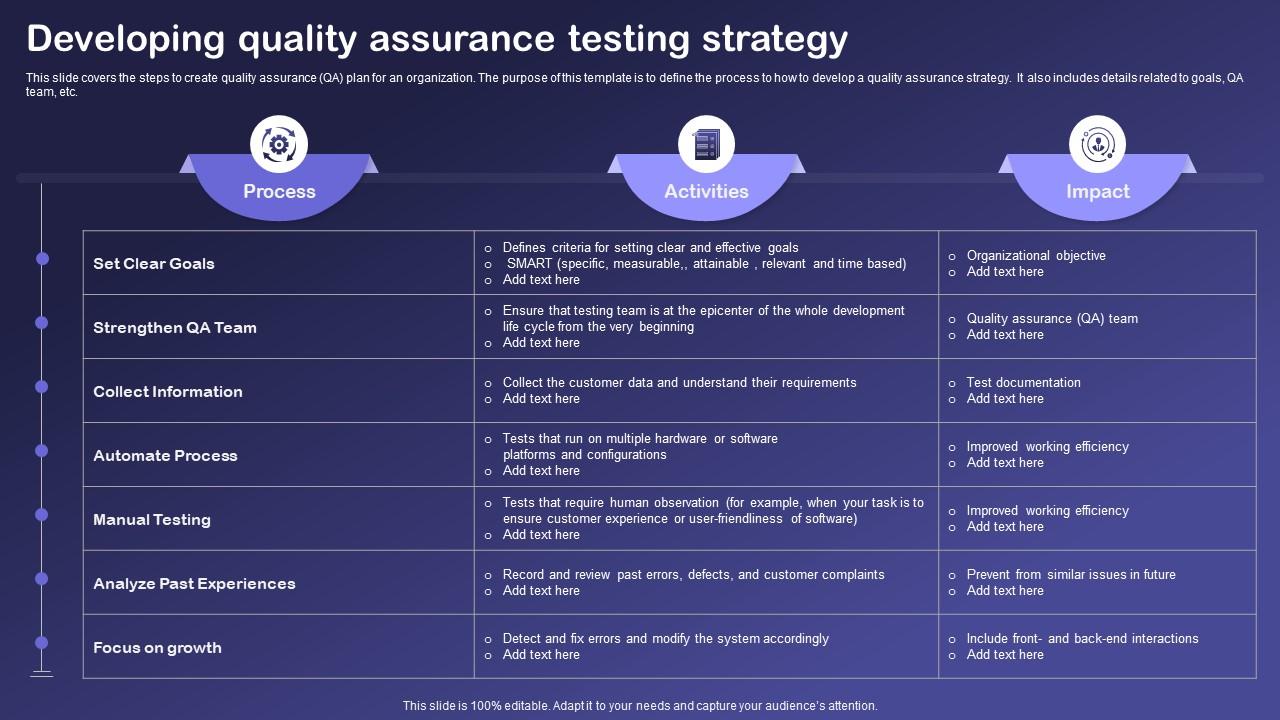
This slide covers the steps to create quality assurance QA plan for an organization. The purpose of this template is to define the process to how to develop a quality assurance strategy. It also includes details related to goals, QA team, etc.
People who downloaded this PowerPoint presentation also viewed the following :
Developing Quality Assurance Testing Strategy with all 6 slides:
Use our Developing Quality Assurance Testing Strategy to effectively help you save your valuable time. They are readymade to fit into any presentation structure.
FAQs for Developing Quality
Effective Quality Assurance Testing Strategies include test planning, risk assessment, automated testing frameworks, manual testing protocols, and continuous integration processes. These components work together by establishing clear testing objectives, identifying potential vulnerabilities early, and streamlining validation workflows, with many organizations finding that strategic QA implementation reduces deployment risks while accelerating product delivery timelines.
Determining QA testing scope involves analyzing project requirements, risk assessment, timeline constraints, resource availability, and stakeholder expectations to define what will be tested and excluded. Through requirement traceability matrices and risk-based testing approaches, organizations establish clear objectives like functionality validation, performance benchmarks, and security compliance, ultimately delivering comprehensive coverage while optimizing testing efficiency and project outcomes.
Automated testing tools streamline Quality Assurance strategies by executing repetitive tests, accelerating regression testing, and ensuring consistent test coverage across development cycles. These tools enable organizations to reduce manual testing overhead, detect defects earlier in development phases, and maintain higher software quality, with many companies finding that automation delivers faster release cycles and significantly improved resource allocation efficiency.
Integrating continuous integration and continuous testing requires automated test suites that run with every code commit, parallel testing environments, and real-time feedback loops between development and QA teams. This strategic combination enables faster bug detection, reduces deployment risks, and accelerates release cycles, with many software companies finding that automated regression testing and continuous monitoring ultimately deliver higher quality products while minimizing manual testing overhead.
Key QA testing effectiveness metrics include defect detection rate, test coverage percentage, defect leakage rate, mean time to resolution, and test execution efficiency. These measurements enable organizations to streamline quality processes, enhance software reliability, and accelerate release cycles, with many development teams finding that comprehensive metric tracking ultimately delivers faster deployments and significantly improved user experiences.
QA testing strategies align with Agile methodologies by integrating continuous testing throughout development cycles, implementing automated test suites, establishing cross-functional collaboration between developers and testers, and adopting shift-left testing approaches. These practices enable organizations to deliver faster release cycles, maintain higher code quality, and respond quickly to changing requirements, with many software development teams finding that early defect detection significantly reduces costs while enhancing customer satisfaction.
Best practices for developing test cases include defining clear objectives, creating comprehensive user scenarios, establishing measurable acceptance criteria, incorporating both positive and negative test paths, and ensuring traceability to requirements. These methodologies streamline quality assurance by covering edge cases, automating repetitive processes, and prioritizing risk-based testing, with many development teams finding that structured test design ultimately delivers faster releases and enhanced product reliability.
Multi-platform testing requires establishing standardized test protocols across environments, implementing automated cross-platform testing tools, maintaining consistent data sets, and coordinating parallel execution schedules. These strategies streamline quality assurance by reducing manual overhead, ensuring uniform coverage, and accelerating release cycles, with many organizations finding that centralized test management ultimately delivers faster deployment and enhanced user experience consistency.
User feedback influences QA testing strategy by identifying real-world usage patterns, revealing overlooked edge cases, highlighting performance issues under actual conditions, and exposing usability gaps that internal testing might miss. This strategic combination of user insights and systematic testing enables organizations to prioritize critical scenarios, refine test cases, and ultimately deliver more reliable products that meet actual customer expectations.
Regression testing is crucial for ensuring existing functionality remains intact after code changes, preventing new bugs from breaking previously working features. Through automated test suites, organizations streamline validation processes, reduce deployment risks, and maintain software reliability, with many development teams finding that comprehensive regression testing ultimately delivers faster release cycles and enhanced user experiences.
Risk assessment guides test prioritization by evaluating potential failure impact, likelihood of defects, and business criticality across different system components and functionalities. Through systematic risk analysis, QA teams focus testing efforts on high-risk areas like payment processing, data security, and core user workflows, while allocating fewer resources to low-impact features, ultimately delivering more efficient testing coverage and better protection of critical business operations.
Companies commonly face challenges including insufficient resource allocation, lack of skilled testing personnel, unclear testing requirements, inadequate test environment setup, and poor communication between development and QA teams. These obstacles often result in delayed product releases, increased costs, and compromised software quality, with many organizations finding that strategic planning and cross-functional collaboration ultimately streamline testing processes and enhance overall product reliability.
Proper documentation and traceability in QA testing require comprehensive test case management, requirement mapping, defect tracking systems, and automated reporting tools. Through integrated platforms like Jira or TestRail, organizations streamline test execution tracking, link requirements to specific test cases, and maintain audit trails, ultimately delivering enhanced compliance, faster issue resolution, and improved project visibility across development cycles.
Involving stakeholders in QA ensures requirements alignment, reduces miscommunication, and enhances product quality through diverse perspectives and real-world insights. This collaborative approach streamlines development cycles, minimizes costly post-launch revisions, and delivers solutions that truly meet user expectations, with many organizations finding that stakeholder engagement ultimately accelerates time-to-market and improves customer satisfaction.
Evaluating QA tools requires assessing your testing requirements, team expertise, budget constraints, integration capabilities, and scalability needs. Organizations should prioritize tools that seamlessly integrate with existing development workflows, support multiple testing types like automated regression and performance testing, while delivering faster release cycles, reduced manual effort, and enhanced product quality across diverse project environments.
-
Placing an order on SlideTeam is very simple and convenient, saves you a lot of your time.Â
-
Based on my personal experience, I would recommend other people to subscribe to SlideTeam. No one can be disappointed here!