

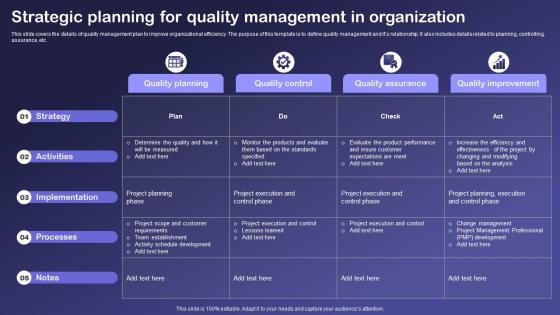
Strategic Planning For Quality Management In Organization




Try Before you Buy Download Free Sample Product
 Impress Your
 Audience
 100%
100% Editable
 Save Hours
 of Time


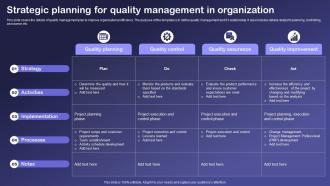
This slide covers the details of quality management plan to improve organizational efficiency. The purpose of this template is to define quality management and its relationship. It also includes details related to planning, controlling, assurance, etc.
People who downloaded this PowerPoint presentation also viewed the following :
Strategic Planning For Quality Management In Organization with all 6 slides:
Use our Strategic Planning For Quality Management In Organization to effectively help you save your valuable time. They are readymade to fit into any presentation structure.





FAQs for Strategic Planning For Quality
Focus on customer needs first, then get leadership actually committed - not just talking about it. Most places completely blow this part. You'll want engaged employees who think in terms of processes, plus that continuous improvement mindset. Use real data for decisions and build solid supplier relationships. Quality can't just be one department's problem, everyone needs to own it. I'd start by mapping out your key processes first, see where you're bleeding customers or wasting money. Companies fail at this because they treat quality like a checkbox instead of changing how they actually operate.
Dude, TQM is a game changer - it gets everyone obsessed with making things better instead of just the quality control people. Your products get way better, fewer screw-ups happen, and customers actually stick around. The crazy part is how much money you save once you stop wasting resources on dumb processes. Employees get more invested too since they're not just cogs in the machine anymore. Oh and you'll destroy your competition, which is nice. My advice? Pick one department first and let it spread organically from there.
Honestly, your leaders make or break this whole thing. If they don't actually care about quality, nobody else will either. Watch how they handle quality issues - do they throw money at problems or just talk about them in meetings? The good ones celebrate wins publicly and call people out when standards drop. But here's the kicker - they have to live it themselves. Can't just preach about quality while cutting corners on their own stuff. I know it sounds obvious, but you'd be surprised how many companies miss this. Resources matter too. Quality initiatives need actual budget behind them, not just good intentions.
So basically, track your defect rates and customer complaints to catch patterns before they blow up. Predictive analytics is where it gets interesting though - you can actually see which processes are about to fail and jump on them early. I'd start by figuring out your key quality metrics first, then build dashboards to watch them in real-time. The visual stuff makes presenting to bosses way less painful too. Oh, and benchmarking against industry standards helps you see if you're actually improving or just think you are.
So QA is like putting up guardrails before anyone drives - you're building processes to stop problems from happening in the first place. QC comes after, where you're actually inspecting stuff to catch whatever went wrong anyway (and trust me, something always does). One focuses on HOW you do things, the other on WHAT you actually made. QA is proactive, QC is reactive. Honestly, most teams I've worked with need both - there's no way QA catches everything upfront, so you'll still need that safety net of checking your final output.
Track the hard numbers first - defect rates, customer complaints, how long processes actually take. But honestly, don't ignore the soft stuff either. Employee feedback and customer surveys catch problems that spreadsheets miss completely. I've seen companies with "perfect" data where customers were still pissed off, so yeah... both matter. Management should review everything regularly to connect the dots. Oh, and pick maybe 3-5 metrics that actually matter to your business instead of drowning in data. You'll go crazy trying to measure everything at once.
Honestly, the worst part is dealing with suppliers who all have different quality standards - it's like herding cats. Data integration is a total nightmare too since everyone's using different systems and you can't get real-time info from half of them. Then you've got vendors scattered across time zones and countries with their own regulations. The costs add up quick when you're trying to monitor quality at every step. My advice? Map out your most critical quality points first. Don't try to fix everything overnight - focus on standardizing with your main suppliers instead.
So ISO 9001 is basically like having a roadmap for quality management that actually works. You'll document your processes, track customer satisfaction, and fix problems systematically instead of just hoping for the best. The whole thing forces you to think through quality rather than scrambling when stuff goes wrong. Regular audits become part of the deal, plus you've got to show you're actually solving issues. Honestly, most companies catch problems way earlier once they start following it. Everyone stays aligned on what quality looks like too. First step? Map what you're doing now against their requirements - you'll spot the gaps pretty quick.
Honestly, you've gotta set up regular check-ins instead of waiting for things to blow up. Monthly or quarterly reviews work way better than those useless annual ones - I've watched too many companies crash and burn with that approach. Get your team trained properly so they actually know what quality looks like, and make sure they feel comfortable speaking up about problems. Customer feedback should be happening constantly, not just when someone complains. Track your metrics over time, but don't get stuck just collecting data. Actually do something with what you learn! Start small though - pick one process this month and really dig into it.
Look, your team needs both the skills AND the motivation - can't really have one without the other. Training teaches them how to do things right from the start. But engaged employees? They actually *care* about maintaining those standards instead of just going through the motions. I've seen it happen - people who feel invested catch problems before they become disasters. They'll speak up when something's off. Training alone just gets you robots following procedures. Skip the training though, and even your most enthusiastic workers will mess things up with good intentions. Start with solid skills training, then show them how their work affects the bigger picture.
Honestly, feedback collection is just the beginning - surveys, social media monitoring, direct complaints, all that stuff. But here's where most companies screw up: they collect everything then do nothing with it. Pick three complaints you keep hearing about and fix those first. Quick wins are everything for building momentum. Set up some basic system to sort feedback by themes, figure out what's actually hurting customers most, then get someone to own fixing each issue. Oh and track whether your changes actually help - I've seen too many "improvements" that didn't move the satisfaction needle at all.
Think of risk management as your quality crystal ball - you're spotting problems before they bite you in the ass. Way smarter than scrambling to fix disasters later, trust me. Map out what could potentially go wrong in your processes, then figure out how likely each thing is to actually happen. That gives you a roadmap for where to dump your time and money. Short sentences work great for this stuff. Start simple - grab a notepad and brain-dump everything that might fail. Honestly, most people skip this step and then wonder why they're constantly firefighting quality issues.
Tech is honestly a game-changer for quality stuff - automation can handle those boring repetitive inspections while AI spots defects before they even happen. The pattern recognition is insane, way better than what we can catch manually. Real-time data gives you instant insights too. Your team gets freed up from all the tedious checking to work on actual strategic problems, which is huge. Compliance tracking becomes way less of a headache. I'd say start small though - maybe pick that one process that's driving everyone crazy and test automation there first. Way less overwhelming that way.
Honestly, prep work makes or breaks your audit. Build a solid checklist first, then actually watch processes happen - don't just talk through them with managers. I always interview frontline people too since they know where stuff really breaks down. Too many audits are just checking boxes while missing the actual problems (drives me crazy). Document as you go and dig into the "why" behind issues instead of surface-level stuff. When you wrap up, make your findings super actionable. Oh and definitely follow up in a month or you'll never know if anything actually changed.
Look, good quality management basically means your customers can count on you. They'll stick around when they know your stuff won't break or suck. Simple as that. Nobody's coming back after dealing with garbage products twice - I sure wouldn't. The smart move is catching problems before they hit customers, saves you from those brutal complaint calls later. Trust builds retention naturally. Oh, and start by figuring out where things usually go wrong in your process first. Way more efficient than trying to fix everything at once.
-
I loved the hassle-free signup process. A few minutes and, I had this giant collection of beautiful designs.
-
Satisfied with the way SlideTeam resolved my query regarding the right business PPTs that I was having difficulty finding. I found the perfect match with their assistance.