


Quality Control Plan For Manufacturing Process QCP Templates Set 3




Try Before you Buy Download Free Sample Product
 Impress Your
 Audience
 100%
100% Editable
 Save Hours
 of Time


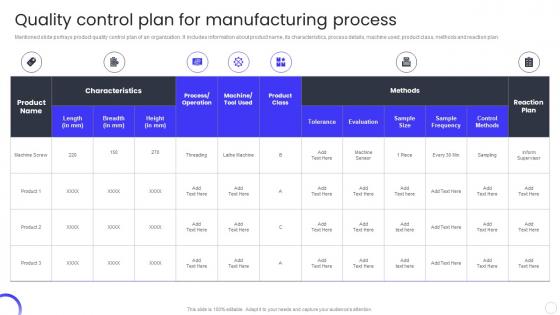
Mentioned slide portrays product quality control plan of an organization.It includes information about product name, its characteristics, process details, machine used, product class, methods and reaction plan.
People who downloaded this PowerPoint presentation also viewed the following :
Quality Control Plan For Manufacturing Process QCP Templates Set 3 with all 6 slides:
Use our Quality Control Plan For Manufacturing Process QCP Templates Set 3 to effectively help you save your valuable time. They are readymade to fit into any presentation structure.





FAQs for Quality Control Plan For Manufacturing Process QCP
A Quality Control Plan is basically your game plan for catching problems before they blow up your project. You define what standards to hit, who checks what at each stage, and exactly which tests to run. Honestly, it's like insurance for those 3am panic moments when something goes wrong. The plan also covers how to deal with defects - and trust me, there will be defects. My advice? Build it early in your project and actually follow the thing. I've seen too many teams create these detailed plans just to ignore them completely. Don't be those people.
Look, a QC plan basically stops defects from turning into massive headaches later. Map out where things usually go wrong first - that's where you put your checkpoints. Set up testing at those spots and create feedback loops so you can catch patterns. Honestly, it's wild how many companies just wing it without this stuff. Your team stays on the same page with standards, plus you get actual data to improve with. Think of it like having safety nets at every sketchy part of your process. Start with your biggest risk areas and build from there.
So you'll need clear quality standards first - what's acceptable and what isn't. Set up inspection procedures at your key checkpoints, then figure out who's responsible for what (this part gets messy if you don't nail it down early). Document everything for tracking. When stuff inevitably breaks down, have your corrective action steps ready. Oh, and training requirements for the team - can't forget that one. Include how you'll monitor and measure things, plus regular reviews to keep it all current. Honestly, I'd tackle your biggest quality risks first, then expand from there.
So QC is reactive - you're testing stuff after it's made to catch problems. QA happens way earlier though, it's all about preventing issues before they start. Like, QC is your proofreader catching typos (honestly been there too many times), but QA is having solid writing rules so the typos don't happen. Makes sense? Your QC plan should have specific tests and what passes/fails. QA is more about the processes you'll set up to avoid headaches later. Both matter, but I'd say good QA saves you way more time in the long run.
Track both leading and lagging indicators - you need the whole picture. Defect rates, first-pass yield, customer complaints, cost of quality stuff like rework and scrap. Process capability indices are huge too, plus audit scores. Those really show if your controls actually work or if they're just paperwork. Oh, and cycle time for fixing issues! What's the point of catching problems if it takes forever to resolve them? Honestly, I'd start with maybe 3-4 metrics that hit your specific process hardest. Build from there once you've got solid baseline data. Don't go crazy measuring everything at once.
Yeah, QC plans are super important in healthcare, aerospace, automotive, and food - basically anywhere failures could kill someone. Medical devices with tiny defects? Fatal. Planes falling apart? Also bad. You get the idea. Even "safer" industries like software really need them though. Costly mistakes suck, and nobody wants their reputation trashed over something preventable. I'd start by figuring out what failure actually looks like for your specific situation - that's honestly half the battle right there. Once you know what you're preventing, the rest gets way easier.
Honestly, tech and automation are game-changers for QC. Real-time monitoring catches issues instantly instead of finding them later (which sucks). Automated testing gives you way more consistent measurements than doing everything manually. Digital checklists mean your team won't skip steps anymore - I've seen that happen too many times. Data analytics helps you spot problems before they blow up, plus you get solid documentation for audits automatically. The data collection part is actually pretty useful for figuring out where you can improve processes. I'd start with automating whatever repetitive checks you're doing first.
Your employees are everything here - they're the ones doing the actual quality control work daily. If they don't get it or aren't on board, your whole plan crashes. Honestly, I've watched so many companies build these perfect QC manuals that just collect dust because workers had no clue what they were supposed to do. Your frontline people spot problems first. They need to feel comfortable calling stuff out when it's wrong. Get them involved from the start and give them steps that actually make sense. Without their buy-in, you're basically screwed.
Officially it's once a year, but that's kinda pointless tbh. I'd go with quarterly reviews - stuff changes too fast these days. Plus you'll need to update it whenever big things happen like new regulations, process changes, or when customers complain. The whole point is keeping it current with what's actually happening, not some dusty document from 2022. Set a calendar reminder now (trust me, you'll forget otherwise) and definitely get your team involved when you do the reviews. They're the ones actually using it anyway.
Honestly, the biggest pain is always money and time - you're constantly trying to do proper testing while everyone's breathing down your neck about deadlines. Getting different teams to actually care about the same quality standards? Good luck with that, especially when everyone has their own agenda. Plus you'll spend way too much time figuring out how often to test stuff without making it overly complicated. Oh, and defining what "good quality" even means when stakeholders all want different things - that's fun too. Start with the basics that'll actually break your product if they fail. Build from there once you figure out what doesn't make your team want to quit.
Hey! So basically a Quality Control Plan catches problems before your customers ever see them. You'll spot issues early in production instead of getting angry phone calls later - trust me, those calls suck. Regular checkpoints throughout your process mean you're fixing stuff upstream rather than scrambling when complaints roll in. Happy customers stick around and buy more, obviously. The whole point is building that trust by consistently hitting their expectations. Honestly, it's way cheaper than dealing with returns and refunds all the time. Set up those quality checks and your satisfaction scores will jump.
Make your QC plan something people actually reference daily, not just dusty paperwork. Train everyone regularly on current procedures - gaps turn into disasters fast. Write everything down because legally speaking, undocumented work never happened. Each department needs QC champions who catch problems early. Honestly, the best advice? Create safe channels for staff to report issues without getting blamed. Most people want to do good work anyway. Schedule regular audits and make following protocols the easy path, not the hard one.
So regulatory standards are basically your non-negotiable minimums - think FDA, ISO, whatever applies to your field. You've gotta figure out which ones hit your industry first. Then build your QC processes around their testing and documentation requirements. Honestly, it feels like following a strict recipe when you start out. The cool part though? You can totally go above and beyond these baseline requirements if you want a stronger plan. Just map out your key regulations, then set up QC checkpoints that hit all the critical stages. Makes the whole compliance thing way less scary.
Dude, skip the QC plan and you're gonna regret it big time. More defects will slip through to customers, which absolutely kills your reputation. Your team ends up constantly putting out fires instead of actually preventing problems - been there, it sucks. Meeting regulatory stuff becomes a nightmare, and clients might drop you. Oh, and recalls? Those are brutal on the budget. I know setting up the plan feels like extra work now, but honestly it's way cheaper than dealing with all that mess later. Just do it.
Start by figuring out where things usually go wrong in your current setup - honestly, this part's kinda tedious but super worth it. Different industries need totally different approaches, so don't just copy what works for tech companies if you're in manufacturing. Think about your team size too, because there's no point creating some elaborate system if you only have three people. I'd say start basic and see what actually sticks. Most places try to do too much upfront and then nobody follows it. Test things out for a few weeks, then tweak based on what your team finds realistic to maintain.
-
Their professional templates are very impressive, even my manager was curious about the source. I am very grateful.
-
It makes easy work of my work presentations. I’ve never had to be nervous about my presentations for meetings.