


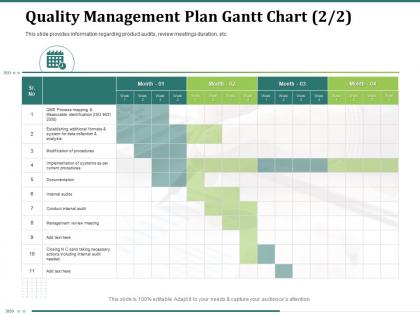
Quality management plan gantt chart qms process ppt powerpoint presentation file layout




Try Before you Buy Download Free Sample Product
 Impress Your
 Audience
 100%
100% Editable
 Save Hours
 of Time


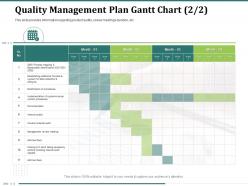
This slide provides information regarding product audits, review meetings duration, etc.
People who downloaded this PowerPoint presentation also viewed the following :
Quality management plan gantt chart qms process ppt powerpoint presentation file layout with all 2 slides:
Use our Quality Management Plan Gantt Chart QMS Process Ppt Powerpoint Presentation File Layout to effectively help you save your valuable time. They are readymade to fit into any presentation structure.
FAQs for Quality management plan gantt chart qms process ppt powerpoint
Start with figuring out what "quality" actually means for your project - sounds obvious but most people skip this step. Then you need objectives, standards, and metrics to measure against. Map out who's responsible for what quality-wise. Set up your QA processes, testing protocols, and review cycles. Here's the thing though - you absolutely have to plan for when stuff goes wrong, because it will. Document your corrective actions and communication plans ahead of time. Oh, and make sure you've got the right tools picked out. Everything should connect back to what your stakeholders expect, otherwise you're just creating busy work.
Start with whatever regulations hit your industry - FDA stuff if you're pharma, ISO certs for manufacturing, that kind of thing. The basic QMP framework stays the same across the board. But then you customize everything else: your processes, what metrics you track, compliance checkpoints. Healthcare companies drown in documentation while tech startups can be way more flexible. Manufacturing folks obsess over defect rates and process control. Software teams? They're all about user experience and smooth deployments. Honestly, just focus on the quality problems that actually keep you up at night in your sector, not some cookie-cutter approach.
So here's the thing - you absolutely have to talk to your stakeholders when building that Quality Management Plan. They're literally the ones deciding what "good enough" looks like for your project. Get their input early about standards, acceptance criteria, all that stuff. I've seen so many plans crash and burn because people think they can figure this out solo. Different stakeholders want different things (shocking, I know), so talking to them upfront helps you spot those conflicts before they bite you. Document what they actually want and get them to sign off. Trust me on this one.
So basically, quality problems ARE project risks - they're the same thing. I'd start by figuring out what could go wrong quality-wise, then build your prevention stuff right into the QMP. Your risk register flags the quality threats, and the QMP shows how you'll handle them through testing, inspections, whatever. It's like having backup plans for when things get messy (which they will). List your worst quality nightmares first. Then make sure your QMP tackles each one specifically. Honestly, most people treat these as separate things but they shouldn't.
Track both leading and lagging indicators for your QMP - stuff like defect rates, customer satisfaction, process cycle times. The cost of quality metric is huge too, most people don't realize how eye-opening that one is. Compare your baseline to current performance in regular reviews. Also watch how well teams are actually adopting your quality processes (this matters more than you'd think). Pick 4-6 metrics that connect to your business goals instead of measuring everything. Start with your top 3 and do monthly reviews to keep things moving.
Honestly, quality management software is a lifesaver. It handles all that tedious documentation stuff automatically and tracks your metrics in real-time instead of you scrambling weeks later trying to figure out what went wrong. Everything lives in one spot, which is nice because I'm always losing track of compliance reports otherwise. The workflow automation part is clutch - it basically forces people to follow procedures without you having to nag them constantly. Real-time dashboards are probably the best feature though. My advice? Figure out what's driving you crazy about your current process first, then find tools that fix exactly those problems.
Honestly, the worst thing you can do is make your QMP super vague and theoretical. Like, actually tailor it to your specific project! Don't set these crazy perfectionist standards that look good on paper but are totally unmeasurable. I've seen people do this so many times - they go overboard trying to sound impressive. Make sure someone's clearly responsible for each quality task, otherwise you'll have chaos later. Oh, and your metrics need to match what stakeholders actually give a damn about. My advice? Map out your deliverables first, then build realistic quality criteria around those specific things.
So basically, a Quality Management Plan is like having a game plan for getting better at whatever you're doing. You set up regular check-ins to see what's working and what's totally bombing. Then you actually do something about it instead of just crossing your fingers and hoping for the best. It tracks all your lessons learned and creates these feedback loops - sounds fancy but it's really just "learn from your mistakes systematically." The whole point is making improvement intentional rather than random. Honestly, without one you're just throwing stuff at the wall and seeing what sticks.
Definitely focus on defect rates, customer satisfaction scores, and first-pass yield first. Schedule adherence matters too - plus cost of quality, which people weirdly ignore until their budgets explode. Rework rates show if your processes actually work. Inspection pass/fail gives you that real-time pulse check. If you're in a regulated space, audit results and compliance scores are non-negotiable. Honestly though? Start with maybe 3-5 metrics max. Don't go crazy tracking everything right away - you can add more once things are running smooth.
Dude, you absolutely have to start with mapping out which regulations hit your project first. ISO standards, FDA stuff, whatever applies to you. Your QMP structure literally flows from those requirements - there's no getting around it. Document the processes they want to see. Build in their approval checkpoints. I learned this the hard way when auditors couldn't follow our quality trail because we organized everything backwards. The whole thing needs to mirror how regulators think, so when they show up, they can easily trace through your activities. Trust me, don't try to shortcut this part.
Okay so the Quality Management Plan is basically your project's blueprint for not screwing things up. You define what "good quality" actually means for your deliverables, then map out how to get there. Honestly, most people skip this step and regret it later. It covers your quality standards, who's responsible for what, and how you'll measure if things are working. Plus it shows stakeholders you've got your act together. Create it during planning - don't wait until you're already deep in execution. Trust me, it's way better than just crossing your fingers and hoping everything works out.
Oh absolutely, don't treat that plan like it's carved in stone. Start with your basic standards and processes, but then actually update the thing as you go. Real quality metrics will tell you what's working and what isn't - way more than your original guesses will. I've watched teams just ignore theirs completely after week one, which is honestly worse than not having one at all. Hit those major milestones? Perfect time to review what needs tweaking. Scope changes? Same deal. The whole point is making it match what you're actually dealing with, not some fantasy version from your kickoff meeting.
Training-wise, your team needs the basics like ISO 9001, inspection methods, and whatever specific procedures your company uses. Root cause analysis and documentation stuff too. For tools, get quality management software - seriously, it beats the hell out of spreadsheets. You'll also want measuring equipment, audit checklists, access to industry standards. Oh and budget for ongoing training since these standards change all the time. I'd probably start by figuring out what gaps your current team has, then plan training around that and whatever projects are coming up.
Honestly, the biggest mistake is just dumping a quality plan on people without getting them involved first. Run workshops where your teams actually help create the standards - they'll catch stuff you completely missed. People need to understand what's in it for them personally, not just some corporate BS about company goals. Training is huge too, obviously. I'd start with teams who already care about quality and let them be your success stories. Oh and definitely celebrate when things go right - people remember that stuff. The whole thing works way better when employees feel like they built it with you instead of having it forced on them.
Honestly, most quality programs fail because people set up these elaborate systems nobody actually checks. Start simple - get one visual dashboard showing your key metrics where everyone can see it. Skip the corporate-speak when writing standards; plain English works way better. Weekly 15-minute huddles beat monthly hour-long meetings every time. People need to see what good looks like, not just hear about it once in some all-hands meeting. Oh, and don't try to track everything at first - pick like 2-3 metrics that actually matter. You can always add more later once the habit sticks.
-
Excellent Designs.
-
Content of slide is easy to understand and edit.