


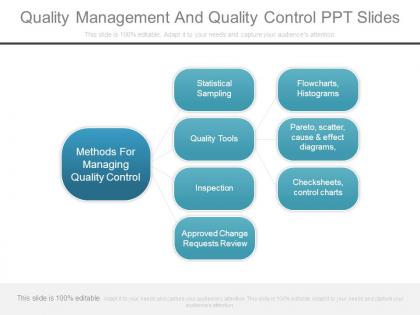
Quality management and quality control ppt slides




Try Before you Buy Download Free Sample Product
 Impress Your
 Audience
 100%
100% Editable
 Save Hours
 of Time


Other people give boring presentations. You use high quality Quality Management And Quality Control Ppt Slides to add perfect design to every project.
People who downloaded this PowerPoint presentation also viewed the following :
Quality management and quality control ppt slides with all 7 slides:
Fulfill demands with our Quality Management And Quality Control Ppt Slides. You will be like a genie to them.



FAQs for Quality management and quality
So basically it's all about putting customers first and never stopping the improvement cycle. Your team knows the actual problems way better than management does - trust me on that one. Get them involved in finding solutions. Map out your main process and see where you're missing good data. That's usually where the quick wins hide. Don't just focus on individual tasks either. Think bigger picture about how everything connects. Oh, and base decisions on real numbers, not hunches. I'd start small though - pick one process that's bugging everyone and work from there.
Leadership buy-in is everything - seriously, if your execs aren't on board, you're dead in the water. Put customers at the center, then get everyone (not just QA) thinking they own quality. Train people on stuff like PDCA cycles so they can actually spot and fix issues themselves. You've gotta measure everything though. Can't improve what you don't track, right? Start with small pilot programs instead of going all-in immediately - that's just asking for chaos. Oh, and celebrate the small wins! People need to see progress or they'll lose steam during the culture shift.
Honestly, leadership makes or breaks quality culture - I've watched so many companies mess this up. The big thing? Leaders can't just talk about wanting quality then lose their minds when problems come up. People need to feel safe reporting issues without getting thrown under the bus. Your leadership team has to actually walk the walk - celebrate quality wins, invest in proper training, give people decent tools. And here's the kicker: they need to reward doing things right over doing things fast. Might sound obvious, but you'd be surprised how backwards most places have their priorities. Start by looking at what leadership actually rewards versus what they claim matters.
Look, data analytics completely flips quality management on its head - you go from playing defense to offense. Instead of waiting for stuff to break, you're spotting patterns in defect rates and predicting problems before they happen. Honestly, the root cause analysis alone makes it worth it. Real-time monitoring catches issues super early too. I'd start small though - grab one quality metric you're already watching and throw together a simple dashboard. Once you see those trends visualized over time, you'll be hooked. It's wild how much clearer everything becomes when the data's right there.
So basically, QA is about setting things up right from the beginning so you don't get defects in the first place. QC happens after - that's when you're testing and inspecting to catch whatever went wrong. I always think of it like... QA is "let's build this process so we don't screw up" and QC is "okay, what did we miss?" QA's more strategic and proactive. QC's reactive, focused on the actual product. You'll need both, but honestly? Get your QA sorted first - it saves you so much headache later.
Hey! So there's a bunch of ways to track this stuff. Post-purchase surveys work great - just ask about their experience and if they'd recommend you. NPS is huge right now (that 0-10 recommendation thing). I'd also keep an eye on complaint volumes and how fast you're responding. Oh, and don't forget social media mentions and online reviews - people love to vent there. Honestly, the trick is staying consistent with whatever methods you pick. Maybe grab 2-3 metrics that actually matter for your business and check them monthly. You'll start seeing patterns pretty quickly.
So basically you'll run into Six Sigma and Lean everywhere - one cuts defects, the other kills waste. SPC charts are your friend for tracking when things go sideways. Root cause stuff is massive, especially "5 Whys" which feels too simple but actually works. Control charts, Pareto analysis for figuring out what to fix first, FMEA for risk stuff. Oh and honestly? Don't get caught up learning every single tool out there. Pick what fits your actual problems. Start with basic SPC and root cause analysis - I swear those two alone will handle like 80% of your quality nightmares.
Make it part of your regular routine instead of some big separate thing. Have everyone spend like 10-15 minutes weekly spotting one annoying thing that's slowing them down. Sounds basic but honestly it works great! Put those quick wins on a board where people can actually see what's happening. Let them test small tweaks right away - don't make them wait for approval on stuff like rearranging their workspace or fixing a process. The whole point is making improvement feel normal, not like you're piling more work on top. Start with one tiny experiment this week.
Honestly, the main thing is you're already swamped and suddenly you're supposed to build quality systems too? Resources are tight. Training costs money, documentation takes forever, and don't even get me started on new software expenses. Your team will probably push back - people hate changing how they work, especially when the old way felt easier. Nobody has time to be the "quality person" so someone's juggling that on top of their real job. Here's what actually works though: just pick one thing to fix first. Don't try revolutionizing everything or you'll burn out fast.
So ISO certification makes you document and standardize everything - sounds tedious but it's actually worth it. You can't just write policies and ignore them (trust me, tried that before). Your whole team gets more accountable since there's actual structure to follow. Customers definitely trust ISO companies more, which opens up opportunities you wouldn't get otherwise. I'd start by mapping what you're already doing - you're probably handling quality stuff informally without realizing it. The audit part keeps you honest too. Just be ready for some paperwork!
Dude, training is seriously the foundation of good quality - without it you're basically screwed from the start. Most quality problems? They trace back to people who just don't know what they're doing. When your team actually understands the processes and what's expected, they'll catch issues before they snowball into major disasters. Here's the thing though - it can't be a one-and-done training session. You need ongoing stuff. I'd start by figuring out where the gaps are in your current setup. Trust me, proper training creates that mindset where quality becomes second nature.
Look, most companies mess this up badly, but here's what actually works: grab feedback from customers, employees, whoever - then don't just stick it in a folder somewhere. Actually dig into the patterns you're seeing. Regular surveys help, suggestion boxes, those monthly review meetings. But here's the thing - and this is where everyone screws up - you've got to circle back and show people their suggestions actually changed something. Otherwise they'll stop caring. Track your numbers before and after making changes so you can prove it worked. Honestly, just pick one feedback method first, nail that process, then add more later.
Think of risk management as your heads-up system for catching quality problems early. You map out what could go wrong with your product, figure out how likely each thing is to happen, then put safeguards in place. Way better than scrambling to fix stuff later - learned that the hard way at my last job. Short version: identify your biggest risks first, assess the damage they'd cause, then tackle those controls. It's honestly just being smart about preventing headaches instead of always putting out fires. Start with whatever keeps you up at night quality-wise.
QMS tech is getting crazy smart these days. AI can actually predict quality problems before they blow up, which honestly saves so much headache. IoT sensors give you real-time monitoring, and everything's moving to the cloud so you can access it anywhere. Remember all that paperwork hell? Most of that's digital workflows now. Machine learning spots patterns in your quality data that you'd totally miss otherwise. The whole industry's shifting from putting out fires to preventing them. I'd start figuring out which digital features could clean up your current mess of processes.
So here's the thing - transparency and safety are huge. Don't mess around with those. When your boss pushes you to cut corners, that's where it gets tricky because you know it might hurt product safety. Fudging quality metrics seems like an easy fix but honestly? It always backfires later. Fair treatment matters too - both for suppliers and your team. Cost pressure is real, I get it, but think about it this way: would you feel okay explaining your quality decisions to customers? Or letting your own family use whatever you're making? That usually tells you everything you need to know.
-
Best way of representation of the topic.
-
Excellent template with unique design.