


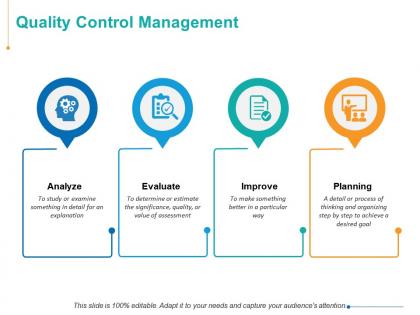
Quality control management ppt powerpoint presentation inspiration deck




Try Before you Buy Download Free Sample Product
 Impress Your
 Audience
 100%
100% Editable
 Save Hours
 of Time


Get appreciated for your artistry with our Quality Control Management Ppt Powerpoint Presentation Inspiration Deck. Your ability acquires an alluring charm
People who downloaded this PowerPoint presentation also viewed the following :
Quality control management ppt powerpoint presentation inspiration deck with all 5 slides:
You are bound to dish out an ace with our Quality Control Management Ppt Powerpoint Presentation Inspiration Deck. Be able to breach their defences.




FAQs for Quality control management ppt powerpoint
So you need solid quality standards first - that's your foundation. Regular inspections and testing come next, plus good documentation (trust me, auditors love that stuff). Train your people so they actually get WHY this matters, not just the steps. Oh and supplier management too - can't forget those guys. Measurement tools are huge because you're basically flying blind without data. Honestly? I'd start by figuring out where your biggest gaps are right now, then focus on whatever could bite you hardest. The corrective action process ties it all together when things go sideways.
So basically you'll want to track defect rates, customer complaints, and how much you're spending on rework - those are the big ones. First-pass yield is solid too. Honestly, the real win is catching problems before customers see them, so measure that. I'd probably throw in cost of quality metrics - like how much you spend preventing issues vs fixing them after the fact. But here's the thing: don't go crazy tracking everything. Pick maybe 3-4 that actually make sense for your situation. Start with whatever's easiest to measure consistently, then add more later. Way better than drowning in data you won't use.
Oh man, training is huge for quality control. Your team needs to actually understand the standards and procedures, not just go through the motions. Think about it - even the fanciest QC system won't help if people don't know how to use it right. I've seen companies blow tons of money on equipment but skip proper training. Bad move. Regular updates keep everyone sharp on new standards too. Focus on your biggest problem areas first when you're setting up training programs. Quality really starts with people knowing their stuff.
QA is about preventing problems before they happen - you're building solid processes from the start. QC is different though. It's more like catching mistakes after the fact through testing and inspections. Here's the thing - you really can't pick just one. QA saves you tons of headaches (and money) down the road, but let's face it, things still break sometimes. That's when QC swoops in to catch issues before customers see them. I'd probably start by figuring out which processes you can tighten up first. Way easier than fixing everything at once.
Dude, you should totally look into AI for quality control - it's actually pretty amazing. Computer vision can scan your products way faster than humans and catch stuff we'd completely miss. The pattern recognition is honestly kind of freaky how good it gets. Plus machine learning can predict equipment failures before they happen, which is huge. Real-time insights mean you can fix issues immediately instead of discovering problems after you've already screwed up whole batches. Oh, and the historical data analysis helps spot quality trends early. I'd say test it on just one production line first though.
Honestly, the worst part is when every department does things differently and you're flying blind without real-time data. Getting teams on board is like herding cats - production always thinks you're slowing them down. Budget fights are constant, plus finding good people is rough. Oh, and regulations keep changing while customers want more for less. Start with standardizing your processes first. Training helps too. But seriously, get leadership backing early or you'll be banging your head against the wall. Communication breakdowns between departments will kill your progress faster than anything else.
Start by collecting feedback from customers through surveys, support tickets, and social media - basically wherever they're complaining. Have your quality team review this stuff monthly alongside production data. Honestly, most companies skip this step but it's gold. Get customer service and QC managers talking regularly about common issues. The trick is actually using the feedback - categorize problems, spot patterns, then update your quality checkpoints based on real customer experiences. Oh, and don't try to do everything at once. Pick one feedback source first, get that working smoothly, then add more channels later.
So Six Sigma and Lean are probably your best bets here. Six Sigma is all about cutting defects using actual data - they have this DMAIC process that's pretty systematic for tackling quality problems. Lean's more about ditching wasteful steps, which ends up improving quality too since you're removing places where things can go wrong. TQM is decent if you want everyone caring about quality, not just one department. Most places I've seen actually mix these approaches instead of going all-in on one. My advice? Figure out what's driving you crazy quality-wise first, then pick whichever method fits that problem best.
Look, continuous improvement and quality control are basically joined at the hip. Your QC has to evolve constantly - you're learning from defects, customer complaints, all that performance data. It's like debugging but for your whole quality system, which honestly sounds way more fun than it actually is. Spot problems, fix them, measure what happens, then do it again. Static quality standards are useless because you'll miss chances to stop issues before they blow up. I'd start checking your QC metrics weekly and look for patterns. What keeps showing up?
Look, catching problems early is where the magic happens - saves you from expensive fixes and angry customers later. Your team stops running around putting out fires all the time. Instead they can actually focus on getting stuff done. Honestly, the workflow becomes so much smoother when you're not constantly stopping to fix things. Everything moves faster too since there's less back-and-forth drama. Resources don't get wasted on cleanup mode anymore. Here's what I'd do first: figure out where most of your problems start. That's usually where you'll see the biggest improvement. It's kind of obvious but people skip this step.
Build a good checklist first - base it on your standards and what you've caught before. Quarterly audits work best, monthly just burns people out (learned that the hard way). Mix up who's doing the auditing so you get different perspectives. Always loop in the process owners during walkthroughs since they actually know where things go wrong. Document stuff right away or you'll forget half of it. Focus on bigger patterns, not random one-off screw-ups. Here's the thing though - follow up on fixes within 30 days or they'll disappear into the void.
So basically, regulatory standards are what your QC processes have to follow - like ISO, FDA rules, whatever applies to your industry. You can't just ignore these things (learned that the hard way once). Map out what you're doing now against the standards first. Then figure out where you're falling short. Regular audits become mandatory, plus you'll need standardized testing and solid record-keeping. It's annoying but necessary. The documentation part is probably where most people mess up.
So for QC stuff, Minitab and JMP are your go-to for statistical analysis and control charts. Six Sigma tools are everywhere - Fishbone diagrams, Pareto charts, plus Visio for process mapping. Most companies use quality management systems like MasterControl or TrackWise to handle documents and CAPA tracking. Excel's still weirdly popular even though there are way better options now. Manufacturing might need gauge R&R software or specialized SPC packages. Oh, and just go with whatever your industry already uses - trust me, don't try being the person who brings in some obscure new tool nobody's heard of.
Honestly, quality can't just be the QC team's problem - everyone needs to own it. Leadership has to walk the walk first though, prioritizing quality over rushing stuff out the door. Your team copies what they see from the top, trust me on this. Train people properly so they actually get WHY quality matters, not just the boring procedures. Way too many companies skip this part then act shocked when nothing works. Celebrate when someone spots an issue or suggests fixes. Never punish people for speaking up about problems - that kills everything fast. Give frontline workers real input on processes. Reward what you want repeated.
Start with the basics first - defect rates, customer complaints, and rework costs. Those show you what's already gone wrong. For the predictive stuff, look at process adherence and how often you're actually doing inspections. First-pass yield is huge since it directly hits your efficiency. Oh, and training completion rates matter more than most people think. I'd definitely track how fast you're fixing quality issues too - speed counts. Honestly, just pick 3-4 metrics that match your biggest headaches right now. You can always add more later once you've got those dialed in.
No Reviews