

Operational Quality Control Powerpoint Presentation Slides




Try Before you Buy Download Free Sample Product
 Impress Your
 Audience
 100%
100% Editable
 Save Hours
 of Time


This Operational Quality Control PowerPoint presentation covers the risk-based approach to quality management. It includes assessing, controlling, communicating, and reviewing quality concerns. The pharmaceutical business can use this ppt since product quality significantly impacts customer health and safety. This template shows details on quality risk assessment with the help of different tools and methodologies for the pharmaceutical industry. It also covers information on the risk tolerance capacity of the stakeholders and a tracker for future risk possibilities. Further, it includes risk assessment processes such as risk identification, analysis and evaluation. Next, it covers the risk control process, such as risk reduction, risk acceptance, and risk control policy, along with risk communication and review processes. This presentation enfolds risk management methodologies such as risk ranking and filtering, fault tree analysis, hazard operability analysis, hazard analysis and critical control point. Further, it comprises failure mode analysis and failure mode, effects and criticality analysis. Lastly, it covers risk tolerance capacity and risk tracker. Download our 100 percent editable and customizable template, which is also compatible with google slides.
People who downloaded this PowerPoint presentation also viewed the following :
Content of this Powerpoint Presentation
Slide 1: This slide displays the title Operational Quality Control.
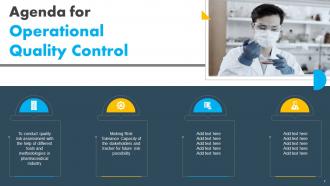
Slide 2: This slide displays the title Agenda.
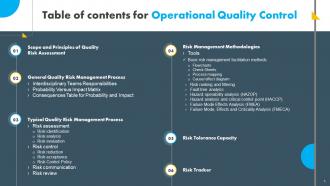
Slide 3: This slide exhibit table of content.
Slide 4: This slide showcase table of content that is to be discuss further.
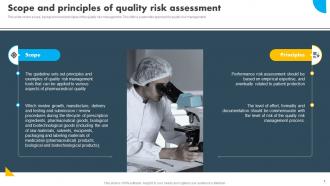
Slide 5: This slide covers scope, background and principles of the quality risk management.
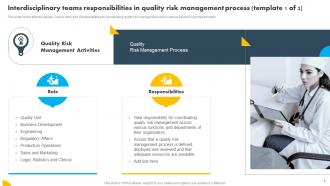
Slide 6: This slide covers Interdisciplinary Teams roles and Responsibilities for coordinating quality risk management across various functions and departments.
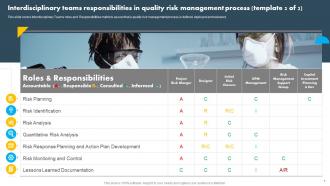
Slide 7: This slide covers Interdisciplinary Teams roles and Responsibilities matrix to assure that a quality risk management process is defined, deployed and reviewed.
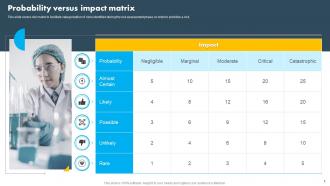
Slide 8: This slide covers risk matrix to facilitate categorization of risks identified during the risk assessment phase. In order to prioritize a risk.
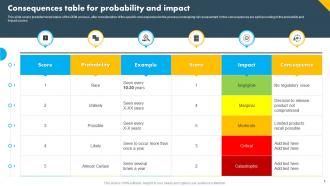
Slide 9: This slide covers predetermined status of the QRM process, after consideration of the specific consequences for the process undergoing risk assessment.
Slide 10: This slide showcase table of content that is to be discuss further.
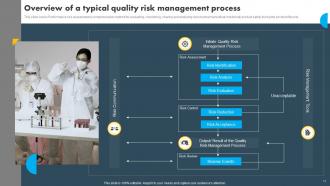
Slide 11: This slide covers Performance risk assessment a comprehensive method for evaluating, monitoring, sharing and analyzing risks to pharmaceutical (medicinal) product.
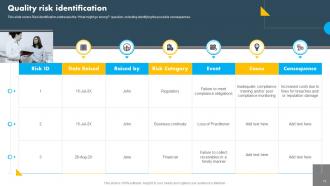
Slide 12: This slide covers Risk identification addresses the “What might go wrong?” question, including identifying the possible consequences.
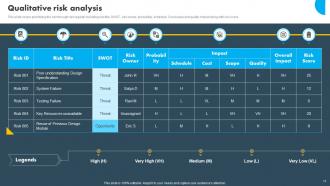
Slide 13: This slide covers prioritizing the risk through risk register including risk title, SWOT, risk owner, probability, schedule.
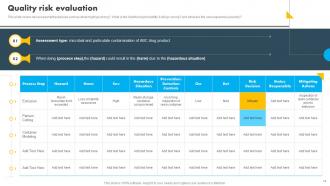
Slide 14: This slide covers risk assessment purposes such as what might go wrong?, What is the likelihood it will go wrong? And what are the consequences(severity)?
Slide 15: This slide showcase table of content that is to be discuss further.
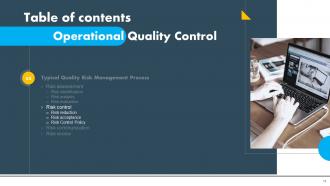
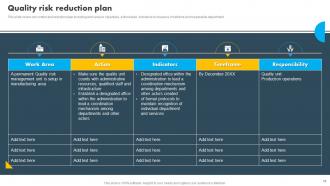
Slide 16: This slide covers risk control and reduction plan including work area or objectives, action taken, indicators to measure, timeframe and responsible department.
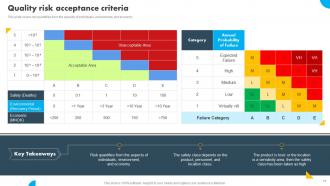
Slide 17: This slide covers risk quantifies from the aspects of individuals, environment, and economy.
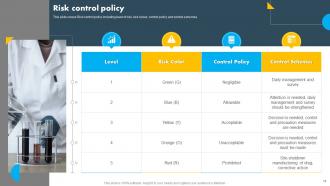
Slide 18: This slide covers Risk control policy including level of risk, risk colour, control policy and control schemes.
Slide 19: This slide showcase table of content that is to be discuss further.
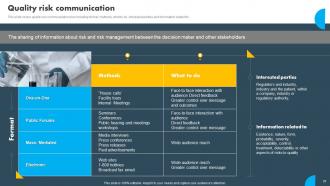
Slide 20: This slide covers quality risk communication plan including format, methods, what to do, interested parties and information related to.
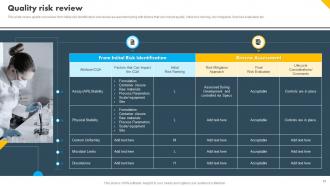
Slide 21: This slide covers quality risk review from initial risk identification and review assessment along with factors.
Slide 22: This slide showcase table of content that is to be discuss further.
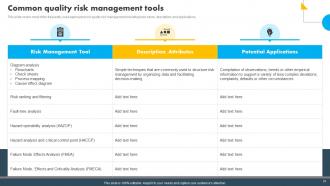
Slide 23: This slide covers most of the frequently used approaches for quality risk management including tools name, description, and applications.
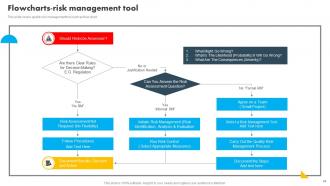
Slide 24: This slide covers quality risk management tool such as flow chart.
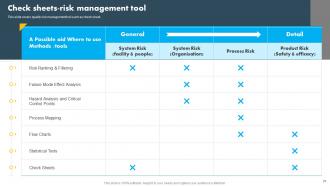
Slide 25: This slide covers quality risk management tool such as check sheet.
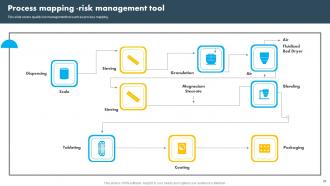
Slide 26: This slide covers quality risk management tool such as process mapping.
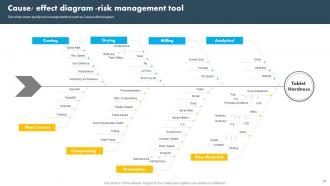
Slide 27: This slide covers quality risk management tool such as Cause/ effect diagram.
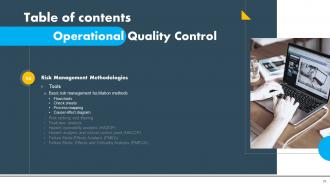
Slide 28: This slide showcase table of content that is to be discuss further.
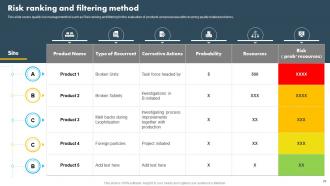
Slide 29: This slide covers quality risk management tool such as Risk ranking and filtering for the evaluation of products and processes with recurring quality related problems.
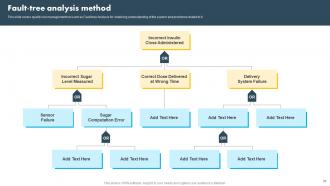
Slide 30: This slide covers quality risk management tool such as Fault-tree Analysis for obtaining understanding of the system and problems related to it.
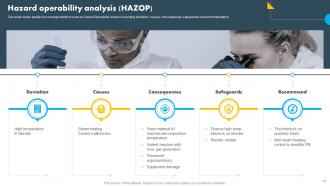
Slide 31: This slide covers quality risk management tool such as Hazard Operability Analysis including deviation, causes, consequences, safeguards and recommendation.
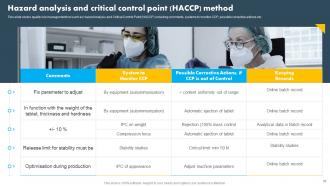
Slide 32: This slide covers quality risk management tool such as Hazard Analysis and Critical Control Point (HACCP).
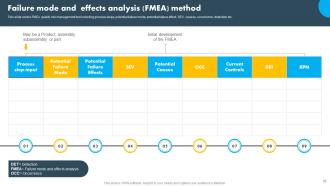
Slide 33: This slide covers FMEA quality risk management tool including process steps, potential failure mode, potential failure effect, SEV, causes, occurrence, detection etc.
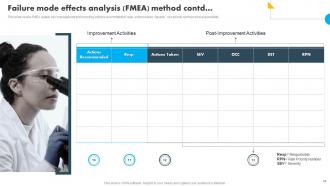
Slide 34: This slide covers FMEA quality risk management tool including actions recommended, resp. actions taken, Severity, risk priority number and responsibility.
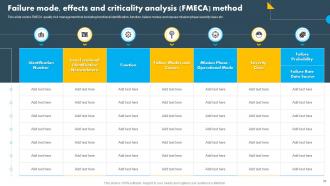
Slide 35: This slide covers FMECA quality risk management tool including functional identification, function, failure modes and causes mission phase severity class etc.
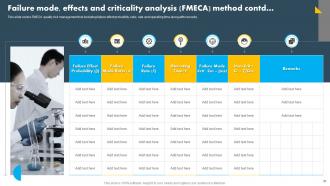
Slide 36: This slide covers FMECA quality risk management tool including failure effect probability, ratio, rate and operating time along with remarks.
Slide 37: This slide showcase table of content that is to be discuss further.
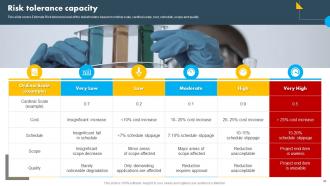
Slide 38: This slide covers Estimate Risk tolerance level of the stakeholders based on ordinal scale, cardinal scale, cost, schedule, scope and quality.
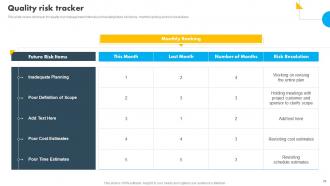
Slide 39: This slide covers risk tracer for quality risk management internal unit including future risk items, monthly ranking and risk resolutions.
Slide 40: This is the icons slide.
Slide 41: This slide presents title for additional slides.
Slide 42: This slide depicts 30-60-90 days plan for projects.
Slide 43: This slide showcase Our target.
Slide 44: This slide shows puzzle for displaying elements of company.
Slide 45: This slide showcase Magnifying glass.
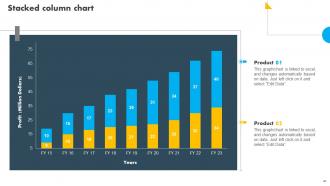
Slide 46: This slide showcase Stacked column chart for different products.
Slide 47: This slide display Venn.
Slide 48: This slide depicts posts for past experiences of clients.
Slide 49: This is thank you slide & contains contact details of company like office address, phone no., etc.
Operational Quality Control Powerpoint Presentation Slides with all 54 slides:
Use our Operational Quality Control Powerpoint Presentation Slides to effectively help you save your valuable time. They are readymade to fit into any presentation structure.






FAQs for Operational Quality Control
So you'll want solid documentation first - like actual SOPs people use, not those binders collecting dust. Real-time monitoring helps catch problems early, plus regular audits to make sure everything's actually working. Training's massive though - your team has to get why quality matters, not just the how-to stuff. Leadership support honestly makes or breaks it (learned that one the hard way). I'd start by mapping where defects usually happen in your current process. That way you're not wasting time fixing things that aren't broken.
Honestly, you need both leading and lagging indicators or you're flying blind. Track stuff like defect rates, first-pass yield, customer complaints, and cost of quality - basically catching problems before customers do. Control charts are clutch for spotting trends instead of just random snapshots. But here's the thing - numbers only tell half the story. Get feedback from your operators and customers too. Pick maybe 3-4 metrics that actually matter to your bottom line first, then build dashboards people will genuinely check every day. Don't overcomplicate it at the start.
Data analytics flips your quality control from putting out fires to actually preventing them. Instead of random sampling, you can focus on the stuff that's most likely to break - way smarter use of your time. The cool part is finding patterns in defect rates and figuring out what variables actually matter (trust me, it's never what you expect). You'll catch problems before they blow up into expensive messes. Honestly, just start small though. Pick one process, collect data for like a month, then see what trends pop out. Don't overthink it at first.
Don't treat quality checks like some separate thing you tack on later - weave them right into what you're already doing. Figure out where things usually go wrong and stick quick verification steps there. Maybe automated alerts, maybe just simple checkpoints. Honestly, if it feels like extra busywork, people won't do it. Train your team to think of it as doing things right the first time instead of fixing messes later. Automate whatever you can with digital tools. Create checklists for the manual stuff. Pick one workflow first, nail that down, then move to the next one.
Honestly, the worst part is dealing with people who just refuse to change. They're so set in their ways! You'll also run into crappy documentation everywhere and never having enough resources to do things right. Oh, and don't get me started on departments that won't talk to each other. Start with small pilot programs instead of going big right away. Get a few influential people on your side first - they'll help sell it to everyone else. Keep your procedures dead simple or people won't bother following them. And pick metrics that actually matter instead of tracking everything under the sun.
Honestly, good training is like giving your team superpowers - they'll spot problems way before they blow up. People start understanding the *why* behind what they're doing, not just mindlessly following steps. That's when things click. They catch defects earlier, stick to protocols better, and actually see how their work fits into everything else. Oh, and they'll actually speak up about issues instead of staying quiet and hoping someone else deals with it. I'd start with whatever processes matter most and focus on real practice over boring classroom stuff.
So QA is basically preventing stuff from going wrong in the first place - you're setting up processes and training people right. QC happens after you've made something, when you're testing and catching defects. Picture QA like building a good fence to keep problems out. QC is more like having guards check everything afterward. Honestly, most companies focus way too much on the QC side. You want both working together though. Better QA upfront means less scrambling to fix things later when you're already behind schedule.
So basically you're always tweaking stuff based on what your data's telling you. Don't just hit your checklist and move on - actually dig into trends and spot where things get stuck. Pick one metric you check weekly and make one tiny improvement monthly from what it shows. Honestly, the feedback loop thing is huge - your quality numbers should drive process changes, which gives you new data to look at. It's kinda like being that detective who won't let a case go cold. You're constantly hunting for the next thing to fix or polish up.
Honestly, compliance runs the whole show now - you can't just figure it out as you go. Everything needs paper trails and documented procedures because regulators want actual proof your stuff works. Super annoying sometimes but it does make you catch problems earlier. Your quality numbers usually get better too since you're tracking everything. I'd start by figuring out which rules actually apply to what you're doing (some don't even matter), then set up your checkpoints around those. Way less headache than trying to retrofit everything later.
Dude, culture really is everything for quality control. Like, if your team doesn't actually care about quality standards, you'll be fighting an uphill battle forever. People need to feel safe reporting problems without getting blamed - that's huge. Leadership has to actually model this stuff, not just talk about it. Celebrate the wins when quality improves and don't treat mistakes like the end of the world. Oh, and here's something most managers skip: just ask your team what's making their job harder quality-wise. You'd be surprised what they'll tell you if they think you're actually listening.
Start with statistical process control software - that's your bread and butter for catching problems before they blow up. Digital dashboards are clutch for real-time monitoring. I swear, once you get used to having everything at your fingertips like that, going back feels like the stone age. Mobile apps and IoT sensors crush manual data collection every time. Oh, and automated inspection systems with ML for predictive stuff? Pretty much expected now. My advice is pick one solid SPC platform first instead of going crazy trying to set up everything simultaneously.
First thing - define what actually went wrong and grab all the data from when it happened. I usually work backwards using the 5 Whys method (honestly way better than those complicated fishbone diagrams). Keep asking "why" until you get past the obvious stuff. Check equipment, procedures, materials, the environment - basically everything that could've caused it. Here's the thing though - don't stop when you find the first issue. There's usually something deeper. Once you nail down the real root cause, fix it and watch to make sure it actually worked. Oh, and write it all down so you're not starting from scratch next time this pops up.
Start with the damage - what broke, how screwed you are, and what happens next. Technical details come after, not before, unless you want everyone checking their phones. Different people need different info though - your CEO doesn't care about the same stuff as the guy actually fixing it. Always end with who's doing what by when. I've sat through way too many meetings where everyone just stares at each other afterward like "okay... so now what?" The reports that actually work tell a story with simple charts instead of data-dumping everywhere.
Stop treating quality checks like some separate thing you do at the end. Build them right into your regular workflow instead. Set up automated monitoring so you catch problems early - way cheaper than fixing stuff later, trust me. Don't waste time checking everything equally though. Focus your manual reviews on the riskiest parts only. Train your team to actually notice issues while they're working, not just blast through tasks. First step? Map out where defects usually happen in your current setup, then add preventive stuff at exactly those spots.
Focus on the big four first: defect rates, cycle times, first-pass yield, and customer complaints. Equipment downtime and rework costs are solid additions - they're like canaries in the coal mine, spiking before everything goes sideways. Don't sleep on leading indicators either, stuff like supplier quality scores and training completion rates. Honestly, the real trick isn't picking metrics, it's getting people to actually look at them. Daily dashboards work way better than those weekly reports everyone ignores. Start with maybe 5-7 metrics tops, then add more once it becomes routine.
-
Happy to found you SlideTeam. You guys are value for money. Amazing slides.
-
I am glad to have come across Slideteam. I was searching for some unique presentations and templates for my business. There are a lot of alternatives available here.