


QRM powerpoint presentation slides





Try Before you Buy Download Free Sample Product
 Impress Your
 Audience
 100%
100% Editable
 Save Hours
 of Time


This QRM PowerPoint presentation covers the risk based approach to quality management. It includes assessing controlling communicating and reviewing quality concerns. The pharmaceutical business can use this ppt since product quality significantly impacts customer health and safety. This template shows details on quality risk assessment with the help of different tools and methodologies for the pharmaceutical industry. It also covers information on the risk tolerance capacity of the stakeholders and a tracker for future risk possibilities. Further it includes risk assessment processes such as risk identification analysis and evaluation. Next it covers the risk control process such as risk reduction risk acceptance and risk control policy along with risk communication and review processes. This presentation enfolds risk management methodologies such as risk ranking and filtering fault tree analysis hazard operability analysis hazard analysis and critical control point. Further it comprises failure mode analysis and failure mode effects and criticality analysis. Lastly it covers risk tolerance capacity and risk tracker. Download our 100 percentage editable and customizable template which is also compatible with google slides.
People who downloaded this PowerPoint presentation also viewed the following :
Content of this Powerpoint Presentation
Slide 1: This slide displays the title QRM.
Slide 2: This slide displays the title Agenda for QRM.
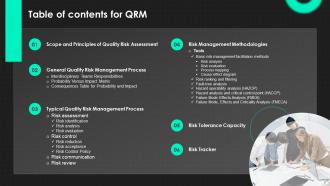
Slide 3: This slide exhibit table of content.
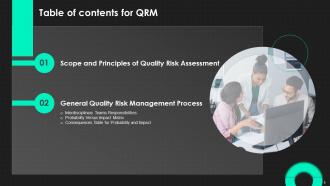
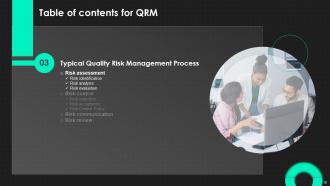
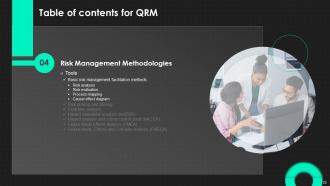
Slide 4: This slide showcase table of content that is to be discuss further.
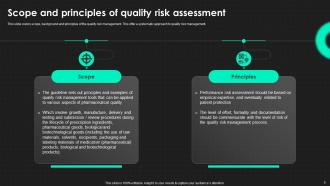
Slide 5: This slide covers scope, background and principles of the quality risk management.
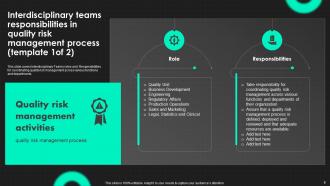
Slide 6: This slide covers Interdisciplinary Teams roles and Responsibilities for coordinating quality risk management across various functions and departments.
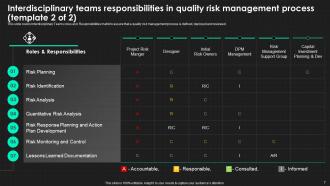
Slide 7: This slide covers Interdisciplinary Teams roles and Responsibilities matrix to assure that a quality risk management process is defined, deployed and reviewed.
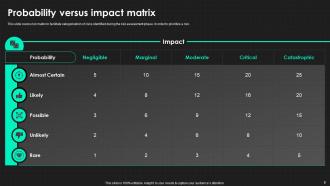
Slide 8: This slide covers risk matrix to facilitate categorization of risks identified during the risk assessment phase.
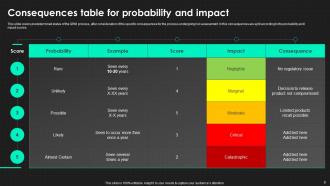
Slide 9: This slide covers predetermined status of the QRM process, after consideration of the specific consequences for the process undergoing risk assessment.
Slide 10: This slide showcase table of content that is to be discuss further.
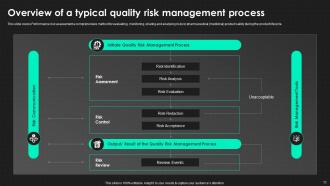
Slide 11: This slide covers Performance risk assessment for evaluating, monitoring, sharing and analyzing risks to pharmaceutical product safety during the product lifecycle.
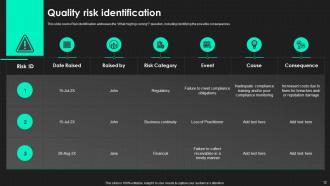
Slide 12: This slide covers Risk identification addresses the “What might go wrong?” question, including identifying the possible consequences.
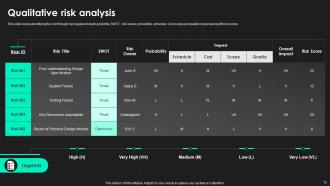
Slide 13: This slide covers prioritizing the risk through risk register including risk title, SWOT, risk owner, probability, schedule.
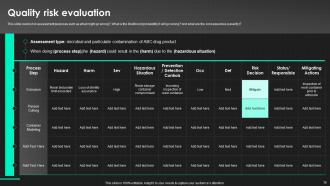
Slide 14: This slide covers risk assessment such as what might go wrong?, What is the likelihood (probability) it will go wrong? And what are the consequences (severity)?
Slide 15: This slide showcase table of content that is to be discuss further.
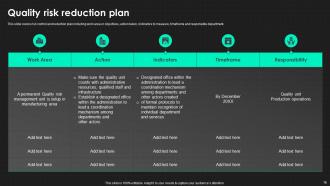
Slide 16: This slide covers risk control and reduction plan including work area or objectives, action taken, indicators to measure, timeframe and responsible department.
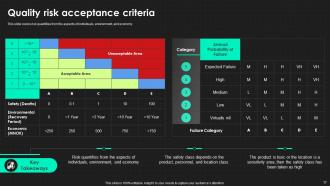
Slide 17: This slide covers risk quantifies from the aspects of individuals, environment, and economy.
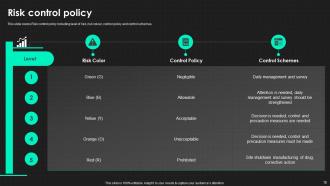
Slide 18: This slide covers Risk control policy including level of risk, risk colour, control policy and control schemes.
Slide 19: This slide showcase table of content that is to be discuss further.
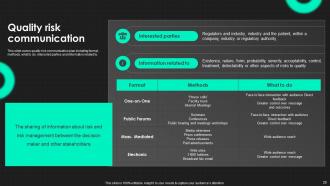
Slide 20: This slide covers quality risk communication plan including format, methods, what to do, interested parties and information related to.
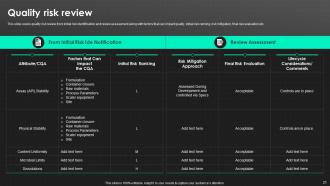
Slide 21: This slide covers quality risk review from initial risk identification and review assessment along with factors that can impact quality, initial risk ranking.
Slide 22: This slide showcase table of content that is to be discuss further.
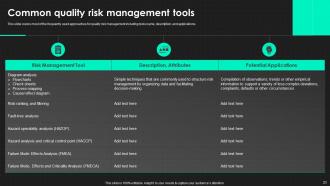
Slide 23: This slide covers most of the frequently used approaches for quality risk management including tools name, description, and applications.
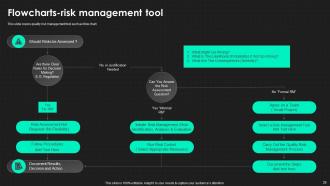
Slide 24: This slide covers quality risk management tool such as flow chart.
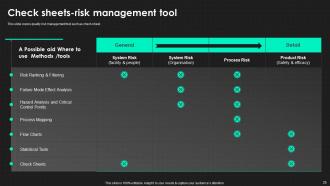
Slide 25: This slide covers quality risk management tool such as check sheet.
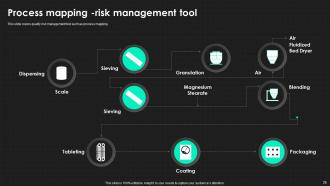
Slide 26: This slide covers quality risk management tool such as process mapping.
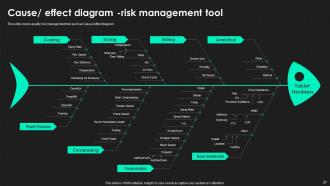
Slide 27: This slide covers quality risk management tool such as Cause/ effect diagram.
Slide 28: This slide showcase table of content that is to be discuss further.
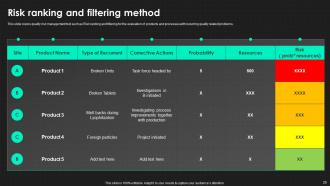
Slide 29: This slide covers quality risk management tool such as Risk ranking and filtering for the evaluation of products and processes with recurring quality related problems.
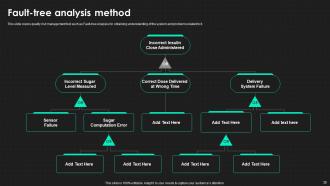
Slide 30: This slide covers quality risk management tool such as Fault-tree Analysis for obtaining understanding of the system and problems related to it.
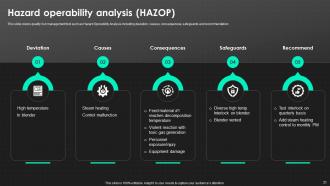
Slide 31: This slide covers quality risk management tool such as Hazard Operability Analysis including deviation, causes, consequences, safeguards and recommendation.
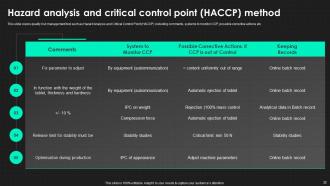
Slide 32: This slide covers quality risk management tool such as Hazard Analysis and Critical Control Point (HACCP) including comments, systems to monitor CCP.
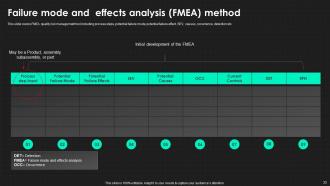
Slide 33: This slide covers FMEA quality risk management tool including process steps, potential failure mode, potential failure effect, SEV, causes, occurrence, detection etc. This slide is 100% editable. Adapt it to your needs & capture your audience’s attention.
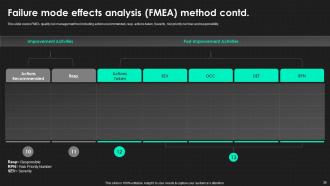
Slide 34: This slide covers FMEA quality risk management tool including actions recommended, resp. actions taken, Severity, risk priority number and responsibility.
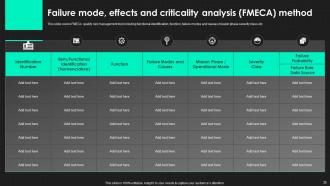
Slide 35: This slide covers FMECA quality risk management tool including functional identification, function, failure modes and causes mission phase severity class etc.
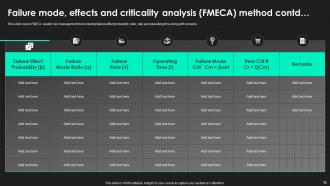
Slide 36: This slide covers FMECA quality risk management tool including failure effect probability, ratio, rate and operating time along with remarks.
Slide 37: This slide showcase table of content that is to be discuss further.
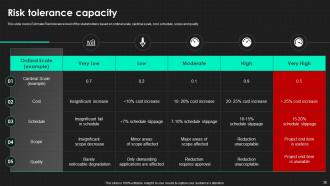
Slide 38: This slide covers Estimate Risk tolerance level of the stakeholders based on ordinal scale, cardinal scale, cost, schedule, scope and quality.
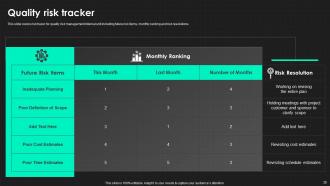
Slide 39: This slide covers risk tracer for quality risk management internal unit including future risk items, monthly ranking and risk resolutions.
Slide 40: This is the icons slide.
Slide 41: This slide presents title for additional slides.
Slide 42: This slide shows about your company, target audience and its client's values.
Slide 43: This slide depicts 30-60-90 days plan for projects.
Slide 44: This slide depicts posts for past experiences of clients.
Slide 45: This slide display SWOT analysis.
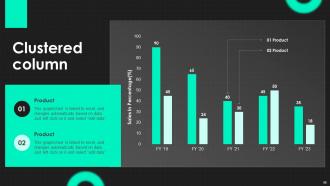
Slide 46: This slide showcase Clustered column for different product.
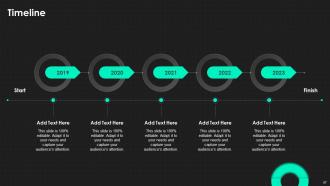
Slide 47: This slide exhibit Timeline.
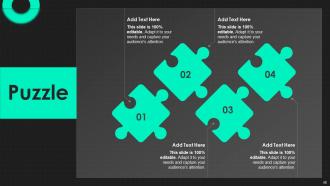
Slide 48: This slide shows puzzle for displaying elements of company.
Slide 49: This slide showcase the title Our team
Slide 50: This slide exhibits ideas generated.
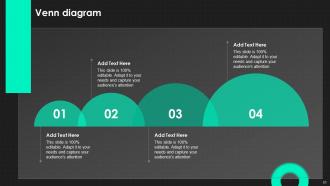
Slide 51: This slide display Venn diagram
Slide 52: This slide display Target.
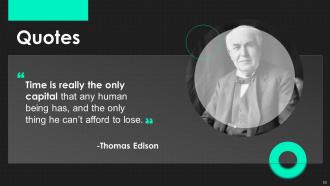
Slide 53: This slide showcase the title Quotes.
Slide 54: This slide showcase Circular process.
Slide 55: This is thank you slide & contains contact details of company like office address, phone no., etc.
QRM powerpoint presentation slides with all 60 slides:
Use our QRM powerpoint presentation slides to effectively help you save your valuable time. They are readymade to fit into any presentation structure.









FAQs for QRM
So QRM is all about cutting lead times and getting faster at responding to what customers want. Basically you're trying to shrink that gap between when someone orders something and when it actually shows up at their door. Sounds easy but honestly it gets messy pretty quick. The whole thing focuses on ditching time-wasting steps, smoothing out workflow, and building manufacturing cells that can pivot when things change. Speed becomes way more important than your typical efficiency numbers. I'd start by actually mapping out your current lead times - you'll probably be surprised where the biggest bottlenecks are hiding.
So QRM basically flips manufacturing upside down - instead of obsessing over costs, you're obsessing over speed. Traditional methods want big batches to keep machines humming along efficiently. QRM says screw that, make smaller batches but get them out way faster. Time becomes your most precious resource, not machine utilization or whatever. It's honestly pretty counterintuitive at first. You'll want to start tracking lead times like crazy if you're serious about switching. The whole point is responding to customers quickly rather than just being "efficient" in the old-school sense.
Lead time is basically everything in QRM - the whole thing centers around it. Cut your lead times and you'll see less variability, better quality, plus you become way more responsive to what customers actually want. Less inventory sitting around too, which is always good. QRM treats lead time as the main metric because honestly? It tells you more about how your system's really doing than those old efficiency numbers. I'd start by mapping out your current lead times first. Then hunt down your worst bottlenecks - that's where you'll see the biggest wins right off the bat.
First thing - map out what you're doing now and find where stuff gets stuck. That's your gold mine. QRM is weird because you focus on speed over saving money, but trust me it works. Set up small teams from different departments who can actually make calls without asking their boss's boss's boss (you know how that goes). Measure everything by time instead of those usual efficiency numbers. Oh, and don't try to fix everything at once - pick one product line or department first. Once you've got some wins to show off, then roll it out everywhere else.
So QRM is basically patient safety first, always. Use actual data to make decisions instead of just winging it. Map your risk levels and respond proportionally - don't go overboard on low-risk stuff. Build quality into your processes from day one rather than trying to fix things later (trust me, way less painful). Cross-functional teams work better than silos. Oh, and be proactive about spotting issues before they blow up. Keep improving based on what you learn. I'd start by looking at your current risk assessment and see where these fit in systematically.
So QRM flips the whole supply chain thing on its head - you're chasing speed instead of just cheap prices. Map out your lead times first, that's where you'll spot the biggest opportunities. Work with fewer suppliers but pick the reliable ones who can pivot fast when stuff hits the fan. I mean, something always goes wrong, right? Focus on flexibility over rock-bottom costs. You'll end up redesigning processes to kill bottlenecks and adding buffer capacity in the right spots. Honestly, it's way more about responsiveness than traditional cost-cutting approaches.
Lead time reduction is huge - that's your main one. Setup times and inventory turns too. Those show if you're actually getting faster. Customer delivery performance matters obviously, plus manufacturing critical ratios since they prove your speed gains are helping service. Honestly? Companies obsess over utilization rates but it's kinda misleading with QRM. Better to focus on time compression and flow instead of just efficiency. Oh, and baseline your current lead times first - I learned that the hard way. Then you can track improvements each month and actually see what's working.
Honestly, just start by getting rid of all those paper forms - that alone will save you hours. Risk management software lets you dump everything into one dashboard so you're not hunting through folders constantly. The automated scoring is pretty solid these days, plus it'll catch stuff you'd probably overlook when you're rushing. I'd avoid the fancy AI features at first though - your team needs time to adjust. Workflows are clutch for staying on top of reviews without having to bug everyone constantly. Once people get the hang of it, you can add the more advanced tools. Way less headache than doing it all manually.
Honestly, the two big headaches are gonna be your team fighting the change and not having enough budget. People hate switching from batch work to flow-based stuff - it freaks them out. Plus you'll need money upfront for training and maybe new equipment. Leadership can be annoying too since they want instant results, but QRM takes months to show the lead time improvements. Oh, and definitely start small with just one area first. Way easier to prove it works there before your whole company has to deal with it.
Look, if your people aren't engaged with QRM, you're basically dead in the water. The whole thing only works when employees actually care and start spotting problems themselves. I've watched so many companies bomb at this because they just handed down orders from above - huge mistake. Your team needs to feel like they own it too, not like it's some corporate nonsense being forced on them. Get them involved early on. Explain what's in it for them personally, because honestly? Nobody cares about profit margins except executives. When people are genuinely invested, they become your best troubleshooters.
Honestly, QRM crushes it in aerospace, medical devices, and custom machinery - basically anywhere you're doing high-mix, low-volume stuff. Job shops absolutely love it too. Electronics manufacturing gets huge wins, especially for prototypes and shorter runs. The messier and more customized your products are, the better QRM works. Which probably explains why everything feels so chaotic right now! You'll want to start with whatever has your worst lead times. That's where you'll see the biggest improvements and actually get your boss excited about it. Trust me on this one.
So QRM catches quality problems before they hit your customers - which is huge because nobody wants broken stuff, obviously. Your customers start trusting you more when things actually work. Here's the cool part though: you can track complaint patterns and fix the real problems instead of just slapping temporary fixes on everything. Honestly, I think of it like having a heads-up before disaster strikes. The trick isn't just collecting data - you've got to actually use it to improve your processes. Start by figuring out where customers get most frustrated, then set up quality checks at those exact spots.
Yeah, QRM has worked really well for some big names. Harley-Davidson cut their engine assembly lead times by 75% - that's huge. Parker Hannifin went from weeks to just days for manufacturing cycles. Boeing did something similar with their supply chain response times. Oh, and it's not just manufacturing either - service companies have jumped on this too. The pattern you see everywhere? Way shorter lead times and better customer response. If you're thinking about trying it, I'd start by figuring out where your biggest bottlenecks are right now. That's honestly where you'll see results fastest.
Yeah, totally doable even when you're strapped for cash! Smaller companies actually have an edge here - you can pivot way faster than big corporations. Map out where things get stuck first, then hunt down your worst time sucks (there's always some ridiculous bottleneck nobody talks about). Quick wins are your friend: cut setup times, teach people multiple jobs, fix whatever process you do most often. QRM doesn't need fancy equipment, just thinking differently about time. Pick one product line to test it on. Measure before and after, then copy what works everywhere else.
Honestly, training makes or breaks QRM implementation. Most people are stuck in that old batch-and-queue mindset, so without proper training they'll just keep doing things the same way. Leadership needs to go first - can't expect workers to buy in if management doesn't get it. Then roll it down to operators. Skip the boring theory stuff though. Use hands-on simulations and examples from your actual workplace. I've watched so many companies think people will just pick it up naturally... spoiler alert: they won't. Focus on flow principles and lead time reduction. Oh, and don't forget the cultural piece - QRM isn't just technical changes.
-
Perfect template with attractive color combination.
-
“I've always gotten excellent slides from them and the customer service is up to the mark.”