


ISO 9001 Standard Powerpoint Presentation Slides





Try Before you Buy Download Free Sample Product
 Impress Your
 Audience
 100%
100% Editable
 Save Hours
 of Time


ISO 9001 is used to determine if the Quality Control Program in place is appropriate and efficient, thus pushing the company to recognize and incorporate improvements. Here is an efficiently designed template on ISO 9001 Standard that is useful for the company to create and integrate a quality management system in compliance with the requirements of the new standard and allow an audit carried out by a Certification Body CB or Registrar to assess the performance of the QMS against the current ISO 9001 standard. This template covers the firms current situation, which includes problems in management procedures, causes of financial loss, etc. It also consists of the ISO 9001 implementation process, such as creating an Implementation Programme, appointing MR and establishing a team, and gap assessment. It also includes Registrar Selection Process and Agreement for Quality Management System Registration. In this template, we have also included Business Internal Audits, Management Review and corrective actions, Root Causes to the Problem, and its Solutions. It also covers Process based QMS Structure, Performance or Process View of Systems, and Results after Implementation of ISO 9001 Quality Systems along with Quality Management System Dashboards, ISO 9001 QMS Dashboards, etc. Download it now.
People who downloaded this PowerPoint presentation also viewed the following :
Content of this Powerpoint Presentation
Slide 1: This slide introduces ISO 9001 Standard. State your company name and begin.
Slide 2: This slide states Agenda of the presentation.
Slide 3: This slide presents Table of Content for the presentation.
Slide 4: This slide highlights title for topics that are to be covered next in the template.
Slide 5: This slide shows reasons to implement ISO 9001 certification in company.
Slide 6: This slide displays causes of financial losses on the firm due to low or no quality management system such as no client interactions and process management.
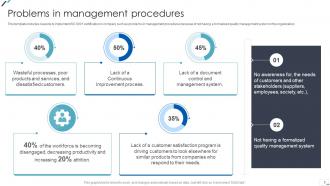
Slide 7: This slide represents old traditional and functional view of the business system which was causing problems such as wasteful processes, poor products and services.
Slide 8: This slide shows reasons why firm want to be ISO certified such as enhanced business prospects, improved internal processes and improved profile or credibility.
Slide 9: This slide highlights title for topics that are to be covered next in the template.
Slide 10: This slide shows ISO 9001 certification implementation program including activity, description, participants, etc.
Slide 11: This slide displays quality management ISO 9001 twelve months implementation plan.
Slide 12: This slide represents appointing manager and establishing team by preparing a charter including team members, core values, etc.
Slide 13: This slide shows appointing manager and establishing team by preparing a charter.
Slide 14: This slide presents employee training schedule for ISO 9001 certification quality standards and business processes.
Slide 15: This slide shows gap in Management Procedures of the firm including company’s current situation, ideal situation, etc.
Slide 16: This slide highlights title for topics that are to be covered next in the template.
Slide 17: This slide represents checklist for documentation required to get ISO 9001 and quality management Certification.
Slide 18: This slide shows quality standards documentation pyramid along with documenting the process such as records, work instructions, etc.
Slide 19: This slide presents documentation process map for the organization used to manage the quality framework.
Slide 20: This slide shows Registrar Selection Process.
Slide 21: This slide displays agreement from the registrar which defines the rights and obligations of the involved parties.
Slide 22: This slide highlights title for topics that are to be covered next in the template.
Slide 23: This slide shows quality management principals such as customer focus, leadership, engagement of people, etc.
Slide 24: This slide presents Defining and assigning the requirements which highlights the relationship between production and administrative support inside the organization.
Slide 25: This slide shows quality management methodological design framework.
Slide 26: This slide displays quality management software specifications including number of occurrences, scope and purpose.
Slide 27: This slide represents quality management software design as an artifact including company's QMS statement, comparison, quality index, etc.
Slide 28: This slide shows normative requirements in ISO 9001, requirements or checklist for quality audit and statements about QMS.
Slide 29: This slide presents quality procedures scorecard including Index by section, quality management system company’s statements, etc.
Slide 30: This slide shows QMS evaluation methods including sections such as functional testing, controlled experiment, etc.
Slide 31: This slide highlights title for topics that are to be covered next in the template.
Slide 32: This template represents business internal audits table including issues, effects, action, results and final status.
Slide 33: This slide shows business Management Review and corrective actions for implementing ISO 9001 standards.
Slide 34: This slide presents root cause Problems of the organization and its Solutions after for successful implementation of the ISO 9001 standards.
Slide 35: This slide highlights title for topics that are to be covered next in the template.
Slide 36: This slide displays pre registration audit procedures including pre assessment , audit plan, establish registration scope, etc.
Slide 37: This slide represents registration audit stage one and two including audit plan, team pre audit meeting, etc.
Slide 38: This slide shows post audit registration procedures including reporting, corrective action plan and evidence, etc.
Slide 39: This slide highlights title for topics that are to be covered next in the template.
Slide 40: This slide shows process based quality management system model including continual improvement, resource management, etc.
Slide 41: This slide displays new and organized Performance or Process View of Systems after achieving quality standards.
Slide 42: This slide represents results of implication QMS ISO 9001 certification such as increasing customer satisfaction, operational efficiency, etc.
Slide 43: This slide highlights title for topics that are to be covered next in the template.
Slide 44: This slide presents Quality management system dashboard including KPI’s such as summary details, customer complaints, etc.
Slide 45: This slide shows Quality management system dashboard including KPI’s such as risk rating, risk matrix, suppliers rating, etc.
Slide 46: This slide displays Quality management system dashboard including KPI’s such as outstanding actions, scheduled audits, etc.
Slide 47: This slide contains all the icons used in this presentation.
Slide 48: This slide is titled as Additional Slides for moving forward.
Slide 49: This is About Us slide to show company specifications etc.
Slide 50: This is Our Mission slide with related imagery and text.
Slide 51: This is Our Team slide with names and designation.
Slide 52: This slide displays Column chart with two products comparison.
Slide 53: This is a Timeline slide. Show data related to time intervals here.
Slide 54: This slide depicts Venn diagram with text boxes.
Slide 55: This slide shows SWOT describing- Strength, Weakness, Opportunity, and Threat.
Slide 56: This is a Thank You slide with address, contact numbers and email address.
ISO 9001 Standard Powerpoint Presentation Slides with all 61 slides:
Use our ISO 9001 Standard Powerpoint Presentation Slides to effectively help you save your valuable time. They are readymade to fit into any presentation structure.










FAQs for ISO 9001 Standard
Honestly, the biggest thing you'll notice is way better process control - everything becomes more consistent. Documenting all your procedures cuts down on errors big time, and customers eat up that certification. It's basically a stamp that says "we have our stuff together." Your team will actually like having clear roles too. The audit part sucks at first, not gonna lie, but once you're in the groove it makes life easier. Management gets solid data to work with instead of guessing. Oh, and definitely map out what you're already doing before jumping in - saves headaches later.
Look, ISO 9001 is basically proof you're not winging it with quality control. Third-party verification beats you just telling customers "we're awesome, trust us" - way more credible. Your processes get documented properly, which customers love because it means less risk for them. The whole certification thing actually makes you fix your complaint handling too, which is honestly overdue for most companies. You'll probably see your satisfaction scores bump up afterward. My advice? Map out what you're already doing first - might be closer than you think. Don't dive in blind.
So ISO 9001 has seven main principles you should know about. Customer focus is the obvious big one, plus leadership engagement and getting your people involved. The process approach is huge too - instead of thinking in departmental boxes, you map how work actually flows (this was a game-changer when I first saw it done right). Evidence-based decisions, continuous improvement, and supplier relationship management round out the seven. Oh, and definitely start by mapping your current processes first - you'll spot exactly where these principles fit way easier that way.
Start your prep about 2-3 months out with an internal audit to catch any gaps. Review all your documented processes and make sure records are complete and easy to find. Train your team on what's coming - the auditor interviews freak people out but they're really not that bad. Everyone should know their role and how their work connects to the QMS. Oh, and be upfront about any issues you've discovered and how you fixed them. Honestly, transparency goes way further than trying to hide stuff. Create a checklist covering all ISO 9001 requirements so you can prove compliance for each one.
Honestly, the paperwork alone will make you want to quit - ISO documentation is no joke. Getting people to actually care is your real battle though. Most employees think it's just corporate BS and will drag their feet. Leadership buy-in is crucial, otherwise you're dead in the water. Resource allocation gets tricky too, especially finding time for proper training when everyone's already swamped. The certification process drags on forever, so momentum dies fast. Start with small wins to keep morale up. Oh, and don't underestimate how long everything takes - I learned that the hard way.
Honestly, ISO 9001 is like a cheat code for landing bigger clients. Those corporate types eat up quality certifications - that little logo on your proposals does serious work. Sure, the documentation process is kinda painful at first, but once you're in the groove it actually streamlines things. Competitors without it? They look amateur by comparison. The best part is you can bump your rates because clients automatically see you as more legit. Oh, and definitely start with a gap analysis - sounds fancy but it just shows you what needs fixing. Then maybe grab a consultant to fast-track the whole thing.
Look, ISO 9001 makes improvement automatic by forcing you into habits. Management has to meet regularly and actually analyze what's broken - not just rubber-stamp everything. You'll be doing internal audits, tracking metrics, and dealing with customer complaints whether you want to or not. The whole thing runs on that Plan-Do-Check-Act cycle, so you're always adjusting something. Honestly, it can feel like a lot at first. But here's what works: pick the one process that drives everyone crazy and use ISO's structure to fix it systematically. That's your starting point.
So ISO 9001 is like the universal quality standard - works for literally any business, which is pretty cool. Other standards get super picky about technical stuff (AS9100 for aerospace, ISO 13485 for medical). But 9001? It just cares about your processes and keeping them consistent. Think "prove your system actually works" instead of checking off a million specific boxes. You could be making apps or pizza and it'd still fit. Honestly, if you're new to this whole quality thing, start here first. You can always pile on the industry-specific ones later when you hate yourself more.
Dude, training your people is honestly what makes or breaks ISO 9001. Without it, you're just creating fancy binders that nobody uses. I've watched companies bomb their audits because they thought they could skip this step - big mistake. Your employees need to get the "why" behind procedures, not just memorize steps like robots. Once they understand the reasoning, they'll actually care about following through. Plus engaged workers become your biggest advocates for quality instead of fighting you on everything. Focus on your main processes first and build from there. Trust me, it's worth the upfront effort.
Honestly, the right software can save you so much ISO 9001 pain. Document management systems are a lifesaver - they keep everything in one spot with automatic version control. No more "wait, is this the latest procedure?" moments. Workflow tools help track your corrective actions and audits so stuff doesn't slip through. Digital forms handle the boring compliance tasks automatically. Pick something that actually works with how your team operates, not the shiniest option. I'd start with just one process first. My old company tried to do everything at once and it was a mess.
So for ISO 9001 metrics, definitely focus on customer satisfaction scores and internal audit findings first. Corrective action closure rates are huge too - auditors love seeing those numbers. Process stuff like defect rates and on-time delivery should be next on your list, plus cycle times if they matter for your business. Training completion rates are surprisingly critical (learned that one the hard way during our last audit). Honestly, most places forget about tracking management review effectiveness and supplier performance, but you'll want those covered. Pick maybe 5-7 that actually tie to your quality objectives. Don't go overboard tracking everything - you'll burn out your team.
So you gotta do internal audits at least once a year to hit your whole QMS - that's the minimum. Most places I've seen don't do one giant audit though, they break it up quarterly or even monthly. Way less painful that way. The standard just says "at planned intervals" so you've got wiggle room to figure out what works. Could be different processes each quarter, whatever makes sense for your setup. Just make sure everything gets covered in that 12-month window. Oh and definitely put together an actual schedule - auditors eat that stuff up when they see you're organized about it.
So documentation is basically your receipts for ISO 9001 - proof you're actually doing what you claim. Auditors want to see real evidence of your processes and procedures, not just empty promises. Map out your critical processes first, then build docs around those. Don't create busywork though - focus on stuff that actually matters for quality control. I learned this the hard way at my last job where we had documentation for everything, even how to make coffee (okay slight exaggeration). Your paperwork should support your workflow, not slow it down.
Yeah totally! All three work together really well actually - ISO 9001, 14001, and 45001 use the same basic framework so you're not reinventing the wheel each time. Document control, audits, management reviews... they all overlap anyway. Way more efficient than running three separate systems (learned this the hard way at my last job). Most companies save money doing it integrated. I'd map out your core processes first and see where they naturally connect - that's where you'll get the biggest wins. Short answer: definitely do it.
Honestly, ISO 9001 is like a trust badge that just keeps paying off. Customers see it and immediately think "okay, these people have their act together." It's especially clutch when you're bidding on contracts - people recognize that standard everywhere. The cool thing is it builds momentum over time too. Each year you maintain it, stakeholders get more confident you're actually committed to quality, not just faking it. My buddy's company saw way more partnership opportunities once they got certified. Oh, and definitely start tracking some reputation metrics now so you can actually see the impact happening.
-
I want to thank SlideTeam for the work that they do, especially their customer service.
-
This visual representation is stunning and easy to understand. I like how organized it is and informative it is.