


Display Advertising Models And Its Targeting Strategies Powerpoint Presentation Slides MKT CD V





Try Before you Buy Download Free Sample Product
 Impress Your
 Audience
 100%
100% Editable
 Save Hours
 of Time


Our Display Advertising Models and Targeting Strategies deck is a comprehensive resource that explores the world of display advertising and its significant role in digital marketing. This Display Advertising deck provides a thorough overview of display advertising, its importance in reaching and engaging the target audience, and the challenges associated with its implementation. It covers various types of display advertising, including banner ads, desktop and mobile leaderboard ads, paid search advertising, native ads, display ads, and programmatic display advertising, offering a comparative analysis of their effectiveness. Additionally, our Display Advertising Strategy presentation delves into buying models, options, and bidding processes in display advertising, helping businesses make informed decisions. Moreover, it offers a strategy and implementation plan for successful display advertising campaigns, enabling organizations to maximize their marketing efforts. Lastly, the module includes dashboards that facilitate the measurement and evaluation of display advertising campaign performance, allowing businesses to track their success and optimize future campaigns. Download this guide now to gain valuable insights and drive your organizations digital marketing success. Get access now.
People who downloaded this PowerPoint presentation also viewed the following :
Content of this Powerpoint Presentation
Slide 1: This slide displays the title Display advertising models and its targeting strategies.
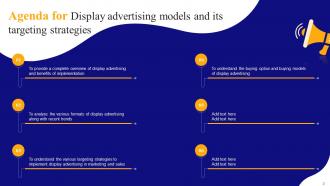
Slide 2: This slide displays the title Agenda complete overview of the role of display advertising in online marketing.
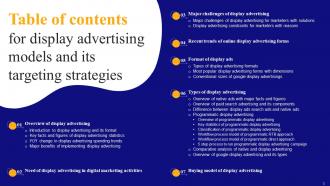
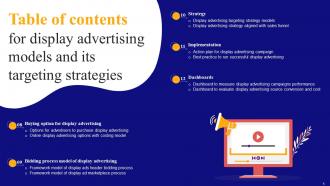
Slide 3: This slide exhibit table of content.
Slide 4: This slide exhibit table of content.
Slide 5: This slide exhibit table of content- Overview of display advertising.
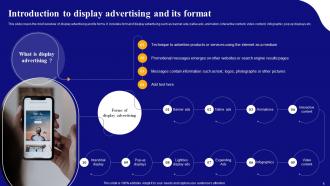
Slide 6: This slide covers the brief overview of display advertising and its forms.
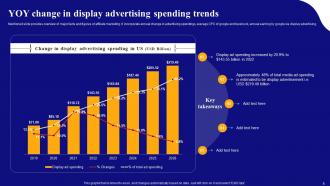
Slide 7: Mentioned slide provides overview of major facts and figures of affiliate marketing.
Slide 8: Mentioned slide provides overview of major facts and figures of affiliate marketing.
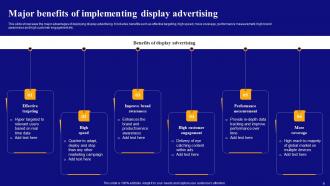
Slide 9: This slide showcases the major advantages of deploying display advertising.
Slide 10: This slide exhibit table of content- Need of display advertising in digital marketing activities.
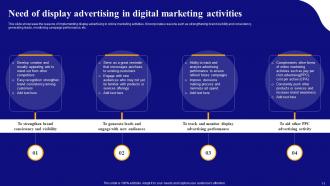
Slide 11: This slide showcases the reasons of implementing display advertising in online marketing activities.
Slide 12: This slide exhibit table of content- Major challenges of display advertising.
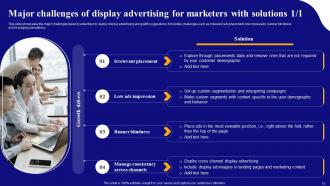
Slide 13: This slide showcases the major challenges faced by advertiser to deploy display advertising along with suggestions.
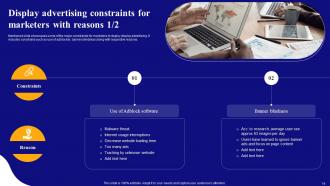
Slide 14: Mentioned slide showcases some of the major constraints for marketers to deploy display advertising.
Slide 15: This slide exhibit table of content- Recent Trends of online display advertising forms.
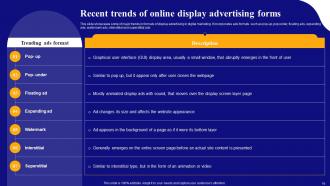
Slide 16: This slide showcases some of major trends in formats of display advertising in digital marketing.
Slide 17: This slide exhibit table of content- Format of display ads
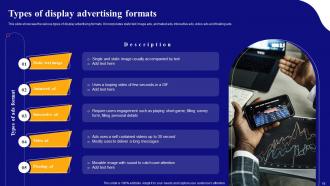
Slide 18: This slide showcase the various types of display advertising formats.
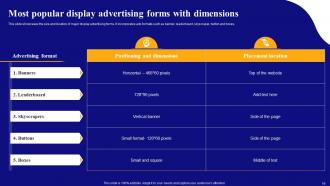
Slide 19: This slide showcases the size and location of major display advertising forms.
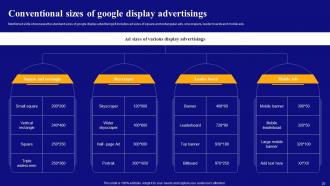
Slide 20: Mentioned slide showcases the standard sizes of google display advertisings.
Slide 21: This slide exhibit table of content- Types of display advertising.
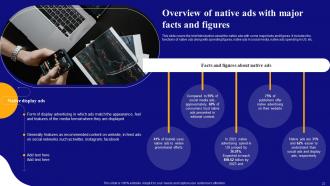
Slide 22: This slide covers the brief introduction about the native ads with some major facts and figures.
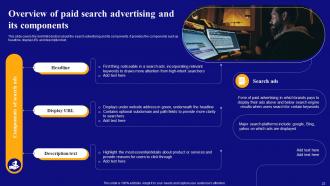
Slide 23: This slide covers the brief introduction about the search advertising and its components.
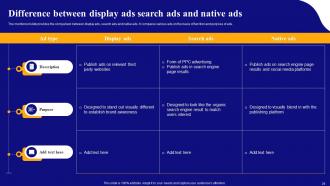
Slide 24: The mentioned slide provides the comparison between display ads, search ads and native ads.
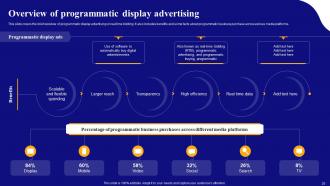
Slide 25: This slide covers the brief overview of programmatic display advertising or real time bidding.
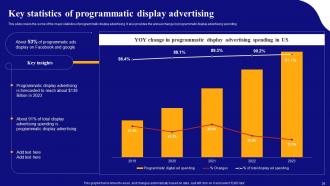
Slide 26: This slide covers the some of the major statistics of programmatic display advertising.
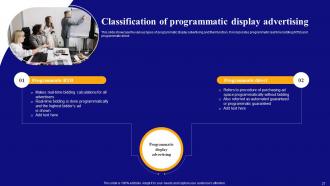
Slide 27: This slide showcase the various types of programmatic display advertising and their function.
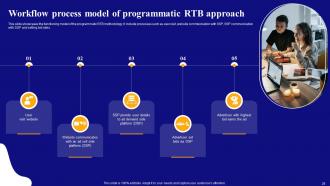
Slide 28: This slide showcases the functioning model of the programmatic RTB methodology.
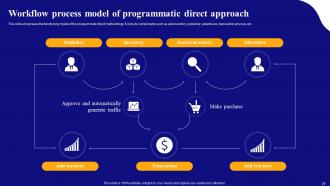
Slide 29: This slide showcases the functioning model of the programmatic direct methodology.
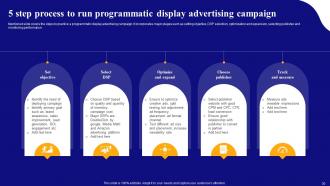
Slide 30: Mentioned slide covers the steps to practice a programmatic display advertising campaign.
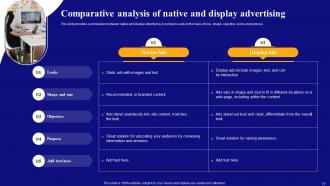
Slide 31: This slide provides a comparison between native and display advertising. It compares ads on the basis of size, shape, objective, looks and purpose.
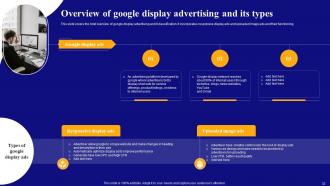
Slide 32: This slide covers the brief overview of google display advertising and it classification.
Slide 33: This slide exhibit table of content- Buying model of display advertising.
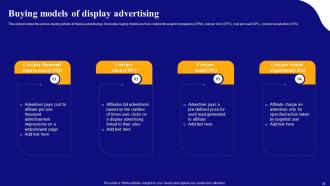
Slide 34: This slide provides the various buying options of display advertisings.
Slide 35: This slide exhibit table of content- Buying option for display advertising.
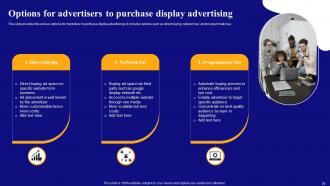
Slide 36: This slide provides the various options for marketers to purchase display advertisings.
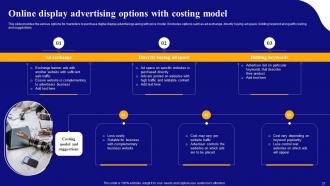
Slide 37: This slide provides the various options for marketers to purchase digital display advertisings along with price model.
Slide 38: This slide exhibit table of content- Bidding process model of display advertising.
Slide 39: The mentioned slide provides a framework model for the header bidding process of the display advertising.
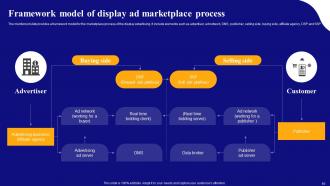
Slide 40: The mentioned slide provides a framework model for the marketplace process of the display advertising.
Slide 41: This slide exhibit table of content- Strategy.
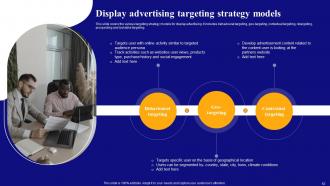
Slide 42: This slide covers the various targeting strategy models for display advertising.
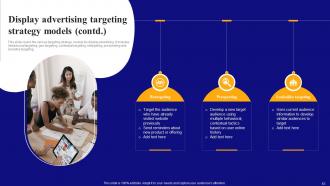
Slide 43: This slide covers the various targeting strategy models for display advertising.
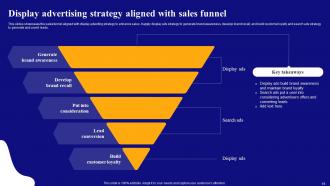
Slide 44: This slides showcases the sales funnel aligned with display adverting strategy to enhance sales.
Slide 45: This slide exhibit table of content- Implementation.
Slide 46: This slide provides the sequential plan of activities to implement display advertising campaign within a given timeframe.
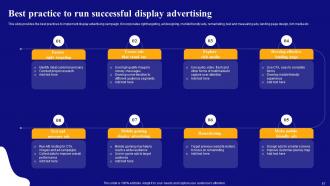
Slide 47: This slide provides the best practices to implement display advertising campaign.
Slide 48: This slide exhibit table of content- Dashboards.
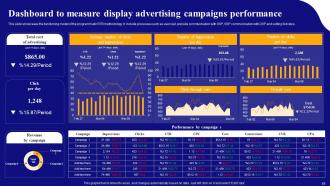
Slide 49: This slide provides a dashboard to monitor the display advertising campaign performance in order to reduce overall marketing cost.
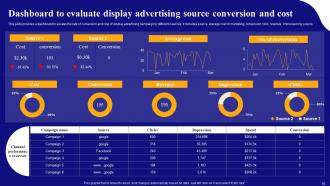
Slide 50: This slide provides a dashboard to assess the rate of conversion and cost of display advertising campaign by different sources.
Slide 51: This is the icons slide.
Slide 52: This slide presents title for additional slides.
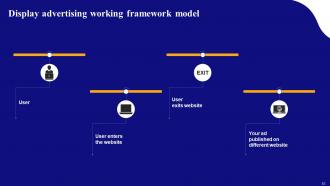
Slide 53: This slide showcase Display advertising working framework model.
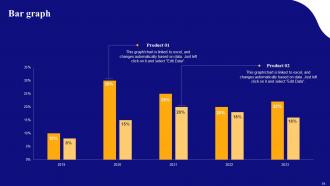
Slide 54: This slide displays yearly bar graph for different products.
Slide 55: This slide showcase Arrow timeline.
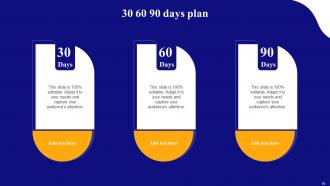
Slide 56: This slide depicts 30-60-90 days plan for projects.
Slide 57: This slide exhibits ideas generated.
Slide 58: This slide presents your company's vision, mission and goals.
Slide 59: This slide showcase Quotes.
Slide 60: This slide shows details of team members like name, designation, etc.
Slide 61: This is thank you slide & contains contact details of company like office address, phone no., etc.
Display Advertising Models And Its Targeting Strategies Powerpoint Presentation Slides MKT CD V with all 66 slides:
Use our Display Advertising Models And Its Targeting Strategies Powerpoint Presentation Slides MKT CD V to effectively help you save your valuable time. They are readymade to fit into any presentation structure.




















FAQs for Display Advertising Models And Its Targeting Strategies Powerpoint Presentation Slides
Primary display advertising models include cost-per-mille (CPM), cost-per-click (CPC), cost-per-acquisition (CPA), programmatic advertising, and retargeting campaigns. These models enable businesses to optimize marketing spend through targeted reach, performance-based pricing, and automated bidding, with many retailers and e-commerce platforms finding that strategic combinations deliver enhanced ROI and customer engagement.
CPC models charge advertisers only when users click their ads, making them ideal for direct response campaigns and lead generation, while CPM models charge per thousand impressions, focusing on brand awareness and reach. CPC typically delivers higher conversion rates and measurable ROI for e-commerce and service businesses, whereas CPM excels for brand building campaigns, with many advertisers finding that combining both models strategically maximizes campaign effectiveness.
Audience targeting enables display advertisers to reach specific demographics, interests, behaviors, and geographic locations, significantly improving campaign relevance and ROI. Through precise segmentation, companies can deliver personalized messages that resonate with potential customers, reduce wasted ad spend, and increase conversion rates, with many retailers and financial services finding that targeted campaigns deliver 2-3x better performance than broad approaches.
Advertisers measure display ad success through key performance indicators like click-through rates, conversion rates, cost-per-acquisition, brand awareness metrics, and return on ad spend across different campaign models. These metrics enable businesses to optimize targeting strategies, budget allocation, and creative performance in real-time, with many retail and e-commerce companies finding that comprehensive measurement ultimately delivers improved customer acquisition and higher revenue growth.
Programmatic advertising platforms enhance display advertising effectiveness by automating ad buying, enabling precise audience targeting, optimizing campaigns in real-time, and providing comprehensive performance analytics. Through machine learning algorithms, these platforms streamline ad placement across multiple channels, reduce manual processes, and deliver personalized experiences at scale, with many advertisers finding significantly improved ROI and engagement rates.
CPA models offer performance-based pricing, reduced financial risk, improved ROI measurement, and guaranteed conversions, making them attractive for budget-conscious advertisers seeking measurable outcomes. While these advantages deliver cost efficiency and accountability, advertisers face higher per-action costs and limited scale compared to impression-based models, with many finding that strategic combination approaches ultimately balance risk management with broader reach opportunities.
Visual elements and design significantly influence display advertising performance by capturing attention, conveying brand messages clearly, and driving user engagement through strategic color schemes, typography, and imagery placement. Well-designed display ads enhance click-through rates, improve brand recognition, and increase conversion rates, with many retailers and e-commerce platforms finding that visually compelling advertisements deliver substantially higher ROI and customer acquisition.
Current trends shaping display advertising include programmatic automation, AI-driven personalization, interactive rich media formats, cross-device targeting, and privacy-first solutions responding to cookie deprecation. These technologies streamline campaign management, enhance audience precision, and deliver measurable ROI, with retailers and financial services increasingly finding that automated bidding and real-time optimization significantly improve conversion rates while reducing acquisition costs.
Retargeting operates as a strategic targeting mechanism within display advertising models, leveraging cookies and pixel tracking to re-engage users who previously interacted with brands but didn't convert. This approach enhances traditional display frameworks by delivering personalized ads across programmatic, direct buy, and real-time bidding models, ultimately improving conversion rates and maximizing advertising ROI for businesses.
Ad placements significantly impact consumer engagement by influencing visibility, relevance, and user experience through strategic positioning, contextual alignment, and timing optimization. Premium placements like above-the-fold positions and native integrations deliver higher click-through rates and brand recall, with many retailers and media companies finding that contextually relevant placements enhance consumer trust while minimizing ad fatigue.
A/B testing refines display advertising strategies by comparing different creative elements, targeting parameters, and placement options to identify top-performing variations. Through systematic testing of headlines, visuals, call-to-action buttons, and audience segments, marketers can optimize click-through rates, conversion rates, and return on ad spend, ultimately delivering data-driven campaigns that maximize engagement and revenue across diverse customer segments.
Display advertising ethics encompass user privacy protection, transparent data collection practices, clear ad labeling, accessibility compliance, and responsible targeting that avoids discrimination or manipulation. While these considerations present compliance challenges, they ultimately enable sustainable advertising relationships, enhance brand trust, and deliver better user experiences, with many organizations finding that ethical practices strengthen long-term customer loyalty and competitive positioning.
Mobile display advertising models differ from desktop models through smaller screen formats, touch-based interactions, location targeting capabilities, and app-based placements versus web browsing. These mobile-specific approaches enable advertisers to leverage GPS data, push notifications, and in-app experiences, ultimately delivering more personalized campaigns and higher engagement rates in an increasingly mobile-first marketplace.
Businesses can improve display ad click-through rates by implementing targeted audience segmentation, compelling visual design, strategic ad placement, A/B testing variations, and personalized messaging based on user behavior. Through programmatic advertising and retargeting campaigns, companies in retail, finance, and e-commerce enhance engagement significantly, with many organizations finding that dynamic creative optimization and mobile-responsive formats ultimately deliver higher conversion rates and improved ROI.
Display advertising models adapt to privacy regulations by implementing first-party data collection, contextual targeting, cookieless tracking technologies, consent management platforms, and privacy-preserving analytics tools. These strategic adaptations enable advertisers to maintain effective targeting while ensuring compliance, with many retail and media companies finding that contextual advertising and direct customer relationships ultimately deliver stronger engagement and build greater consumer trust.
-
“One of the best experiences with SlideTeam for my presentation.Everything on time, communication is efficient and price is reasonable. All good in one place.”
-
Keep doing the good work guys. Surpass the needs and expectations always!!