


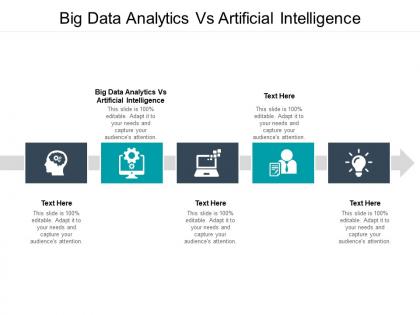
Big data analytics vs artificial intelligence ppt powerpoint visuals cpb




Try Before you Buy Download Free Sample Product
 Impress Your
 Audience
 100%
100% Editable
 Save Hours
 of Time


Break free of constraints with our Big Data Analytics Vs Artificial Intelligence Ppt Powerpoint Visuals Cpb. Don't let events force your hand.
People who downloaded this PowerPoint presentation also viewed the following :
Big data analytics vs artificial intelligence ppt powerpoint visuals cpb with all 2 slides:
Brief your faculty with our Big Data Analytics Vs Artificial Intelligence Ppt Powerpoint Visuals Cpb. Empower them for better education.

FAQs for Big data analytics vs artificial intelligence ppt
Big data analytics focuses on examining large datasets to identify patterns, trends, and insights for informed decision-making, while artificial intelligence creates systems that simulate human intelligence to automate tasks and make autonomous decisions. These approaches serve complementary purposes, with analytics providing the foundation for data-driven strategies and AI enabling predictive capabilities, automated responses, and intelligent automation, ultimately delivering enhanced operational efficiency and competitive advantage across industries.
Big data analytics contributes to AI model training by providing massive, structured datasets, identifying relevant patterns and correlations, and preprocessing information for optimal algorithm performance. Through advanced analytics techniques, organizations can clean, validate, and segment training data more effectively, while ensuring models learn from diverse, representative samples, ultimately delivering more accurate predictions and robust AI systems across industries.
Big data analytics commonly utilizes structured data from databases, unstructured data like social media posts and emails, transactional records, sensor data, and web logs. While AI applications leverage similar datasets, they increasingly emphasize real-time streaming data, image and video content, natural language text, and behavioral patterns, with many organizations finding that combining both approaches delivers enhanced customer insights and operational efficiency.
Big data analytics enhances AI algorithm performance by providing comprehensive training datasets, enabling pattern recognition across larger sample sizes, and improving predictive accuracy through diverse data sources. Through robust data preprocessing and feature engineering, organizations in healthcare, finance, and retail achieve more reliable AI models, reduced bias, and significantly faster decision-making capabilities, ultimately delivering competitive advantages.
Big data analytics provides the foundation by processing vast datasets to identify patterns and trends, while artificial intelligence enhances these insights through predictive modeling, automated decision-making, and real-time optimization. Together, they enable organizations across retail, healthcare, and financial services to streamline operations, anticipate market changes, and deliver personalized customer experiences, ultimately transforming raw data into strategic competitive advantage.
**INPUT**: What are the main challenges associated with integrating big data analytics and AI technologies? **OUTPUT**: Integration challenges include data quality inconsistencies, infrastructure compatibility issues, skill gaps in technical teams, regulatory compliance complexities, and substantial implementation costs. While these obstacles present significant hurdles, organizations in healthcare, financial services, and retail are increasingly finding that strategic phased approaches, comprehensive staff training, and robust data governance frameworks ultimately deliver enhanced operational efficiency and competitive advantage. [Word count: 60 words]
Healthcare, finance, retail, manufacturing, and transportation industries leverage both big data analytics and artificial intelligence to revolutionize operations, enhance customer experiences, and drive competitive advantage. These sectors utilize AI-powered analytics for predictive diagnostics, fraud detection, personalized recommendations, predictive maintenance, and autonomous systems, ultimately delivering improved efficiency, reduced costs, and enhanced service quality while enabling data-driven strategic decision-making.
Data privacy concerns with big data analytics focus on securing vast datasets and ensuring compliant storage, while AI solutions raise additional issues around algorithmic transparency, bias detection, and automated decision-making accountability. Healthcare organizations implementing analytics must protect patient records through encryption and access controls, whereas AI systems require explainable algorithms and bias auditing, ultimately demanding more comprehensive governance frameworks that address both data protection and algorithmic fairness.
Data visualization techniques transform complex big data analytics and AI results into accessible charts, graphs, dashboards, interactive maps, and real-time displays that stakeholders can quickly understand and act upon. These visual tools enable organizations across healthcare, finance, and retail to identify patterns, communicate insights effectively, and make data-driven decisions faster, ultimately delivering enhanced operational efficiency and competitive advantage in an increasingly data-rich business environment.
Organizations ensure data quality and accuracy through comprehensive data governance frameworks, automated validation systems, regular auditing processes, standardized collection protocols, and real-time monitoring tools. These strategies enable companies across sectors like healthcare, finance, and retail to minimize errors, enhance decision-making reliability, and maintain competitive advantage, with many finding that robust data quality management ultimately delivers more accurate insights and improved business outcomes.
Big data analytics professionals need statistical analysis, data visualization, SQL/database management, programming languages like Python or R, and domain expertise in business intelligence. AI professionals require machine learning algorithms, deep learning frameworks, mathematical modeling, neural network design, and natural language processing skills. While both fields overlap in programming and analytical thinking, AI roles increasingly demand advanced mathematics and algorithm development, with many organizations finding that cross-trained professionals deliver the greatest competitive advantage.
Machine learning serves as the foundational bridge between big data analytics and AI, enabling systems to identify patterns and make predictions from vast datasets, while deep learning represents AI's most advanced form, processing complex data through neural networks. These technologies revolutionize sectors like healthcare diagnostics, financial fraud detection, and retail personalization by automating analysis, enhancing accuracy, and delivering faster insights, ultimately enabling organizations to transform raw data into competitive advantage.
Ethical considerations include data privacy, algorithmic bias, transparency in decision-making, consent management, and potential job displacement impacts. Organizations address these through robust governance frameworks, regular bias auditing, explainable AI implementations, and comprehensive privacy protocols, with many financial services and healthcare institutions finding that proactive ethical guidelines ultimately deliver greater customer trust and regulatory compliance.
Predictive analytics from big data enhances AI-driven recommendations by identifying patterns, trends, and correlations that inform machine learning algorithms, enabling more accurate forecasting and personalized suggestions. This strategic combination allows organizations in retail, healthcare, and financial services to deliver targeted product recommendations, optimize inventory management, and improve customer experiences, ultimately driving higher conversion rates and competitive advantage.
Future trends in big data analytics and AI integration include real-time processing capabilities, edge computing implementations, automated machine learning platforms, enhanced predictive modeling, and seamless cross-platform data orchestration. These advancements streamline decision-making processes, reduce operational costs, and accelerate insights delivery, with organizations across healthcare, finance, and retail finding increasingly sophisticated automation ultimately delivers competitive advantage.
No Reviews