


Bitcoin Mining Process Using Mastering Blockchain Mining A Step By Step Guide BCT SS V




Try Before you Buy Download Free Sample Product
 Impress Your
 Audience
 100%
100% Editable
 Save Hours
 of Time


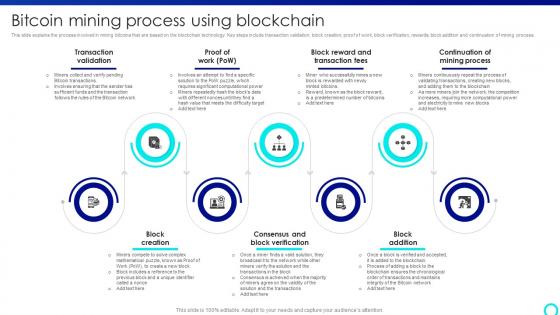
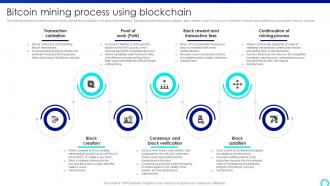
This slide explains the process involved in mining bitcoins that are based on the blockchain technology. Key steps include transaction validation, block creation, proof of work, block verification, rewards, block addition and continuation of mining process.
People who downloaded this PowerPoint presentation also viewed the following :
Bitcoin Mining Process Using Mastering Blockchain Mining A Step By Step Guide BCT SS V with all 9 slides:
Use our Bitcoin Mining Process Using Mastering Blockchain Mining A Step By Step Guide BCT SS V to effectively help you save your valuable time. They are readymade to fit into any presentation structure.








FAQs for Bitcoin Mining Process Using Mastering Blockchain Mining A Step By Step Guide
Bitcoin mining components include specialized ASIC hardware, mining software, digital wallets, mining pools, and reliable internet connectivity. These technologies work together by solving complex cryptographic puzzles, validating transactions, and securing the blockchain network, with many mining operations finding that pooled resources significantly enhance computational power and profitability.
Proof of Work requires miners to compete in solving complex cryptographic puzzles by repeatedly hashing block data until finding a hash below the target difficulty threshold. Through this computational race, miners validate transactions, secure the network against attacks, and earn block rewards, with the energy-intensive process ultimately delivering decentralized consensus and immutable transaction records across the Bitcoin blockchain.
**INPUT**: What hardware is commonly used for effective Bitcoin mining today? **OUTPUT**: Effective Bitcoin mining today relies primarily on Application-Specific Integrated Circuits (ASICs), specialized processors designed exclusively for cryptocurrency mining operations. These high-performance machines significantly outpace traditional GPUs and CPUs by delivering superior hash rates, enhanced energy efficiency, and lower operational costs, with many mining operations finding that ASIC investments ultimately streamline profitability and competitive positioning. [Word count: 58 words]
Mining pools aggregate computational power from multiple miners who collectively solve cryptographic puzzles and share rewards proportionally based on contributed hash rate. Individual miners join pools because solo mining requires enormous computational resources and energy costs, while pools provide more consistent, predictable payouts and reduced variance, with many smaller operations finding that pooled mining delivers steady income streams and operational efficiency in an increasingly competitive landscape.
The mining difficulty adjustment maintains Bitcoin's 10-minute block time by automatically recalibrating every 2,016 blocks based on network hash rate changes. This mechanism ensures consistent transaction processing speeds and network stability, while enabling miners across financial institutions and technology companies to plan operations efficiently, ultimately delivering predictable blockchain performance and maintaining Bitcoin's monetary policy integrity.
Transaction fees significantly enhance mining profitability by supplementing the fixed block reward, especially during periods of high network congestion when users pay premium fees for faster processing. These fees become increasingly crucial as Bitcoin's block rewards halve approximately every four years, with many mining operations finding that transaction fee revenue can represent 10-20% of total earnings during peak demand periods.
Bitcoin mining raises significant environmental concerns due to its massive energy consumption, carbon emissions from fossil fuel-powered mining operations, electronic waste from outdated hardware, and strain on local power grids. However, these challenges present opportunities for sustainable innovation, with many mining operations increasingly adopting renewable energy sources, implementing carbon offset programs, and developing more efficient mining technologies, ultimately driving the industry toward greater environmental responsibility.
The rewards halving event significantly reduces miners' block rewards by fifty percent, decreasing revenue while maintaining operational costs like electricity and equipment expenses. This creates financial pressure that forces less efficient miners to exit, ultimately consolidating mining power among larger, more efficient operations with better technology and lower energy costs, strengthening network security.
Energy consumption presents both challenges and opportunities for Bitcoin mining sustainability, with miners increasingly adopting renewable energy sources, improving hardware efficiency, and relocating to regions with cleaner power grids. Many mining operations are finding that strategic combinations of solar, wind, and hydroelectric power significantly reduce environmental impact while maintaining profitability, ultimately delivering competitive advantage in an increasingly sustainability-focused market.
Mining software evolution has transformed Bitcoin mining through enhanced efficiency algorithms, automated optimization systems, and sophisticated pool management capabilities, enabling miners to maximize computational power while minimizing energy consumption. These advances streamline operations by providing real-time performance monitoring, dynamic difficulty adjustments, and seamless hardware integration, with mining farms increasingly finding that modern software delivers significantly higher profitability and operational control.
Bitcoin mining security risks include cyberattacks targeting mining pools, malware infections, hardware theft, electricity fraud, and regulatory compliance violations. These vulnerabilities can compromise mining operations through stolen computing power, corrupted systems, and financial losses, with many mining facilities increasingly investing in advanced cybersecurity measures, physical security protocols, and regulatory compliance frameworks to protect their investments.
Geographic locations significantly impact Bitcoin mining through electricity costs, climate conditions, regulatory frameworks, and infrastructure availability. Mining operations in regions like Iceland, Kazakhstan, and parts of the United States benefit from cheaper renewable energy, cooler temperatures for natural cooling, and favorable regulations, ultimately delivering lower operational costs and higher profit margins compared to locations with expensive energy and restrictive policies.
Bitcoin mining regulations include energy consumption mandates, environmental compliance requirements, taxation policies, licensing obligations, and cryptocurrency operation permits. These legal frameworks vary significantly by jurisdiction, with countries like China implementing strict bans while others like El Salvador embrace mining operations, ultimately requiring miners to navigate complex compliance landscapes while seeking locations that balance regulatory clarity with operational efficiency.
ASIC miners have revolutionized Bitcoin mining by delivering unprecedented hash rates, energy efficiency, and processing power compared to traditional GPU and CPU mining methods. This technological advancement has intensified competition among mining operations, with large-scale facilities and mining pools increasingly dominating the landscape, ultimately requiring significant capital investment while delivering faster block validation and enhanced network security for institutional miners.
**INPUT**: What are the potential future developments in Bitcoin mining technology? **OUTPUT**: Future Bitcoin mining developments include quantum-resistant algorithms, renewable energy integration, advanced ASIC chips, liquid cooling systems, and AI-optimized mining operations. These technologies streamline energy efficiency, enhance computational power, and minimize environmental impact, with mining facilities increasingly adopting sustainable practices and automated systems, ultimately delivering competitive advantages and operational cost reductions.
-
A fantastic collection of templates. I'll likely use this as my go-to resource for future templates and support.
-
Love how there are no boring templates here! The design is fresh and creative, just the way I like it. Can't wait to edit and use them for my extended projects!