

 0 Comment
 Customer Reviews

The document's open. Twelve boxes, twelve labels. And whoever built this framework clearly expected someone, somewhere, to know exactly what goes in each one.
That's not always how it works.
The phrase "12 core functions" maps onto operating systems, project management offices, cloud computing platforms—any domain complex enough to require a structured breakdown of what the system actually does. The problem of explaining interconnected functions clearly is universal.
We see in substance abuse counselling. Here, these are —screening, intake, orientation, assessment, treatment planning, counseling, case management, crisis intervention, referral, patient education, reports and record keeping, consultation—have been around long enough that most addiction counselors can name them. Listing them isn't the problem. The problem is explaining them. To a supervisor. To a client. To an IC&RC exam panel or a certification board that wants more than a memorized checklist.
There's a gap between knowing the functions and being able to show your competence in them. That gap tends to show up at the worst possible time—mid-presentation, during a training session, or three days before a CASAC exam when the notes don't quite hold together.
Part of it is that these functions aren't isolated. Screening feeds into intake. Intake shapes orientation. Assessment informs treatment planning. When you're trying to communicate how they connect—to a classroom, a clinical team, a licensing board—the prose version rarely cuts it. You need something visual. Something that shows the logic, not just the list.
That's why presentation templates for this exist. Not because the content is hard to know—it's hard to show. Hard to lay out in a way that an audience can follow without you narrating every slide.
SlideTeam's pre-designed templates for 12 core functions give you the structure when you already have the content. Ready-made frameworks that handle the visual logic so you can focus on the substance. Whether you're preparing for drug and alcohol counselor training, building a clinical orientation deck, or mapping out case management workflows—there are slides built for exactly this.
Here's what's in the collection.
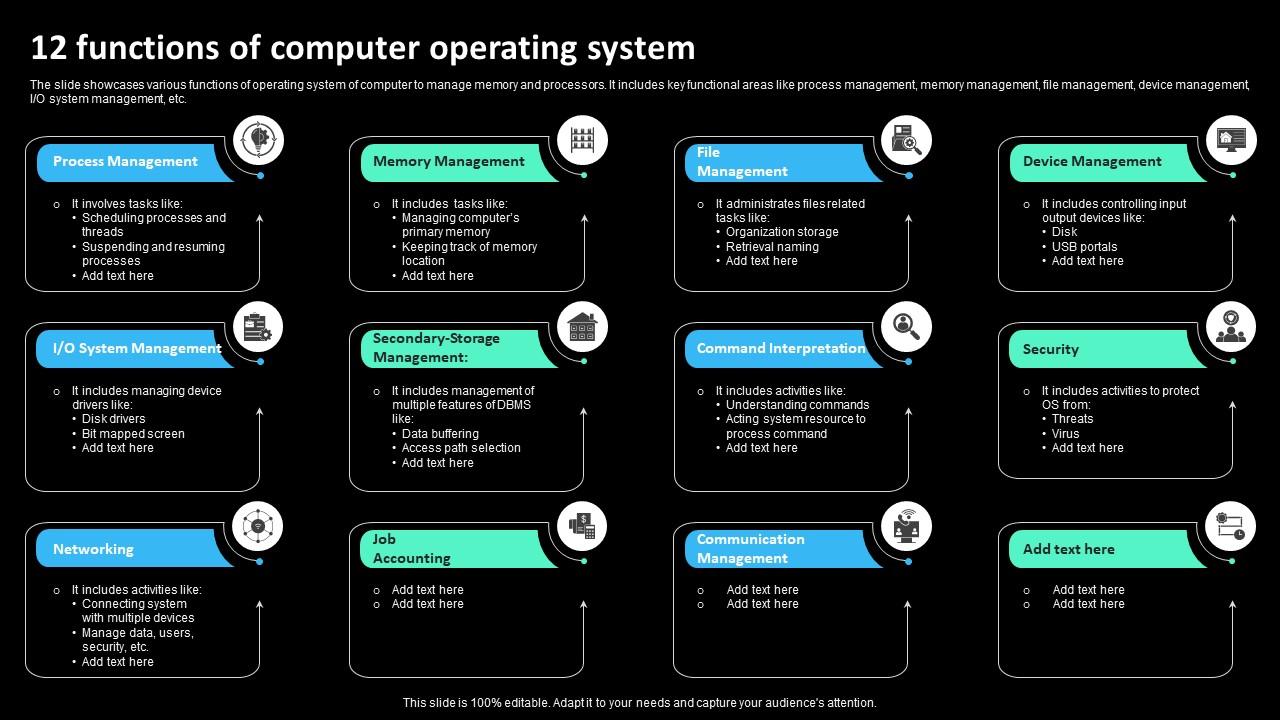
Template 1: 12 Functions of Computer Operating System
Operating system architecture gets dense fast, especially when you need to explain it across multiple functional layers. This PowerPoint slide is built for IT educators, systems architects, and technical trainers who need to break down OS responsibilities clearly. It covers process management, memory management, file management, device management, and I/O system management in one structured visual. Use it for computer science coursework or enterprise IT onboarding sessions. The template is 100% editable and customizable.
Download this PowerPoint Template
Template 2: 12 Functions of Project Management Office
Project management offices often struggle to communicate their full scope of responsibilities to stakeholders. This PPT template is built for PMO leads and program managers who need to map functions like strategic support, multi-project management, resource management, and training in one cohesive view. It works well in 12 core functions presentation decks where clarity across interconnected roles is the goal. The template is 100% editable and customizable.

Download this PowerPoint Template
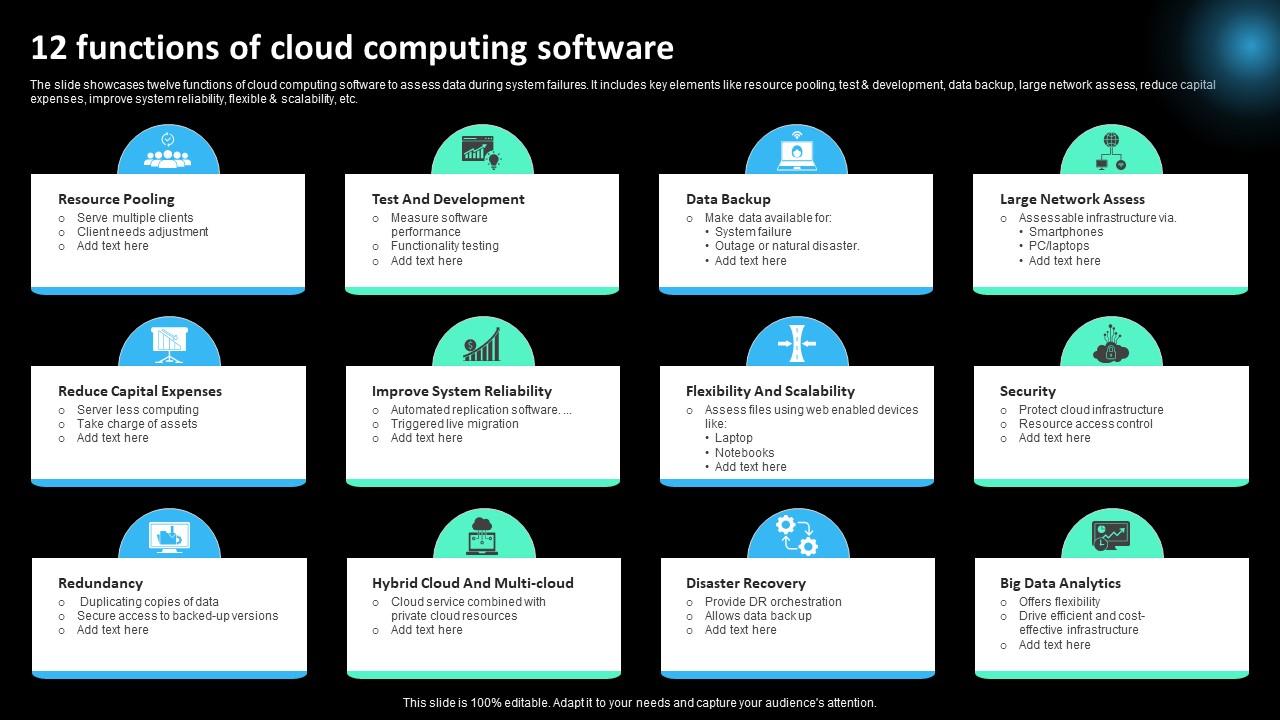
Template 3: 12 Functions of Cloud Computing Software
Cloud infrastructure decisions are hard to justify without a clear functional breakdown. This PPT preset is built for cloud architects, IT managers, and SaaS procurement teams presenting platform capabilities to leadership. It covers resource pooling, data backup, large network access, system reliability, and scalability in one structured layout. So yeah, it fits naturally in both vendor evaluation decks and internal cloud adoption reviews. The template is 100% editable and customizable.
Download this PowerPoint Template
Master Your Core Functions Presentations with SlideTeam
SlideTeam's PowerPoint templates are the best in the industry for presenting 12 core functions across counseling, IT, and project management domains. These content-ready slides give you professional structure without building from scratch—saving time when it matters most. Whether you're covering substance use disorder treatment workflows or cloud computing capabilities, these ready-made frameworks keep your audience focused. Grab these PowerPoint slides to deliver clearer, more credible presentations every time.
FAQs on 12 Core Functions
How do the 12 core functions of substance abuse counseling differ in their application across various treatment settings?
The 12 core functions apply in every setting—outpatient, residential, correctional—but the emphasis shifts. Outpatient counseling leans heavily on individual counseling and relapse prevention strategies. Residential programs prioritize orientation, case management, and group counseling skills. Correctional settings place more weight on crisis intervention and referral. The functions stay constant; how much time and resource each gets depends on the client population and program structure.
What role does screening play as a foundational core function, and how does it influence the subsequent counseling process?
Screening is the entry point. It determines whether a person needs further evaluation for a substance use disorder. A weak or skipped screening means the entire counseling process starts without a clear baseline. What follows—intake, assessment, treatment planning—depends on what screening surfaces. Think of it as the filter that routes clients to the right level of care from the start.
In what ways can intake procedures be streamlined without compromising the depth of client assessment?
Use structured intake forms with standardized fields to reduce time without cutting depth. Collect demographic, legal, medical, and substance use history in a single session. Train staff to separate administrative intake from clinical assessment—they serve different purposes. Digital documentation tools can reduce repetition and keep records consistent. The goal is efficiency in data collection, not shortcuts in clinical judgment.
How does the core function of orientation help clients reduce anxiety and build commitment to the treatment process?
Orientation gives clients a clear picture of what treatment involves—rules, expectations, rights, and available services. Uncertainty is a major driver of dropout in early treatment. When clients know what to expect, resistance drops. Orientation is not a formality; it is the first therapeutic touchpoint. A well-run orientation directly improves early engagement and retention.
What distinguishes a comprehensive assessment from a basic screening within the 12 core functions framework?
Screening asks one question: does this person need further evaluation? Assessment answers a broader set: what exactly is happening, and what does treatment need to address? A comprehensive assessment covers substance use history, mental health, medical status, social support, and legal issues. Screening uses brief tools; assessment uses structured clinical interviews and validated instruments. One opens the door; the other maps the room.
How do counselors effectively develop individualized treatment plans that address co-occurring disorders using the core functions model?
Co-occurring disorders counseling requires treatment plans that address both conditions simultaneously, not sequentially. Counselors should document specific goals for each disorder, with measurable indicators. Use assessment data to prioritize—some clients need mental health stabilization before addiction work can proceed. Coordinate with psychiatric providers early. Treatment plans must reflect integrated care, not two parallel tracks running separately.
What ethical considerations arise when implementing the referral core function for clients with limited access to resources?
Referral carries an ethical obligation to match the client's need with what is actually available and accessible. When resources are limited, counselors must document what was offered, what barriers exist, and what alternatives were explored. Referring to a service a client cannot reach is not a completed referral. Ethical standards in addiction counseling require follow-up to confirm connection, not just handoff.
How does the counseling core function differ from case management in terms of therapeutic scope and client outcomes?
Counseling focuses on the therapeutic relationship—exploring behavior, emotions, and motivations to drive personal change. Case management focuses on connecting clients to services and coordinating care across systems. A counselor addresses why a client uses; a case manager ensures housing, healthcare, and legal needs are handled. Both matter, but they operate on different levels. Confusing the two dilutes both functions.