

 0 Comment
 Customer Reviews

The report is sitting in someone's inbox. Has been for two weeks.
Not because nobody cares. Everyone cares—the funder, the program manager, the board. But somewhere between "we ran the program" and "we can prove it worked," something goes quiet. Numbers exist. Attendance logs, completion rates, hours delivered. And yet the question nobody can fully answer is: did any of it actually change anything?
That's the gap. Not a data gap, exactly. More like a framing gap. Output counts are easy. Outcomes are harder—because outcomes require you to decide, upfront, what "better" looks like. And most teams skip that part. They run the program first, then figure out what to measure.
It compounds. Funders ask for impact. Stakeholders want accountability. Someone from finance wants an ROI evaluation. And the program team is left reverse-engineering a narrative from activity logs that were never designed to answer those questions.
The discomfort isn't unique to one sector. Non-profits feel it during grant renewals. Corporate L&D teams feel it when leadership asks whether the training actually moved the needle. Government programs feel it every audit cycle. The underlying problem is the same: nobody built a logic model at the start, nobody agreed on success metrics, and now everyone's trying to make activity data look like evidence.
Outcome-based evaluation exists because this happens constantly. It's a discipline that forces the hard conversation earlier—before the program runs, not after. Define what change you expect. Agree on how you'll measure it. Build in formative checkpoints so you're not waiting until the end to find out something didn't work.
That's a lot to structure in a slide deck. Especially when you're also trying to communicate to stakeholders who don't want methodology—they want clarity.
SlideTeam's pre-designed outcome-based evaluation templates handle the structural part. The frameworks are already laid out—logic models, performance assessment grids, goal attainment tracking, impact assessment summaries. You fill in the specifics. The templates make the argument visible without making you build it from scratch.
What follows are the templates worth knowing about.
Template 1: Comprehensive Outcome-Based Evaluation Strategies for Success
Systematic outcome measurement starts with a clear, compelling visual structure. This deck merges strategic evaluation frameworks with striking design that commands audience attention immediately. Intuitive layouts guide viewers through program effectiveness data without overwhelming them. Color-coded sections deliver instant clarity across each evaluation stage. You can align every visual element precisely to your organization's brand identity. Built for accountability framework presentations, it simplifies complex results-based management narratives into persuasive slides. The deck supports evidence-based practice presentations where clarity drives stakeholder confidence. Transform your outcome-based evaluation presentations and outshine the competition. Download this dynamic template now and unlock your program's impact story.
[product_image id=1399467]
Template 2: Outcome-Based Education PowerPoint Presentation Rules
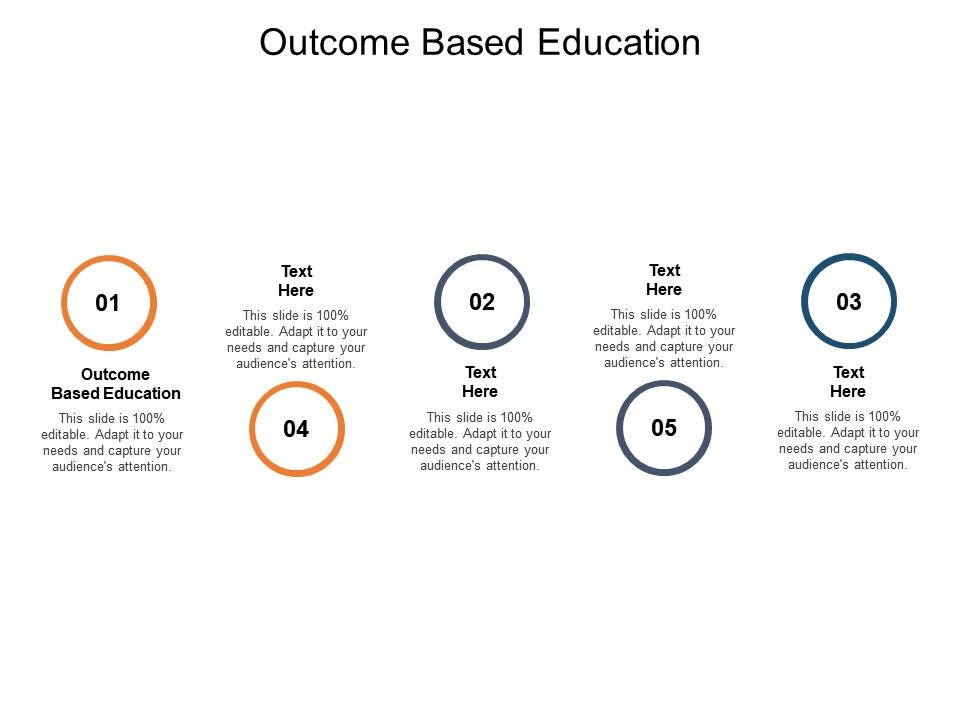
Learning outcomes don't communicate themselves — they need a clear visual structure behind them. This PPT template is built for educators and program designers who need to present outcome-based education frameworks to review boards or curriculum committees. So, whether you're mapping graduate attributes or presenting program-level achievement data, this deck makes the progression across five key stages easy to follow. It fits naturally into summative evaluation reviews or academic accountability meetings. The template is 100% editable and customizable.
Download this PowerPoint Template
Achieve Measurable Impact with SlideTeam
SlideTeam's PowerPoint templates are the best in the industry for outcome-based evaluation. These content-ready slides save you significant time by providing pre-built logic model structures, performance assessment grids, and impact assessment layouts you can deploy immediately. Use these ready-made frameworks to align stakeholders on success metrics and communicate program effectiveness with confidence. Grab these custom-made PowerPoint slides to turn complex evaluation data into clear, persuasive presentations that drive accountability and results.
FAQs on Outcome Based Evaluation
What distinguishes outcome-based evaluation from traditional output-focused assessment methods?
Traditional assessment counts outputs — people trained, hours delivered, events held. Outcome-based evaluation asks what changed as a result. It measures shifts in behavior, capability, or conditions — not just activity volume. The key difference is accountability for results, not effort. Output methods tell you what happened; outcome methods tell you whether it mattered.
How do organizations establish meaningful baseline metrics before implementing an outcome-based evaluation framework?
Collect data on the target population before the program begins. Use surveys, performance records, or existing administrative data to establish a starting point. Define two or three specific, measurable indicators tied directly to your expected outcomes. Without a baseline, you cannot demonstrate change — only describe activity. This step must happen before implementation, not during.
What role does stakeholder alignment play in defining success criteria for outcome-based evaluation?
Stakeholders define what success actually looks like in practice. Without their input early, evaluation criteria reflect program staff assumptions — not community or funder priorities. Bring key stakeholders into the goal-setting conversation before designing metrics. Misaligned success criteria are among the most common reasons evaluations produce findings nobody acts on.
How can short-term outputs be effectively linked to long-term outcomes without losing evaluative accuracy?
Use a logic model or theory of change to map the connections explicitly. Short-term outputs should feed into intermediate outcomes, which then point toward long-term goals. Track each level separately using different data collection methods. Trying to measure long-term outcomes too early inflates failure. Build in staged review points — formative checkpoints — at six or twelve months.
What are the most common pitfalls organizations face when transitioning from activity-based to outcome-based evaluation?
The most common pitfall is defining outcomes after the program runs — making measurement an afterthought. A close second is measuring too many indicators and drowning in data without insight. Teams also tend to confuse outputs with outcomes and report activity as impact. The fix: agree on three to five core outcome indicators before the program launches, not after.
How do you measure intangible outcomes such as behavioral change or cultural shift within an organization?
Use mixed methods — combine survey data with interviews or observation. Behavioral change can be tracked through pre- and post-assessments, 360-degree feedback, or incident reporting shifts. Cultural change is slower; proxy indicators like retention rates, escalation frequency, or peer feedback scores work well. Qualitative evaluation adds the 'why' that quantitative data alone cannot explain.
What frameworks best support outcome-based evaluation in non-profit versus corporate settings?
Non-profits typically rely on logic models, theory of change, and funder-aligned accountability frameworks. Corporate settings lean toward KPIs, ROI evaluation, and performance management dashboards. Both work — the choice depends on who the evaluation serves. Non-profits report to communities and funders; corporations report to internal decision-makers. Match your framework to your accountability audience, not to sector convention.
How does attribution differ from contribution when assessing program outcomes in complex environments?
Attribution claims your program caused the outcome — requiring a control group or counterfactual to rule out other factors. Contribution acknowledges your program was one credible factor among several. In complex environments with multiple actors, contribution is almost always the honest and defensible position. Document your program's specific activities, the change that followed, and the plausible pathway between them.