

 0 Comment
 Customer Reviews

The calendar invite says "attendance review." Someone's already rehearsing their excuse.
That's the thing about attendance conversations—they're uncomfortable before they even start. Managers know the numbers. HR knows the policy. And the employee sitting across the table knows both. But none of that makes the meeting easier to run.
Attendance problems don't usually announce themselves as problems. They show up slowly. A few late arrivals. A Monday pattern. A string of single-day absences that never quite crosses the obvious line. By the time someone decides to act, the issue's been going on for months—and nobody's written anything down.
That's where things get complicated. Because now you need to say something formal. Something documented. Something that holds up if the situation escalates. And the gap between "we've noticed a pattern" and "here's your corrective action plan" is wider than most people expect.
HR teams feel this acutely. Writing an attendance-focused performance improvement plan isn't just filling out a form. You're making a legal record. You're setting measurable targets. You're communicating consequences while still leaving room for the employee to course-correct. Do it wrong and you've either scared someone into quitting or given them nothing they can actually act on.
The stakes are higher than they look. A poorly structured plan doesn't protect the organization. It doesn't help the employee. It just creates paperwork that confuses everyone later.
That's why these templates exist. Managing employee absenteeism is genuinely hard to put on paper—not because the facts are complicated, but because the tone has to be exactly right. Firm without being punitive. Specific without being petty. Documented without feeling like a trap.
SlideTeam's pre-designed templates handle this structural gap. They give HR professionals and managers a content-ready starting point—frameworks that cover the right stages, the right language, and the right level of detail. No starting from scratch when the meeting's already scheduled.
Here are the templates that do the heavy lifting.
Template 1: Developing Employee Attendance Performance Improvement Plan
Developing a clear attendance improvement process takes the guesswork out of corrective action. This template maps six structured stages for building an employee attendance performance improvement plan. Each step—from outlining the attendance policy to monitoring records—gives HR teams a replicable, professional framework. It covers communicating consequences, listening to employees, and providing counseling sessions with clarity. Fully editable PowerPoint shapes let you tailor every element to your organization's standards. Use this slide to anchor your attendance performance improvement plan process with structure and accountability. Transform your HR corrective action conversations today. Download and deliver attendance accountability plans that work.
[product_image id=971619]
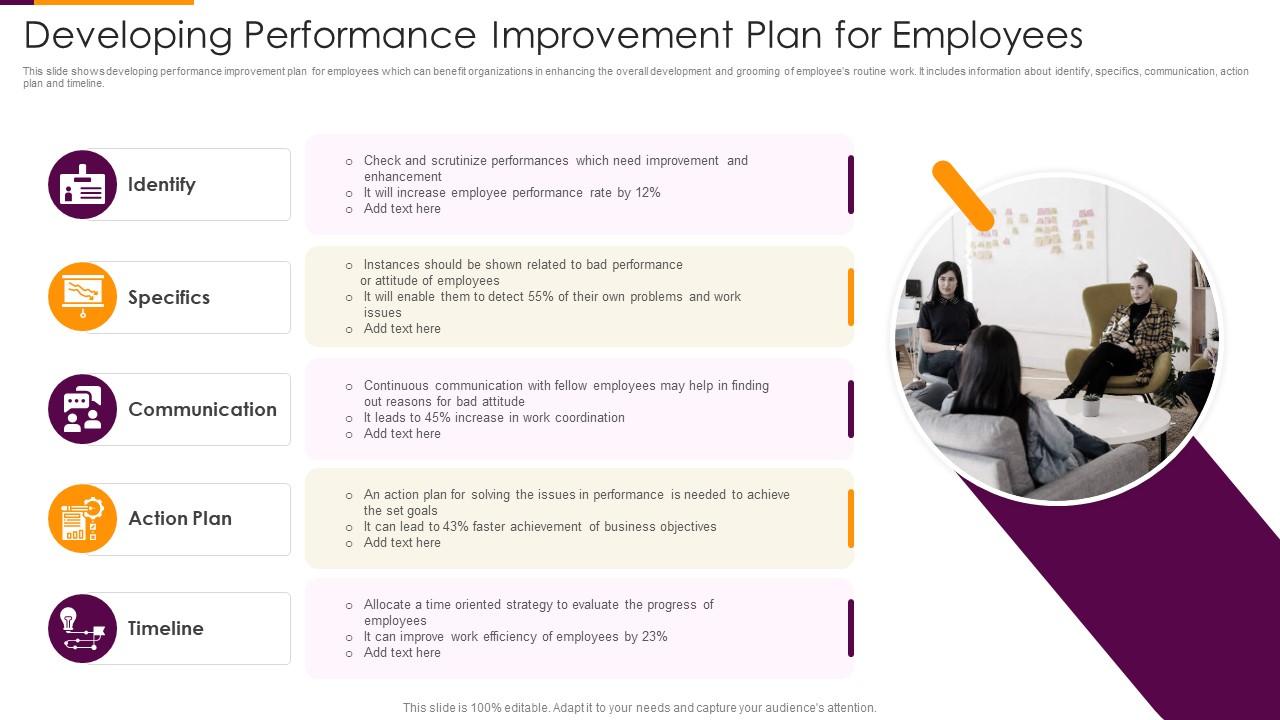
Template 2: Developing Performance Improvement Plan for Employees
Five critical stages drive a well-built performance improvement plan for employees. This template captures each stage—Identify, Specifics, Communication, Action Plan, and Timeline—in one clean, editable layout. It gives managers a visual framework to address employee attendance issues methodically. Every phase connects directly to measurable outcomes, keeping evaluations objective and defensible. The innovatively designed PowerPoint layout makes customization fast and frustration-free. Reference this alongside our guide on attendance improvement plan templates to build end-to-end absenteeism management plans. Transform your HR performance improvement plan process today. Download and give your managers a real structure for tough attendance conversations.
Download this PowerPoint Template
Template 3: Performance Evaluation Showing Attendance Appearance Interest Policy
Evaluating job performance and attendance together creates a complete picture of employee accountability. This two-stage performance evaluation template covers attendance, appearance, and interest policy in one structured layout. It links performance management directly to attendance records, giving HR a defensible review format. Clean visual design makes patterns visible and easy to communicate to employees. Editable fields let you adapt every section to your organization's specific absence management criteria. Use this slide to run performance analysis sessions that are consistent and policy-aligned. Elevate your performance evaluation presentations today. Download this template now and build attendance accountability plans grounded in real data.

Download this PowerPoint Template
Elevate Your Attendance Accountability with SlideTeam
SlideTeam's PowerPoint templates are the best in the industry for building a performance improvement plan for attendance. These content-ready slides save HR professionals hours of drafting time while delivering professional, policy-aligned frameworks that hold up under scrutiny. Ready-made layouts cover every stage—from identifying attendance patterns to setting measurable improvement goals. Deploy these PowerPoint slides to drive workplace attendance improvement and protect your organization with documented, defensible corrective action plans.
FAQs on Performance Improvement Plan for Attendance
What are the key components that should be included in a performance improvement plan specifically designed to address attendance issues?
A strong attendance-focused PIP must include four things: a clear statement of the attendance policy, a factual record of violations with dates, specific improvement targets, and defined consequences for non-compliance. Add a support section covering available resources—counseling, flexible scheduling, or an employee assistance program. Set a review timeline. Keep language factual, not judgmental.
How do managers differentiate between excused and unexcused absences when drafting an attendance-focused performance improvement plan?
Managers should reference the written employee attendance policy first—it defines excused absences. Medical documentation, pre-approved leave, and bereavement qualify as excused in most policies. Unexcused absences lack prior notice or documentation. Log both categories separately in attendance records. Consistency matters most—apply the same classification standard to every employee to avoid discrimination claims.
What measurable attendance benchmarks should be established within a PIP to ensure objective evaluation of employee progress?
Set concrete, time-bound targets. A common benchmark is no more than one unexcused absence per month during the PIP period. Punctuality goals should specify arrival time and tolerated variance in minutes. Track weekly and review monthly. Benchmarks must be written into the PIP document so both manager and employee agree on what 'improvement' actually looks like.
How can HR professionals use attendance data and analytics to identify patterns before initiating a formal performance improvement plan?
HR teams should pull attendance records and look for day-of-week patterns, frequency of single-day absences, and Monday-Friday clustering. Most HR or workforce management systems flag employees crossing policy thresholds. Act before the pattern becomes chronic—early intervention through an informal counseling session is faster and less costly than a formal PIP process.
What legal considerations must employers keep in mind when implementing a performance improvement plan for attendance-related concerns?
Three areas demand attention: the Americans with Disabilities Act (ADA), the Family and Medical Leave Act (FMLA), and state-specific leave laws. Before issuing any attendance-related PIP, HR must confirm the absences aren't protected leave. Document every step. Consult legal counsel if a medical condition is involved. Inconsistent enforcement across employees creates discrimination liability.
How should a manager document attendance violations prior to issuing a formal performance improvement plan?
Document every absence and late arrival with dates, times, and whether notice was given. Record any conversations about attendance, including informal check-ins. Use written warnings progressively—verbal first, then written. Keep copies in the employee's HR file. This paper trail is what makes a formal PIP defensible if the situation escalates to termination.
What role does the Americans with Disabilities Act play in shaping attendance improvement plans for employees with medical conditions?
The ADA requires employers to consider reasonable accommodations before disciplining employees whose attendance issues stem from a disability. This may include modified schedules, intermittent leave, or remote work options. A PIP for attendance cannot penalize protected absences. HR must engage in an 'interactive process' with the employee before any corrective action is finalized.
How can organizations balance empathy and accountability when addressing chronic absenteeism through a structured PIP?
Balance comes from structure, not tone. The PIP should state facts, not frustration. Offer support resources—counseling, flexible scheduling, or an employee assistance program—alongside clear consequences. Hold follow-up check-ins to show the organization is invested in improvement. Accountability and empathy aren't opposites; both require the same thing—consistency and documentation.