

 0 Comment
 Customer Reviews

Carbon nanotubes have become the darlings of industry; their power to revolutionise sectors from ultra-strong materials to cutting-edge electronics is extraordinary. Here's the reality however: even groundbreaking science can lose its impact when presented in an incomprehensible and dull presentation. Imagine pitching an innovative carbon nanotube innovation to investors only to have them glaze over at your wall of text and blurry diagrams. Unfortunately this happens all too often! A powerful idea needs an equally impactful delivery method which engages, educates and persuades.
Refer to our blog on Top 10 Nanoparticles in Drug Delivery PPT Template to confer the safety and effectiveness of treatment through biocompatibility.
This is where making an impressive carbon nanotube presentation is no simple task. You need to strike a balance between scientific accuracy and captivating visuals. That's where SlideTeam's Top 10 Carbon Nanotube PPT Templates come in. Our frameworks cover everything from carbon fiber composites, single-walled nanotubes vs multi-walled nanotubes to molecular structures. The best part is that our frameworks are fully editable,content and user - friendly so you can tailor them exactly to your requirements.
So whether presenting to academia, industry leaders or potential investors check out our top 10 templates now and discover how quickly complex science can become compelling narratives.
Read out our blog on Top 10 Nanoparticles PPT Templates to transport drugs selectively to tumor tissue and minimize injury to the remainder of the body.
Template 1: Cut Carbon Nanotubes Nanoscale Material Modification PPT Sample ST AI
This PPT Slide starts with an overview of CNTs, with emphasis in name structure and their extraordinary characteristics in terms of mechanical strength, thermal conduction, and molecular electronics behavior. In the subsequent slide, you delve into important applications across businesses, highlighting the improved properties of materials which modified CNTs provide. Be it research presentation, innovation pitch, it breaks down complex concepts. Download it now.
[product_image id=1227245]
Template 2: Carbon Nanotube Capacitive Deionization PPT Graphics ACP
This presentation slide shows the whole process of how carbon nanotubes maximize the purification of water by CDI. The write-up initiates with explaining the importance of this technology in providing energy-efficient solutions for worldwide water shortage. It shows how electrically charged nanotubes absorb salt ions from water. This slide presents some advantages over normal methods such as low energy storage, high regeneration etc. It highlights the visual superiority of the storage capacity of the nanotube-based CDI. Claim it now.
[product_image id=1372710]
Template 3: Cut Carbon Nanotubes Powerpoint Template Bundles
This PPT Template presents an overview of important approaches to cut carbon nanotubes (CNTs), particularly, controlled oxidative cutting. It also includes the introduction of SWNT (single-walled nanotubes) that can play an important role in electronics and medicine. It helps in smoother implementation of nanotechnology applications by providing insight into technical challenges and solutions at the same time. Download it now.
[product_image id=1303033]
Template 4: Optical Properties of Modified Nanotubes
This presentation theme examines the interesting optical properties of functionalized CNTs, including how these CNTS, are integrated into structural materials so as to have a better light. It covers thermal conductivity and quantum properties, showing why modified nanotubes are ideal for harsh environments. It shows the nanotubes showing features that are critical for laser, based and photonic applications. Get it now.

Template 5: Properties of Carbon Nanotubes
This PPT Template emphasizes their high strength, demonstrating how nanotubes are stronger than steel but very lightweight—ideal for aerospace and automotive applications. It is necessary for next-generation electrical conductivity. It explains the high temperatures that they endure, in most industrial processes. No matter if you're pitching to investors, academics or students, it clarifies why carbon nanotubes are disrupting other industries. Get it now.

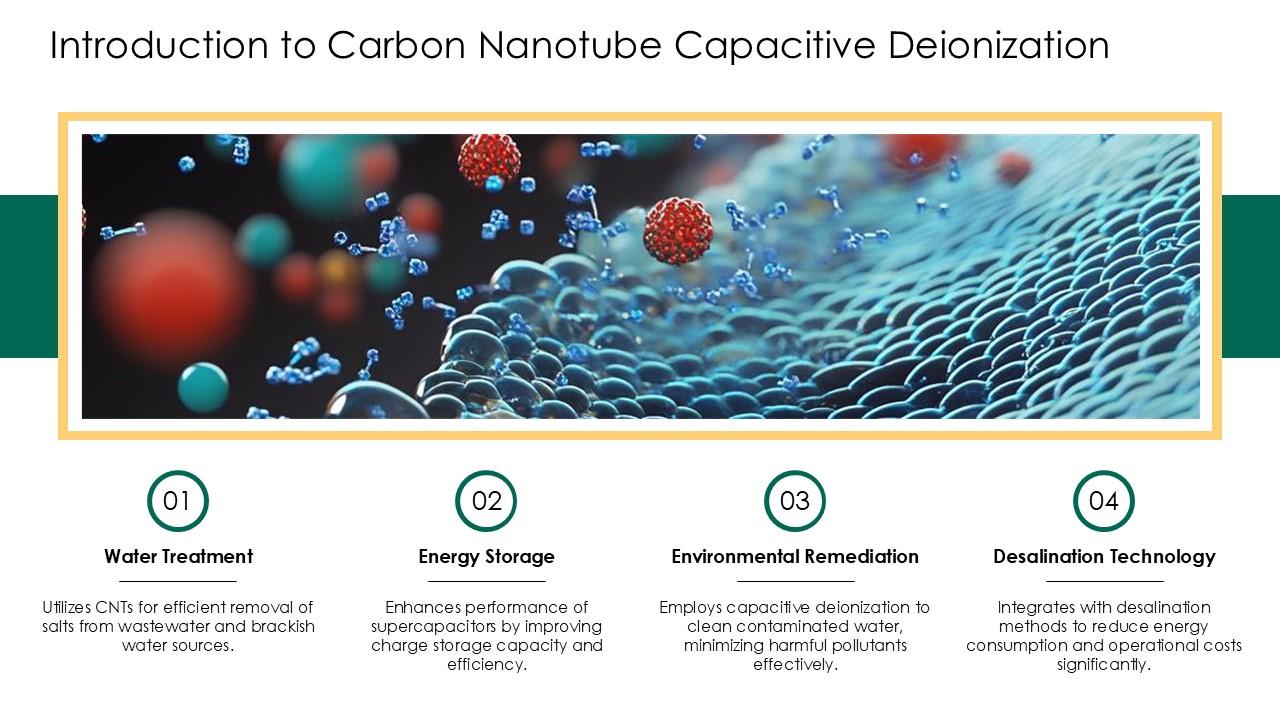
Template 6: Introduction to Carbon Nanotube Capacitive Deionization
This presentation theme explains basics of CDI conversion using nanomaterials based water purification. This allows the hybrid water treatment–energy storage process to act as a new and more sustainable way to treat water while capturing energy compared to traditional methods. It focuses on how CDI offers the best of both worlds — clean water with minimal energy requirements. It is best for researchers, and water treatment professionals to communicate CDI's potential. Claim it now.
Template 7: Technological Innovations in Carbon Nanotube Synthesis
This presentation slide reviews state-of-the-art developments in carbon allotropes nanotube (CNT) synthesis including growth mechanism, scalability approaches as well as functionalization processes. It illustrates that advances in methods such as chemical vapor deposition (CVD) and plasma-enhanced techniques lead to increased levels of purity and production levels of CNTs. Stakeholders will be informed of the advances in CNT synthesis and their transfer into the real world. Download it now.

Template 8: Methods Involved to Cut Carbon Nanotubes
This PPT Theme includes chemical cutting, mechanical strength, laser cutting, and plasma cutting, with special benefits for each. Strong acids or oxidizers are used for chemical cutting that cleave CNTs into shorter fragments, making it possible to control length accurately. Laser cutting is a micro process with high precision and low contamination, while plasma cutting cuts the materials using ionized gas. This slide aims at selecting their method of cutting the material of their interest. Download it now.

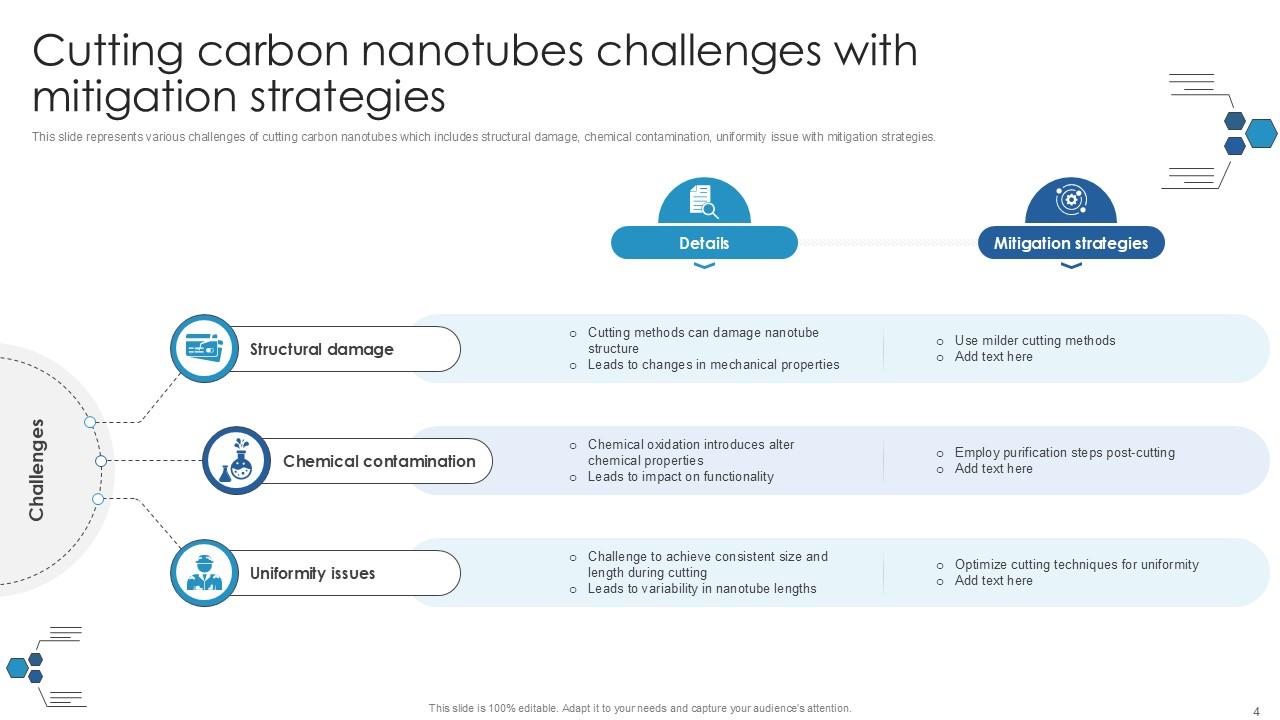
Template 9: Cutting Carbon Nanotubes Challenges With Mitigation Strategies
This PPT Template discusses major challenges to cut CNTs and solutions to overcome them. The first is structural reinforcement whereby CNTs are largely resistant to cutting owing to the strength of their bonds. Another form of risk it poses is that exposure to harsh cutting agents that can be harmful and leave unwanted residues in the lungs. It helps to overcome challenges for various applications– electronics, energy storage, or drug delivery systems. Download it now.
Template 10: Role in Energy Storage Solutions
This presentation slide comprises of key challenges with the use of CNTs; revolutionary solutions with substantial advantages (source), batteries and supercapacitors face one big challenge, lack of conductivity with slow charge cycles. The combination of their greater surface area also increases electrode utilization, enhancing overall performance. Illustration of CNT role in an advanced flexible electronics, its development, testing, and implementation. Get it now.

Present Carbon Nanotubes with Confidence and Clarity!
Due to their extraordinary physical properties remarkable intrinsic strength, high thermal & electrical conductivity, and wide-range applications including aerospace, medicine, electronics, and renewable energy carbon nanotubes (CNTs) have been marveling almost every industry . You will need a presentation as revolutionary as the technology itself to tell the world about their potential effectively. Top 10 Carbon Nanotube PPT Templates from SlideTeam helps to make you understand complex concepts in a precise and impactful manner.
Our frameworks are perfect for researchers, engineers, educators, and business professionals looking to present the latest breakthroughs in nanotechnology applications. Are you set to mesmerize the onlookers? Grab our templates now and make complex scientific data tangible through a compelling presentation.
PS: Don’t miss our blog on Top 10 Nanotechnology Presentation Templates to break down intricate details and showcase groundbreaking advancements.
FAQs
1. What are the different types of carbon nanotubes and their properties?
Carbon nanotubes CNTs are mainly divided into two types according to the structural characteristics of chiral vectors:
Single-Walled Carbon Nanotubes (SWCNTs):
- Made out of a single sheet of graphene wrapped up into a cylinder.
- Diameter: ~0.4–2 nm.
- Good electrical conductivity (metallic or semiconducting, depending on chirality)
- Very strong in tension (~100x that of steel).
- Very high thermal conductivity (~3,500 W/m·K)
- Utilised in transistors, sensors and soft electronics.
Double-Walled Carbon Nanotubes (DWCNTs)
- Composed of several graphene tubes that are arranged concentrically.
- Diameter: ~2–100 nm.
- High electrical/thermal properties, lower mechanical strength than SWCNTs
- Higher defect tolerance and production efficiency.
- Application areas include composites, conductive coatings, and structural materials.
Other classifications:
- Armchair, Zigzag and Chiral CNTs (rolling direction of graphene)
- Functionalized CNTs (obtain chemicals for high dispersity and reactivity properties of CNT).
2. How are carbon nanotubes used in electronics and material science?
Electronics Applications:
Transistors & Nanoelectronics: Due to their high carrier mobility, SWCNTs are used in the development of high-speed, low-power transistors.
Flexible & transparent electronics: CNT-based films are employed in touchscreens, flexible screens and wearable sensors amongst other devices.
Chips: CNTs have a high current-carrying capacity to use in the place of copper interconnects.
Sensors: Useful in gas, chemical and biosensor due to high surface area and sensitivity.
Material Science Applications:
Reinforcement: Used to make polymers, metals, and ceramics stronger, stiffer, and more conductive.
Conductive Coatings: Anti-static films, EMI shielding and battery electrodes
Energy Storage: Use in lithium-ion battery and supercapacitor performance improvements
Thermal Management: High thermal conductivity makes it useful in heat sinks and thermal interface materials.
3. What are the challenges in manufacturing carbon nanotubes at scale?
High Production Costs: Current methods (CVD, arc-discharge, laser ablation) are energy-intensive and use costly catalysts.
Quality Control: Lack of control over uniform CNT generation (e.g., not consistent in diameter, length, chirality)
Purification & Separation: The purification of SWCNTs is challenging and the separation of metallic vs. semiconducting SWCNTs is even more challenging.
Problem of Dispersion: CNTs find it difficult to disperse uniformly in material because of their tendency to agglomerate.
Health & Environmental Risks: Possible toxicity with no units for acceptable contamination level
Scalability: The key challenge to industrial level ubiquity is mass production, without sacrificing quality.
These challenges are being addressed by improving synthesis (e.g., floating catalyst CVD) and post-processing techniques.