


 0 Comment
 Customer Reviews

Have you ever thought some organisms can slip past your body without being noticed? Definitely, there are! These organisms are so dangerous that they can rewire your cells and serve their own needs.
These organisms are called parasites. They play an important role in microscopic parasite biology. From malaria to toxoplasmosis, these microscopic organisms have developed some strategies to survive the most complex immune systems. But now, science is striking back—with molecules as its weapons.
Before I explain how science is invading this field, let's get into the basics!
Parasite microbiology is the study of parasites through the lens of molecular biology. From its looks, it can seem simple, like the recognition of parasites under a microscope, but it is more than that. It helps in understanding organisms at its core levels, including their genes and metabolic pathways. The study also delves deeply into how these organisms interact with their hosts. It has combined parasitology with molecular techniques like gene editing, DNA sequencing, and transcriptomic profiling.
Now, let's understand why parasite microbiology is important. Although parasites seem tiny, their impact is massive. They can cause various parasitic diseases, from malaria to Chagas disease. Parasites continue to be a major cause of mortality, especially in those regions which has low-income.
Molecular parasitology is important for scientists because it helps fighting parasitic diseases. This study helps in the development of targeted drugs that are more effective and less toxic. Through this study, drugs can be easily developed, diseases diagnosed, vaccines discovered, and host parasitic interactions understood.
Get your hands on nematodes PPT templates to highlight the organisms in detail along with major information involved!
SlideTeam has crafted some ready-to-use PPT templates to highlight the essential components of molecular parasitology. These well-thought designed slides can help researchers, educators, and students effectively present complex concepts such as host-parasite interactions, molecular diagnostic tools, and gene-editing techniques. These slides allow you to visually engage with people in your academic presentations, lab meetings, or science outreach, tethering clarity to a field that's as intricate as it is important.
Download our ready-to-use Toxoplasmosis PPT templates to familiarize the masses with zoonotic diseases!
Template 1: Molecular Parasitology
As discussed earlier, molecular parasitology plays an important role in the identification of several diseases and the crafting of medicines. This content-ready slide can help you highlight every process involved with it, from its basics, techniques, basic concepts, and major classes to global perspectives, and funding opportunities. You can learn about global perspectives and get training in molecular parasitology. This template is a must-have for those who are looking to profoundly enlighten the audience about this topic.
[product_image id=1317596]
Template 2: Importance of Molecular Techniques
Molecular techniques are crucial for biologists and researchers who are closely involved with the science field for several reasons. This template will help inculcate a deeper understanding of molecular parasitology by highlighting its benefits. You can underline the advantages of rapid disease diagnosis, epidemiological surveillance, biomarker discovery, research advancements, targeted treatment, pathogen characterization, and vaccine development.

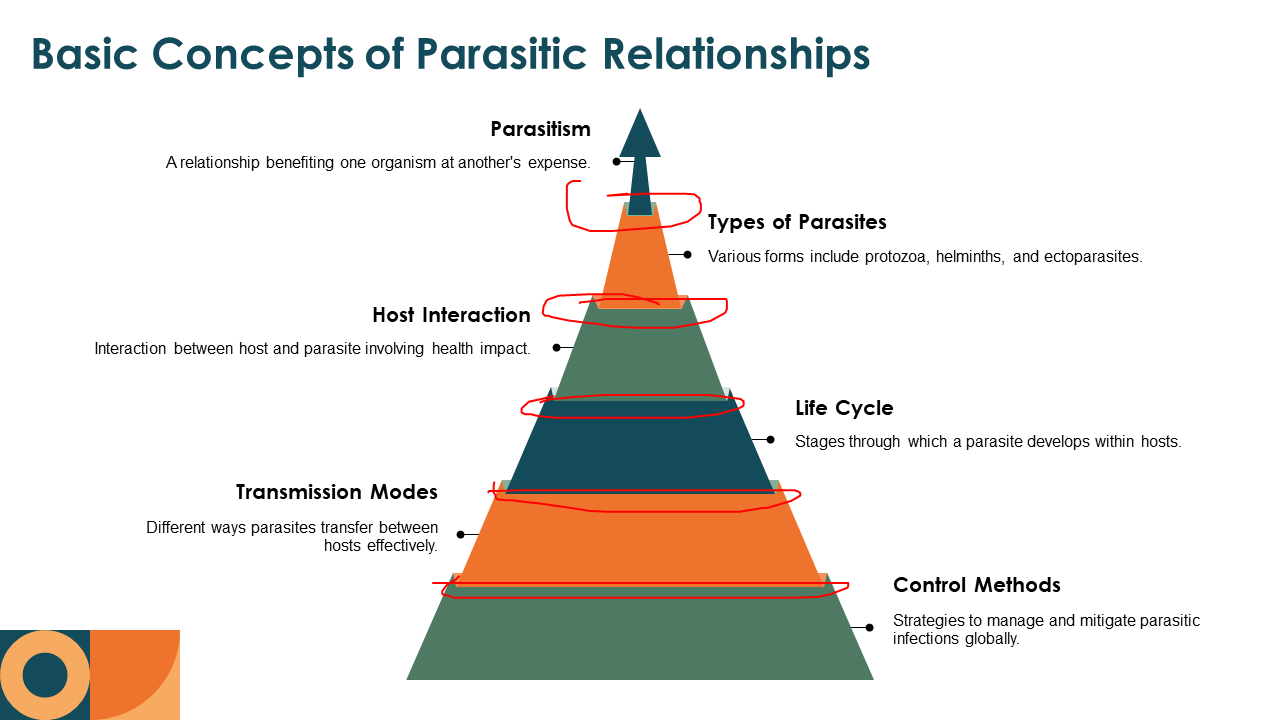
Template 3: Basic Concepts of Parasitic Relationships
Parasitic relationships are complex; this slide will help you simplify them. You get to demonstrate these relationships from their core. Firstly, you can highlight parasitism, types of parasites, host interaction, life cycle, transmission modes, and control methods. You get to educate about all these in detail to instill a deeper knowledge about parasitism.
Template 4: Major Classes of Parasites
Parasites are divided into different categories, and you get to learn about all of them in detail through this slide. Get familiar with the classes like protozoa, fungi, nematodes, and arthropods in detail. Each group represents a different category of parasites with different biological features, life cycles, and disease-causing factors. This slide simplifies their classes with clear explanations, making it easier to understand their structural differences, modes of transmission, and the specific diseases they are associated with.

Template 5: Lifecycle of Protozoan Parasites
Knowing the lifecycle of protozoan parasites is important to knowing when they can make a new host. This pre-designed slide highlights the complete lifespan of protozoa: infection, replication, transmission, extraction, and development. Understanding each of these phases help in identifying the most vulnerable points for intervention, whether through drug treatment and different preventive measures. The slide simplifies complex biological processes into an easy-to-follow format, making it ideal for presentations, lectures, or training sessions.

Template 6: Lifecycle of Helminth Parasites
Elongated, flat, or round bodies characterize helminth parasites. This pre-designed template will help you demonstrate the lifecycle of those parasites. Understanding each stage of these parasites can help you identify how they will infect hosts. You get to highlight the phases of eggs, larvae, and adults. The slide allows you to underline the complete developmental journey of helminth parasites, including how they migrate through various organs, avoid immune responses, and adapt to different environments within the host.

Template 7: Molecular Genetics of Parasites
Molecular genetics is a field that studies the structure, function, and activity of genes at the molecular level. This template will give you a framework for the molecular genetics of parasites. You can clearly highlight the process from disease diagnosis, treatment development, vaccine advancement, and epidemiological training. Get your hands on this template to streamline difficult concepts of the molecular genetics of parasites.

Template 8: Host-Parasite Interaction Mechanisms
In a host-parasite relationship, a parasite benefits by living on or in a host. This often happens at the host's expense, as the parasite relies on the host for resources and survival. This pre-designed template will help you highlight their interaction mechanisms to control diseases and manage ecosystems. You get to highlight the host response, pathogen recognition, and immune evasion for insights into the evolution of both hosts and parasites.

Template 9: Immune Responses to Parasitic Infections
When parasites invade the body, they trigger a complex and dynamic immune response. Unlike bacteria or viruses, many parasites have evolved intricate strategies to evade, suppress, or manipulate the host’s immune system. Through this content-ready slide, you get to underline how immune responses to parasitic infections, from cell-mediated immunity to therapeutic approaches.

Template 10: Molecular Methods for Parasite Identification
Identification of parasites is a complex process, and knowing different methods will keep you up-to-date. You can highlight different techniques like PCR, RT-PCR, Microarrays, Genotyping, Sequencing, Fish, Lamp, and Crispr. Also, you get to mention these types in detail and enlighten your audience about it in detail.

Conclusion!
To put it all together, molecular parasitology is an exciting and important field that helps us understand how parasites live, grow, and affect our health. These tiny organisms may be small, but they can cause big problems. There are several challenges especially in parts of the world with fewer medical resources. That’s why it’s so important to study it using modern tools and share it with others.
The ready-made PPT templates from SlideTeam make it much easier to explain these complex topics. Whether you're a student, teacher, or scientist, these slides can help you talk about parasites clearly. From showing how parasites avoid our immune systems to how we can stop them with medicine or vaccines, each template covers key ideas in a simple, visual way.
If you want your next science presentation to be more engaging and easier to follow, these templates are a great choice. They’ll save you time and help your audience better understand why parasitology matters.
P.S. Explore our rice diseases PPT templates to take preventative measures against these infections!
Frequently Asked Questions (FAQs)
1. What are the 3 main types of parasites?!!
The three main types of parasites are Protozoa, Helminths, Ectoparasites.
2. What are 5 examples of parasitic organisms?
Here are five examples of parasites which involve:
- Plasmodium falciparum that causes malaria.
- Giardia lamblia that causes giardiasis.
- Taenia solium that causes cysticercosis.
- Ascaris lumbricoides, the roundworms that live in the intestines.
- Pediculus humanus capitis causes lice that live on the scalp.
3. What are the common parasitic diseases?
Some of the most common parasitic diseases include Malaria, Giardiasis, Schistosomiasis ,Ascariasis, Toxoplasmosis, and Amebiasis.