

 0 Comment
 Customer Reviews

One of the most important aspects of managing an agile project is to have a proper mechanism for tracking progress and outcomes. Sprint summaries are an important tool that enables project managers and the team to record and document the essentials, review the progress made, and learn about any issues that may have occurred in the particular sprint. These summaries not only contribute to good communication but also the improvement of the team’s performance as they record how the team is doing.
In this post, we will be looking at the Top 10 Sprint Summary Templates that have been developed as tools to help improve productivity and make the sprint review more efficient. Therefore, through these templates, organizations will be in a position to guarantee that every single sprint is in line with the project objectives and that the decisions made in the course of that particular sprint are useful for the subsequent sprints in the project. Now, let us see how these templates can help to achieve operational excellence within your framework of the agile methodology.
Template 1: Sprint Summary Powerpoint Ppt Template Bundles
This PPT Deck includes several slides that provide key information on the concept of sprint and project management and templates for summarizing the Scrum project sprint report and Jira sprint summary. All the slides are informative and are organized in a simple manner with a plain design; they may contain statistics, timelines, diagrams, etc. These templates are quite versatile and may be used in any special style that is needed for a specific project. Therefore, the bundle is quite informative for project managers and other agile teams in their search for a tool that could facilitate their work. Download this 'bundle of joy,' quite literally!
[product_image id=678486]
Template 2: Scrum Project Sprint Summary Report
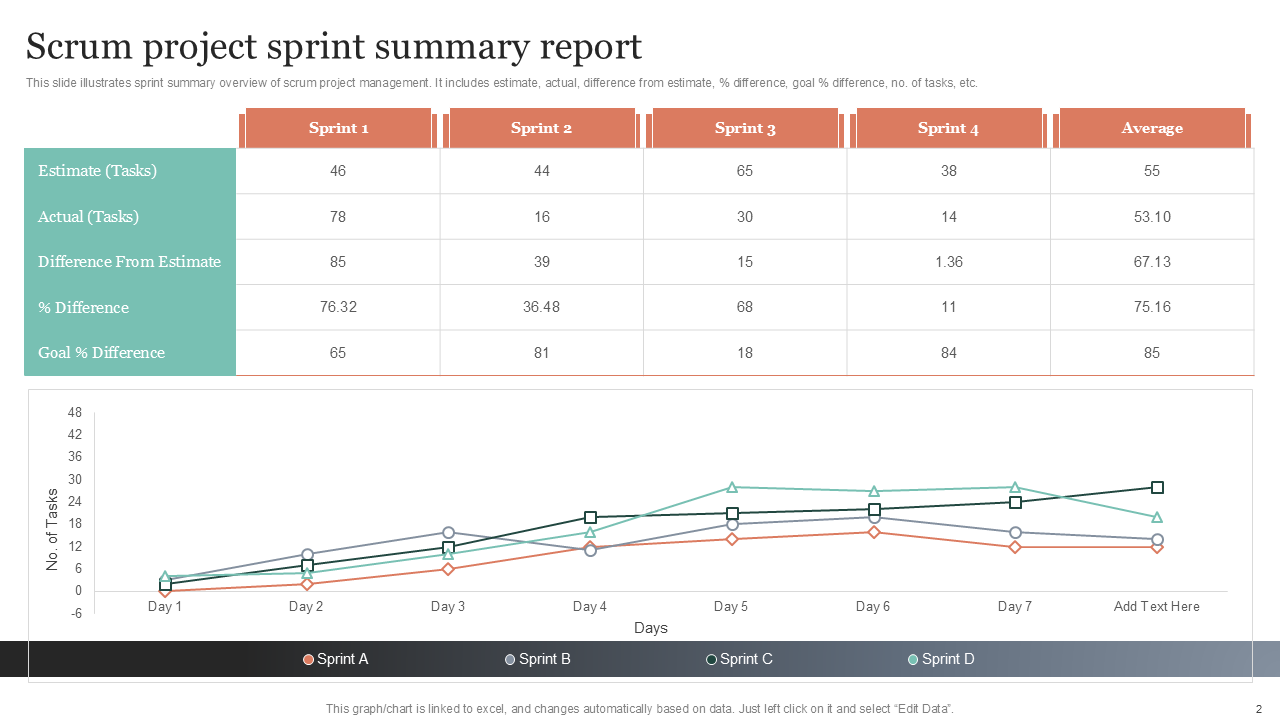
The Sprint Summary Report slide briefly describes the performance of the sprint in scrum project management. It shows estimates, actual values, the deviation from the estimates, percentage deviation, and goal percentage. All the data is arranged in the form of a tabular structure to display progress made over four specific sprints. All the analyses are done per sprint, and the last slide provides a summary of all the metrics gathered in the four sprints, thus giving a general overview of the project's health. This slide helps keep track of the effectiveness of the sprint planning and the work done for the agile development teams and helps understand the trends.
Template 3: Jira Sprint Closure Summary Report with Velocity Chart
The Sprint Closure Summary slide gives an overview of the key information about the current sprint through charts and tables. The slide has a burn-down chart that shows the amount of work remaining in the sprint and a velocity chart that shows the amount of work done in the past few sprints. Further, there is a scrum team table showing the people who are present in the team and their duties. At the end of each slide, a brief conclusion of the overall findings from the performance of the sprint is presented, which makes it easy to understand the progress and result of the sprint.

Template 4: Jira Sprint Testing Highlights and Summary Reports
This particular slide provides a good summary of various testing results and sprint performance indicators. It captures basics like the spring overview, issues in the whole process, risks seen, and the retrospective meeting outcomes. Furthermore, it also discusses the idea of sprint spillover, which refers to the tasks that are not finished in a particular sprint. A pie chart is shown on the side to give a visual representation of some key data in order to categorize the issues, tasks, or progress within the sprint and the testing performance and challenges.

Template 5: Sprint Metrics and Backlogs Summary Reports
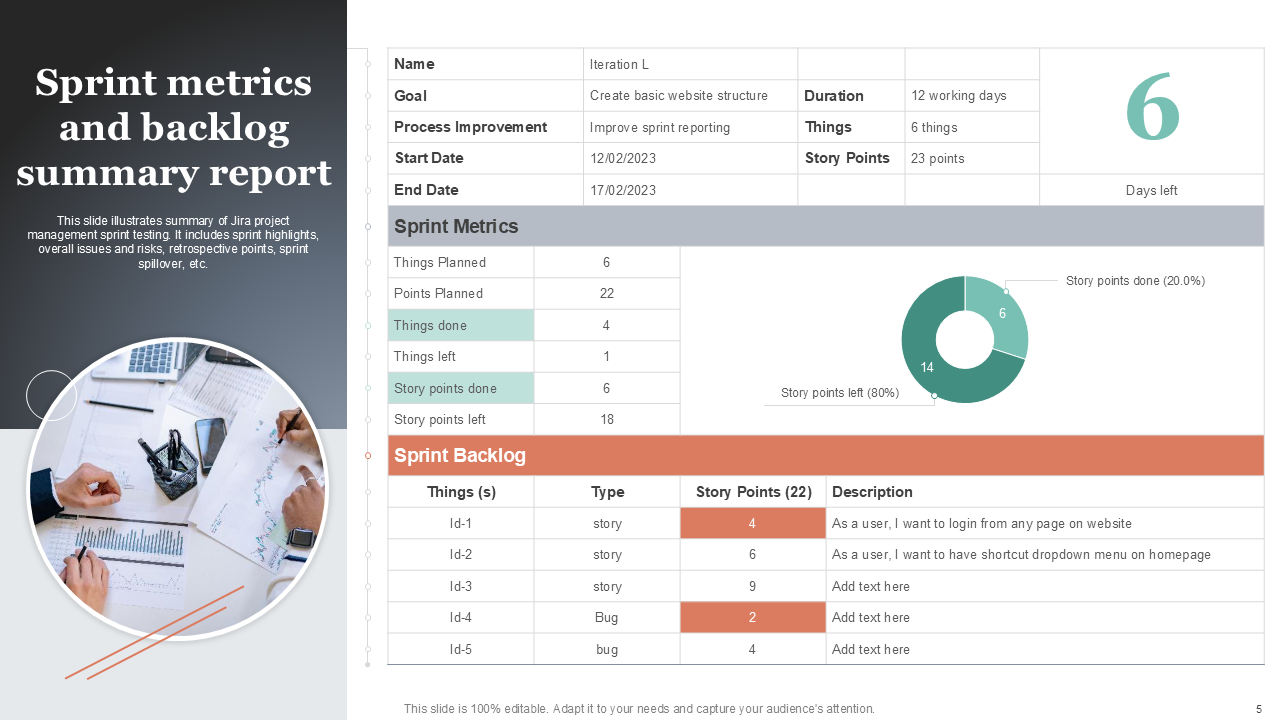
This slide gives a quick view of the sprint metrics and backlog performance, where you can find information about what was accomplished, what problems were faced, and what risks might hinder progress. There are also retrospective feedback issues,ues, and problems that have been procrastinated and then brought over. Together with these metrics, the slide also contains information about individual projects and the time needed to accomplish them. Such metrics and backlog data are useful to know how a sprint and the project in general work, as well as when the project is planned to be completed, which is helpful for management and decision-making.
Template 6: Sprint Status and Timeline Summary Report
This slide gives a clear and concise account of the status and timeline of the current sprint with a relevant picture on the left side to keep the interest of the audience. The information presented includes vital information like the sprint, the assigned team, current status of tasks, priority, estimated time to complete tasks, timelines, and project type. There are two tables on the slide: one table shows the tasks for the current sprint, and the second one presents the backlog. Together, these elements give a clear and systematic overview of the project as it is now, which helps the teams to get an understanding of the work progress and backlog and thereby control the work.

Template 7: Agile Product Management Sprint Summary Report
As shown in this slide, the sprint summary report elaborates on the main focus on agile product management, especially backlog management. It has a detailed list with the basic information, including Task Names, Story Points, Sprint Readiness, Stories, Status, Priority, and which Task to which Sprint. The data is presented in a way that is divided into three sprints; this allows for a simpler assessment of the flow of tasks and their completion. Due to the inherent scope of the table, all aspects of the sprint and backlog are captured, which enables teams to effectively manage the product and schedule their work in a manner that is conducive to efficient delivery across several sprints.

Template 8: Sprint Summary Report with Split by Priority and Status
This slide includes a sprint summary report with the breakdown by priority and status illustrated by two pie charts. Two charts present the distribution of tasks according to their urgency levels and the progress of those tasks. This particular slide provides a statistical glance at the ongoing sprint, the average time taken to complete a certain task, and a report of how well the sprint has gone up to the current date. These visualizations, together with the metrics-driven information, give a distilled view of sprint performance to enable teams to review the allocation of work and focus on the most critical activities based on the current state of progress.

Template 9: Sprint Task Planning Summary Report
This slide contains an elaborate sprint planning summary in relation to the user stories for the scrum project management. It shows a clear and detailed table that consists of important information, including the story ID, the story name, the story points, and the user story details, respectively. Also, it comprises the name of the sprint, the roles, and the managers of the respective activities of the sprint. The slide also shows the finish date of each story, as well as any notes that are useful for the team during the sprint. This is because all the elements of the sprint plan are systematically arranged to allow easy tracking of the various plans and their timelines.

Template 10: Website Development Sprint Planning Summary
This slide is a sprint task planning summary for agile product management, the key facets of which include tasks, assignees, status, epics, priority, and time estimates. This report is organized in two parts according to the two sprints – Sprint A and Sprint B –each presented in the corresponding table. These tables facilitate easy comparison of the progress and the order of the tasks in the two sprints in order to assess resources and accomplishments. This way of presenting the information makes planning and decision-making easier for both sprints, thus increasing the chances of the two sprints being delivered successfully.

Final Word
A good sprint summary template is crucial to enhancing the overall work of a project as well as the relationship between the team members. The ten templates for the sprint summary highlighted in this article will allow you to save time and effort while enhancing collaboration within your teams. Through using these templates, teams will be in a position to see progress, find out what is slowing them down, and make decisions that are backed by facts and figures. These tools are meant to assist you in maintaining an order of business and to keep your projects on track and on course to accomplish their goals. When using these resources, you will notice that they greatly enhance the efficiency of your agile practices.