

Sprint Summary Report With Split By Priority And Status





Try Before you Buy Download Free Sample Product
 Impress Your
Audience
 100%
Editable
 Save Hours
of Time


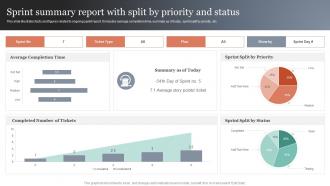
This slide illustrates facts and figures related to ongoing sprint report. It includes average completion time, summary as of today, sprint split by priority, etc.
People who downloaded this PowerPoint presentation also viewed the following :
Sprint Summary Report With Split By Priority And Status with all 7 slides:
Use our Sprint Summary Report With Split By Priority And Status to effectively help you save your valuable time. They are readymade to fit into any presentation structure.






FAQs for Sprint Summary Report With Split By
Key metrics for a Sprint Summary Report include sprint goal achievement, velocity, burndown progress, completed versus planned story points, and team capacity utilization. These metrics enable project managers and stakeholders to assess team productivity, identify bottlenecks, and optimize future sprint planning, with many agile organizations finding that consistent tracking ultimately delivers improved predictability and enhanced delivery performance.
A Sprint Summary Report improves team communication by providing transparent visibility into completed work, blockers encountered, and upcoming priorities, ensuring all stakeholders stay aligned on progress and challenges. Through centralized documentation of achievements, lessons learned, and action items, teams enhance collaboration across departments, streamline decision-making processes, and ultimately deliver more coordinated project outcomes with reduced miscommunication.
Sprint Summary Report data visualization best practices include using clear burn-down charts, velocity graphs, progress bars for story completion, color-coded task status indicators, and comparative metrics dashboards. These visual elements streamline stakeholder communication by highlighting sprint achievements, identifying bottlenecks, and tracking team performance trends, with many agile teams finding that strategic data presentation ultimately enhances project transparency and accelerates decision-making processes.
Retrospective insights can be effectively captured by documenting team feedback on process improvements, identifying bottlenecks or blockers encountered, and highlighting successful practices worth replicating in future sprints. These insights enable organizations to continuously refine their development processes, enhance team collaboration, and accelerate delivery timelines, with many teams finding that structured retrospective documentation significantly improves sprint-over-sprint performance outcomes.
Teams should avoid including excessive technical details that obscure key insights, focusing solely on completed tasks without analyzing blockers or lessons learned, and presenting data without actionable recommendations for future sprints. Many organizations find that overly lengthy reports, inconsistent formatting across sprints, and failing to highlight team achievements ultimately diminish stakeholder engagement and reduce the report's strategic value for continuous improvement.
Sprint Summary Reports should be distributed to stakeholders at the end of each sprint cycle, typically every 2-4 weeks depending on sprint length, with additional reports for major milestones or critical blockers. This regular cadence ensures stakeholders stay informed about progress, deliverables, and upcoming priorities, while enabling teams to maintain transparency, gather timely feedback, and make strategic adjustments that ultimately enhance project outcomes and stakeholder alignment.
Sprint Summary Reports serve as critical communication tools in Agile project management, documenting completed work, identifying blockers, measuring velocity, and tracking progress against sprint goals. These reports enable teams to maintain transparency with stakeholders, facilitate retrospective discussions, and demonstrate value delivery, with many organizations finding that regular sprint reporting enhances accountability, improves forecasting accuracy, and ultimately delivers stronger project outcomes.
Sprint summary reports facilitate continuous improvement by identifying successful practices, recurring obstacles, team performance patterns, and resource allocation insights from completed iterations. These comprehensive reviews enable teams to refine estimation accuracy, streamline workflows, and enhance collaboration strategies, with many agile organizations finding that systematic sprint analysis ultimately delivers faster delivery cycles and improved product quality.
Tools that enhance Sprint Summary Report creation include Jira, Azure DevOps, Trello, Confluence, and Microsoft Project, along with visualization platforms like Tableau and Power BI. These technologies streamline reporting by automating data collection, generating real-time analytics, and creating comprehensive dashboards, with many agile teams finding that integrated toolsets significantly reduce manual effort while delivering enhanced transparency and stakeholder communication.
Different Agile methodologies influence Sprint Summary Report formats through varying emphasis on ceremonies, metrics, and deliverables, with Scrum focusing on sprint goals and burndown charts, Kanban emphasizing flow metrics, and SAFe incorporating program-level dependencies. These frameworks enable teams to customize reporting structures by highlighting methodology-specific outcomes, stakeholder requirements, and organizational scaling needs, ultimately delivering enhanced transparency and strategic alignment across development cycles.
Essential elements include sprint goals and outcomes, completed user stories, velocity metrics, burndown charts, identified blockers and resolutions, and team retrospective insights. These components enable project managers to track progress effectively, communicate achievements to stakeholders, and identify process improvements, with many agile teams finding that comprehensive sprint summaries enhance transparency and facilitate better planning for future iterations.
Feedback from sprint summary reports integrates into next sprint planning through retrospective analysis, stakeholder input review, and performance metric evaluation. Teams can adjust sprint goals, reallocate resources, and refine user stories based on previous sprint outcomes, with many organizations finding that this iterative approach enhances delivery timelines and overall project quality.
Including both successes and challenges creates a balanced, credible assessment that drives continuous improvement and stakeholder trust. This transparency enables teams to replicate successful strategies while proactively addressing obstacles, with many organizations finding that honest reporting accelerates problem-solving, enhances team accountability, and ultimately delivers more realistic project planning and stronger long-term performance outcomes.
A template streamlines Sprint Summary Report drafting by providing predefined sections for key metrics, accomplishments, challenges, and next steps, eliminating guesswork and ensuring consistency across reporting cycles. This structured approach enables teams to focus on analyzing sprint outcomes rather than formatting, with many agile organizations finding that standardized templates reduce reporting time by 40-50% while improving stakeholder communication.
The tone should reflect professional transparency and constructive progress assessment, using clear, objective language that balances achievements with areas for improvement. Effective reports adopt collaborative language that emphasizes team accomplishments, lessons learned, and forward momentum, with many agile organizations finding that balanced, solution-focused communication enhances stakeholder confidence and drives continuous improvement.
-
Attractive design and informative presentation.
-
Loved the templates on SlideTeam, I believe I have found the go to place for my presentation needs!