

 0 Comment
 Customer Reviews

The sugar industry is more than just a story of sweetness. It's a complex web of agriculture, economics, global trade, and sustainability. It is about analyzing production trends using complex datasets, highlighting innovations in biofuels, communicating your sugar supply chain to the stakeholders, swiftly responding to fluctuating sugar prices and marketing policies, and pitching a new marketing strategy for a sugar mill expansion.
With a combined output of over 182 million tonnes in 108 countries across the globe and a revenue of over $ 13 billion in the USA alone, looking past the potential of the sugar industry is impossible. To exploit its scope, most mid-to-large operations rely on regular data analysis and formal reporting tools.
Imagine a boardroom where people discuss the future of a five-decades-old sugar mill. Stakeholders lean in, analysts flip through charts, and executives glance at outdated slides that fail to communicate the real story—production bottlenecks, evolving sugar market trends, and sugar regulations. Despite rich data and valuable insights, the presentation falls flat. Why? Because how you present matters just as much as what you present. The form is equally important as the content.
Introduce an analytics-driven proposal style with our Industry templates to smoothly extract relevant data and transform your pitches!
SlideTeam aces this challenge with its Sugar Industry Presentation Templates. Designed specifically for agribusiness professionals, sugar mill owners, researchers, and trade analysts, these templates are not just simple presets—they're strategic tools. With the right visuals, layout, and flow, they help you turn complex data into compelling stories, making your stakeholders and audience pay attention and act.
Get our Industry report templates to explore and capitalize on significant market opportunities in retail, food, and other industries!
Let’s examine our sharp-as-sugar blade presets!
Template 1: Material Flow Analysis of Sugar Industry PPT Structure
With over 30 PPT templates, this bundle ensures a robust framework for maintaining a seamless sugar production network. It covers a diverse range of elements, from input materials and water usage to sugar supply chain coordination. Its key priority, however, remains achieving optimum energy consumption goals. The deck offers multiple performance indicators, along with their benchmarks, to measure the industry’s performance on CO2 emissions, water footprint, and other energy efficiency parameters. Moreover, it provides flowcharts and funnel diagrams to optimize water resource utilization and manage logistics, along with handling waste. Use these proposals to pitch potential growth and expansion areas.
[product_image id=1395778]
Template 2: Sugar Manufacturing Industry Process Costing
Whether you are presenting in front of well-qualified research analysts or a team of stakeholders, this slide simplifies the visualization of data that covers sugar manufacturing costs in different steps. It offers bar graphs to represent the prices of cane shredding, milling, heating, spinning, crystallization, and other processes. Additionally, the template helps you align the presentation according to the meeting agenda and discuss the most relevant concerns.

Template 3: Food Industry Sugar Crystallization Insights PPT Slides
Do you want to educate your audience on sugar refining? This template serves as the panacea to your broad needs. It offers valuable, detailed insights concerning the processes, such as temperature control, seeding techniques, and agitation dynamics. Modify and implement the information provided to plug in pertinent gaps with potentially detrimental effects. Strengthen your base with the minute details to maximize sugar quality and purity.

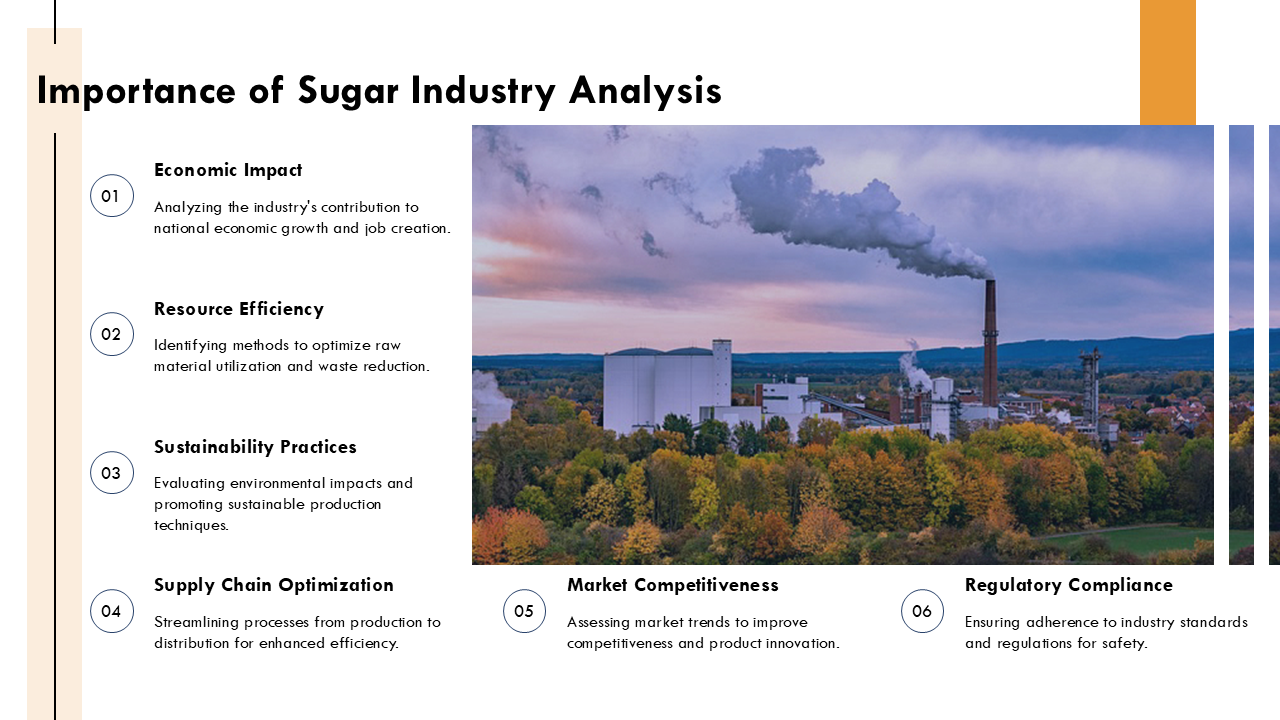
Template 4: Importance of Sugar Industry Analysis
This preset compiles a number of variables that a sugar industry analysis controls, helping you make a strong case in its favor. From an economic perspective to environmental impacts and raw material utilization to product innovation, a comprehensive analysis contributes to understanding the wide presence of the sugar industry. Use the above template to pitch the requirement. Download now!
Template 5: Current Trends in Sugar Industry
Being updated with the prevalent trends is significant for businesses to maintain their relevance, more pertinently in an ever-changing sugar market landscape. However, with the primary focus on the other aspects of the operations, keeping an eye on updated sugar industry news becomes challenging. Our template addresses this concern by incorporating emerging sugar market trends like the growing use of automation technology and increased biofuel demand for you to capitalize on.

Template 6: Energy Consumption in Sugar Production
The sugar manufacturing industry thrives on minimizing energy consumption and its related environmental impact for prolonged sustainability. The USP of this template exists in the precise application of its highly appropriate KPIs, metrics, and graphs, which assist you in monitoring your progress in getting to this objective. Get this to measure how far you are from your renewable energy target or your current progress in saving energy.

Template 7: Life Cycle Assessment in Sugar Production
This template categorizes different sugar production phases according to their environmental impacts and input metrics, helping you gather sufficient knowledge to understand each cycle. This further helps you formulate unique strategies to minimize land degradation in the cultivation phase or control air pollution during the distribution stage. Additional key metrics like yield per hectare and cost per kg help you measure the phase-wise achieved results in a standardized way.

Template 8: Water Usage and Management
With its bottom-up funnel diagram, this slide presents a framework for your sugar processing setup to make the best use of available water resources, with a complete focus on recycling. It includes a step-by-step process that implements a steady approach to utilizing water in first growing sugar crops, followed by their harvesting, processing, boiling, and refining until they are ready for consumption. Adopt this roadmap to minimize water wastage.

Template 9: Transportation and Logistics in Sugar Industry
Sugar export and sugar import together are among the largest expenditures in the sugar production industry. Depending on numerous factors, they may empty a quarter to almost one-third of your budget. This calls for construing a rigid sugar supply chain, identifying and managing the nuanced steps, such as transportation to processing mills, weighing, refining, packaging, and distribution. Download this slide to get this framework and optimize each transportation & logistics move.

Template 10: Research Gaps and Future Studies
This template strengthens your R&D departments and fosters future-oriented analysis by encouraging your analysts to explore unexplored areas in the sugar trade. It compares the current understanding of waste management and energy consumption practices to the desired state to identify what's still lacking, also known as research gaps. Furthermore, it customizes an action plan prioritizing steps like case studies and collaboration to foster meaningful research in sugar manufacturing.

The Leaving Thoughts
In an industry as layered and dynamic as the sugar sector, message refining is as critical as sugar refining. From analyzing production metrics, energy consumption, and environmental impact to pitching sustainability strategies or navigating global sugar consumption shifts, the sugar industry runs on complex and technical information. Our slides, however, simplify this complex web of information and offer you 100% customizable tools that require minimal time and effort.
The sugar supply chain may be complex, but your presentations don’t have to be.
PS: Perfect for reports, pitches, and strategic reviews, explore our industry overview templates to present different industries with clarity.
FAQs on Sugar Industry
What are the key factors affecting the price of sugar in the global market?
Even though there are a substantial number of factors that determine the sugar prices in the global market, sugar demand and its supply always remain the primary ones. While demand can increase with the growth in population, income, or simply higher sugar consumption, factors such as water availability, conducive temperature, government policies, and others influence its production.
How does sugar production impact the economy of major producing countries?
Since there is a global demand for sugar consumption, it offers a huge revenue-generating opportunity for its producers. Countries such as India, Brazil, and China, which not only produce a large amount of sugar but also focus on maintaining a seamless sugar supply chain, generate heavy revenue through sugar exports. It also creates large employment opportunities, offering jobs to a number of people in the producer countries.
What are the main challenges faced by the sugar industry in terms of sustainability?
The sugar industry faces consequential sustainability challenges, such as a lack of water resources or a lack of a framework to use available water in a way that is cost-effective. Another major problem is land degradation due to the regular cultivation and harvesting of sugar crops.