


Industry Overview Of Food Production Sector Powerpoint Presentation Slides




Try Before you Buy Download Free Sample Product
 Impress Your
 Audience
 100%
100% Editable
 Save Hours
 of Time


Industry Overview of Food Production Sector PowerPoint presentation provides a comprehensive overview food market in the USA. The industry analysis summary showcases the competitive landscape, key trends, and economic indicators related to the food production segment. The PowerPoint deck includes a basic overview of the food manufacturing industry regarding contribution toward GDP, estimated revenues, and the total number of registered plants in the USA. Also, this PPT module includes a comprehensive industry analysis using SWOT, PESTEL, and Porters Five Forces techniques. Additionally, it covers an in-depth market analysis of food production industry sub-segments meat, dairy, grains, fruits, and vegetables. Further, the PPT presentation contains an action plan to adopt Industry 4.0 to overcome the food manufacturing challenges. It also includes details of Industry 4.0 impact on the food manufacturing sector in terms of enhanced surveillance of the food manufacturing ecosystem, better control over complex supply chains, etc., and the possible risks that can hinder the successful adoption of Industry 4.0. Eventually, it also incorporates dashboards to monitor consumer goods sales and supply chain costs. Download it now.
People who downloaded this PowerPoint presentation also viewed the following :
Content of this Powerpoint Presentation
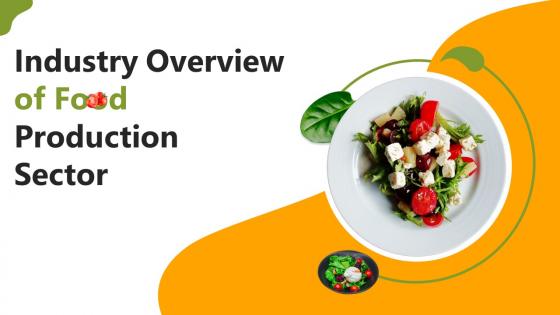
Slide 1: This slide displays the Industry Overview of Food Production Sector.
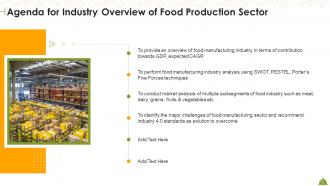
Slide 2: This slide displays the Agenda for Industry Overview of Food Production Sector.
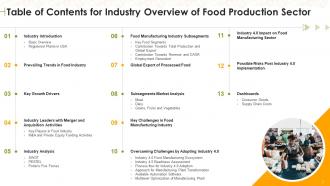
Slide 3: This slide exhibit table of content.
Slide 4: This slide exhibit table of content- Industry Introduction.
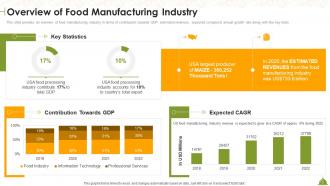
Slide 5: This slide provides an overview of food manufacturing industry.
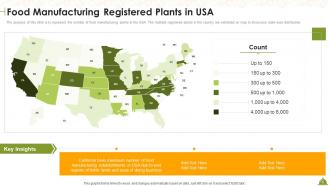
Slide 6: The purpose of this slide is to represent the number of food manufacturing plants in the USA.
Slide 7: This slide exhibit table of content- Prevailing Trends in Food Industry.
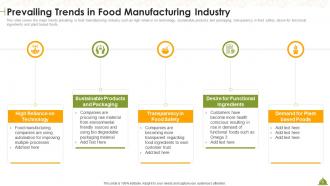
Slide 8: This slide display the major trends prevailing in food manufacturing industry.
Slide 9: This slide exhibit table of content- Key Growth Drivers.
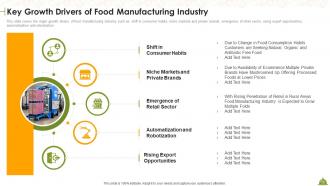
Slide 10: This slide covers the major growth drivers of food manufacturing industry.
Slide 11: This slide exhibit table of content- Industry Leaders with Merger and Acquisition Activities.
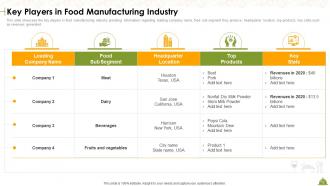
Slide 12: This slide showcase the key players in food manufacturing industry.
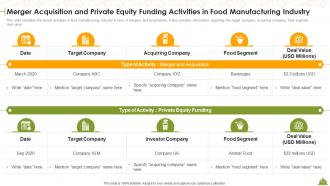
Slide 13: This slide tabulates the recent activities in food manufacturing industry in term of mergers and acquisitions.
Slide 14: This slide exhibit table of content- Industry Analysis.
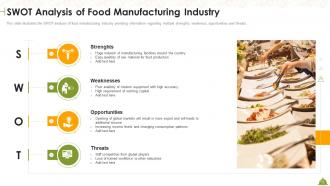
Slide 15: This slide showcase the SWOT analysis of food manufacturing industry.
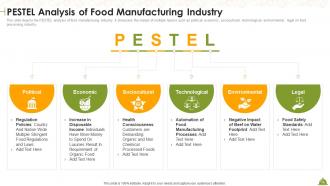
Slide 16: This slide depicts the PESTEL analysis of food manufacturing industry.
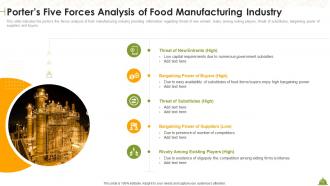
Slide 17: This slide indicates the porter’s five forces analysis of food manufacturing industry.
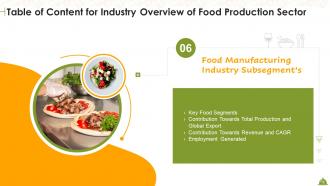
Slide 18: This slide exhibit table of content- Food Manufacturing Industry Subsegment's.
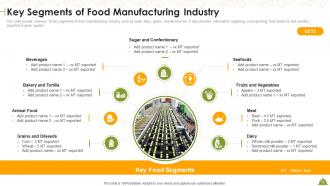
Slide 19: This slide provide overview of key segments of food manufacturing industry.
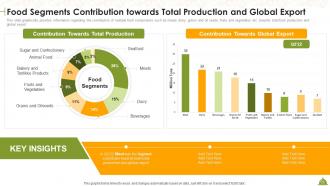
Slide 20: This slide graphically provides information regarding Food Segments Contribution towards Total Production and Global Export.
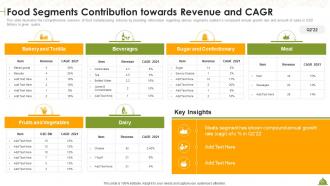
Slide 21: This slide illustrates the Food Segments Contribution towards Revenue and CAGR.
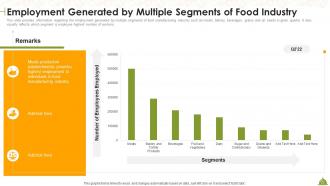
Slide 22: This slide provides information regarding the employment generated by multiple segments of food manufacturing industry.
Slide 23: This slide exhibit table of content- Global Export of Processed Food.
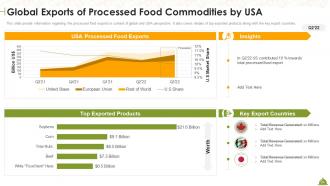
Slide 24: This slide provide information regarding the processed food exports in context of global and USA perspective.
Slide 25: This slide exhibit table of content Subsegments Market Analysis.
Slide 26: This slide provides information regarding the market analysis of meat segment in food manufacturing industry.
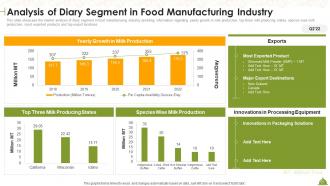
Slide 27: This slide showcase the market analysis of diary segment in food manufacturing industry.
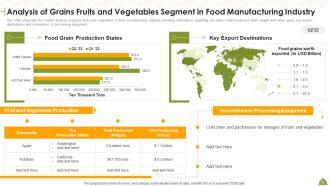
Slide 28: This slide showcase the market analysis of grains fruits and vegetables in food manufacturing industry.
Slide 29: This slide exhibit table of content- Key Challenges in Food Manufacturing Industry.
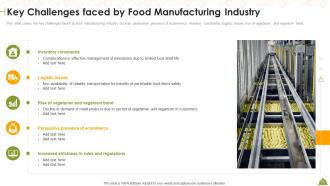
Slide 30: This slide covers the key challenges faced by food manufacturing industry.
Slide 31: This slide exhibit table of content- Overcoming Challenges by Adopting Industry 4.0.
Slide 32: This slide depicts the framework of current and future state of food manufacturing ecosystem.
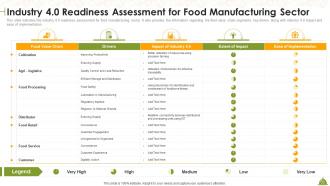
Slide 33: This slide indicates the industry 4.0 readiness assessment for food manufacturing sector.
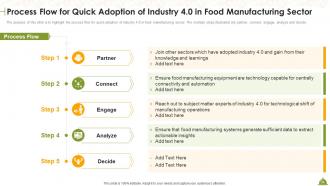
Slide 34: The purpose of this slide is to highlight the process flow for quick adoption of industry 4.0 in food manufacturing sector.
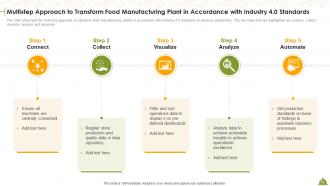
Slide 35: This slide showcase the multistep approach to transform food manufacturing plants in accordance with industry 4.0 standards.
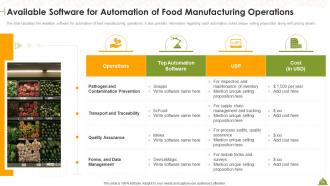
Slide 36: The slide tabulates the available software for automation of food manufacturing operations.
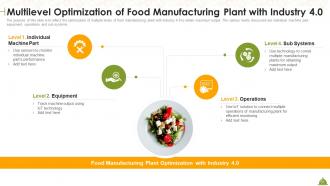
Slide 37: This slide is to reflects multiple levels of food manufacturing plant with industry 4.0.
Slide 38: This slide exhibit table of content- Industry 4.0 Impact on Food Manufacturing Sector.
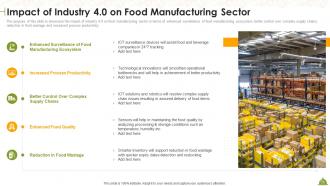
Slide 39: This slide to showcase the Impact of Industry 4.0 on Food Manufacturing Sector.
Slide 40: This slide exhibit table of content- Possible Risk Post Industry 4.0 Implementation.
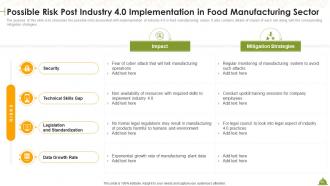
Slide 41: The purpose of this slide is to showcase the possible risks associated with implementation of industry 4.0 in food manufacturing sector.
Slide 42: This slide exhibit table of content- Dashboards.
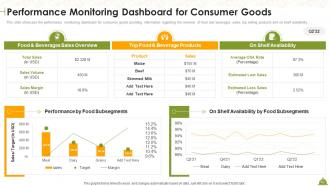
Slide 43: This slide showcase the performance monitoring dashboard for consumer goods.
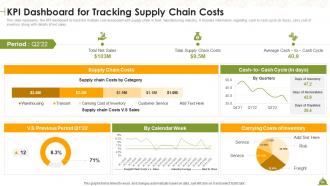
Slide 44: This slide represents the KPI dashboard to track the multiple cost associated with supply chain in food manufacturing industry.
Slide 45: This is the icons slide.
Slide 46: This slide presents title for additional slides.
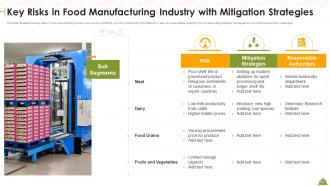
Slide 47: This slide tabulates the Key Risks in Food Manufacturing Industry with Mitigation Strategies.
Slide 48: This slide shows about your company, target audience and its client's values.
Slide 49: This slide presents your company's vision, mission and goals.
Slide 50: This slide depicts posts for past experiences of clients.
Slide 51: This slide depicts 30-60-90 days plan for projects.
Slide 52: This slide shows puzzle for displaying elements of company.
Slide 53: This slide displays Venn.
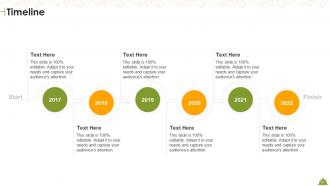
Slide 54: This slide exhibits yearly timeline of company.
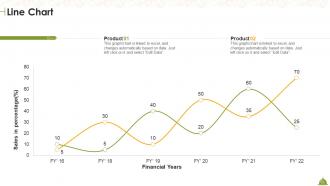
Slide 55: This slide exhibits yearly profits stacked line charts for different products.
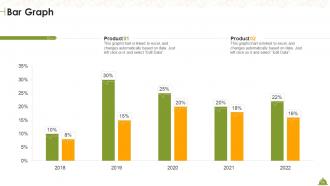
Slide 56: This slide displays yearly bar graph for different products.
Slide 57: This slide displays yearly bar graph for different products.
Industry Overview Of Food Production Sector Powerpoint Presentation Slides with all 62 slides:
Use our Industry Overview Of Food Production Sector Powerpoint Presentation Slides to effectively help you save your valuable time. They are readymade to fit into any presentation structure.










FAQs for Industry Overview Of Food Production Sector
Dude, everything's more expensive and harder to get right now - supply chains are still messed up from, well, everything. Labor shortages are killing everyone I know in the business. Finding good people is nearly impossible. Plus ingredient costs keep going up, and now there's all this pressure about being sustainable and transparent about sourcing. Honestly, the regulations feel endless sometimes. Climate change isn't helping either - crop yields are all over the place. My advice? Diversify your suppliers ASAP and look into automation where it makes sense. At least robots don't call in sick, right?
Dude, the tech stuff happening in food production right now is honestly insane. Those vertical farms with LED lights growing crops indoors year-round? Mind-blowing. Automated planting and harvesting is already here, plus AI can catch quality issues faster than humans ever could. Farmers are using precision agriculture to nail down water and fertilizer use to like, the exact square foot. Blockchain tracks your food's whole journey too. But the real winner? Predictive analytics helping cut down waste by forecasting demand. I'd say figure out what's bottlenecking your process first, then see what tech fits.
Honestly, sustainability isn't optional anymore in food production. Companies are scrambling to cut waste and emissions because consumers actually care now, plus regulations are tightening up. Makes financial sense too - why waste resources when you can save money? Look at regenerative farming, better packaging, supply chain fixes. Water conservation's huge right now. The businesses still ignoring this stuff? They're gonna get crushed by competitors who adapted early. Check what your biggest rivals are doing sustainability-wise - that'll show you where things are headed. Don't wait too long on this one.
So basically regs are like the baseline rules everyone has to follow - minimum safety stuff, testing protocols, all that paperwork hell. You've got HACCP plans, FDA breathing down your neck, labeling rules. Honestly without them it'd be total chaos in food production. They make you set up real systems to prevent contamination and track where everything comes from. Quality controls become mandatory instead of optional. My advice? Stay on top of compliance from day one. Way easier than playing catch-up later when you're already behind.
So the huge thing right now is plant-based stuff everywhere - like, even my dad's asking about oat milk now lol. People are obsessed with knowing where their food comes from too. They'll actually scan QR codes to track supply chains, which is wild if you think about it. Sustainable packaging matters way more than it used to. Honestly, consumers don't mind paying extra if the company's doing things ethically. The magic combo seems to be healthy + convenient since everyone's still crazy busy but won't compromise their values anymore. I'd start paying attention to what your customers are actually saying about this stuff.
Yeah totally doable! Smart resource management is your friend here. Get energy-efficient equipment and water recycling systems first - cuts costs AND helps the environment. Precision agriculture software minimizes waste (seriously, the money you'll save is crazy). Renewable energy and sustainable packaging are worth looking into too. Here's the thing though - think of sustainability as investing, not spending. Most efficiency upgrades actually make you more money while being better for the planet. I'd start with an energy audit to see where you're bleeding the most resources. That'll show you exactly where to focus.
Honestly, climate change is wreaking havoc on farming right now. Extreme weather keeps destroying crops, and farmers can't predict growing seasons anymore - it's becoming a nightmare. Water shortages are hitting everywhere, especially for stuff that needs tons of irrigation. Sure, a few northern regions might get lucky with warmer temps, but most places are struggling. Pests are going crazy too with all these temperature swings. Farmers are basically having to relearn everything they know about what to plant and when. If you're in the food business, I'd definitely start looking into backup suppliers and climate-resistant crops before prices go completely insane.
When supply chains get messed up, food gets way more expensive and harder to find. Trucking issues, worker shortages, ingredient problems - it all snowballs. Companies just pass those extra costs right to us. Remember when avocados were like $3 each during those trucker strikes? That was brutal. Even after things get "fixed," prices stay high for months because everything's so connected. Honestly, grocery stores still feel weird to me sometimes. If you're buying for a business, don't put all your eggs in one basket - find backup suppliers and maybe look into local options too.
So there's actually some pretty wild tech happening right now. AI helps companies predict demand way better, so they don't overproduce in the first place. Smart sensors track food quality constantly - extends shelf life by catching problems early. My favorite though? Companies are turning food scraps into completely new ingredients. Like vegetable peels become natural preservatives or protein powder, which is honestly genius. Better packaging keeps stuff fresh longer too during shipping. Oh, and definitely start by figuring out where you're losing the most food first - that'll give you the biggest bang for your buck.
So automation's basically taking over the boring stuff - packaging, sorting, all that repetitive work. But here's the thing: companies actually need MORE people who can handle the tech side now. Maintenance, data analysis, quality control - that's where the jobs are going. Sure, some entry-level stuff is vanishing, but honestly? The robots still break down and need humans to babysit them. If you're sticking around in food production, I'd definitely brush up on some basic tech skills. Can't hurt, and it'll probably save your butt down the road.
So GMOs are pretty solid for boosting yields and making crops tougher against pests and weird weather. That vitamin-enhanced rice thing is actually pretty cool too. But honestly, there's still pushback from consumers in some areas - which can hurt sales if you're not careful. Environmental stuff worries some people, like creating super-weeds that resist pesticides. Health-wise, research shows they're safe, though I get why folks have questions. Really depends on your local market though. If your buyers are cool with it, the production benefits are hard to ignore.
Dude, the whole local/organic thing has basically flipped food production on its head. Big companies are scrambling to go sustainable and clean up their ingredient lists because that's what people want now. Walmart has huge organic sections – when did that even happen? It's wild. Smaller producers can actually compete with the industrial giants now too. Honestly, if you're not transparent about where your stuff comes from and how it's made, you're toast. That's just reality now, not some hipster trend.
Hey! There's actually tons happening with food security right now. Precision agriculture is using AI and sensors to maximize crop yields. Vertical farms are popping up in cities everywhere. Scientists are breeding drought-resistant crops - some traditional, some genetically modified. The supply chain stuff is pretty cool too, like better storage and transport systems. We're still losing 30% of food globally though, which honestly seems insane in 2024. Countries are building strategic food reserves and diversifying sources. For your project, I'd definitely dig into the tech angle - that's where all the interesting innovations are happening.
Dude, the plant-based thing is totally shaking up food companies. Tyson and Cargill now have their own fake meat lines - crazy, right? Dairy companies are throwing money at oat milk too. Some cattle ranchers are literally switching to growing peas instead. Remember those terrible frozen veggie patties from like 5 years ago? Now Beyond Meat's everywhere. Oh, and if you're working with food suppliers, you should probably check which ones are already jumping on this bandwagon. Things are moving fast.
Dude, data analytics is like having x-ray vision for your production line. Track ingredient waste, equipment hiccups, quality issues - all that stuff in real-time. I'm telling you, most companies are bleeding money without realizing it. You can actually predict when machines will break down before they do, figure out optimal batch sizes, cut spoilage way down. Demand forecasting gets way more accurate too. My advice? Don't go crazy trying to do everything at once. Pick waste reduction first, see how much you save, then expand. Trust me on this one.
-
SlideTeam has helped me take my presentation to the next level. Everyone at the office is impressed! I’ll be using their designs for a long-long time.
-
SlideTeam’s pool of 2Million+ PPTs has really benefited my team, everyone from the IT department to HR. We are lucky to have crossed ways with them.