


Market Research Report For Food Industry Powerpoint Presentation Slides




Try Before you Buy Download Free Sample Product
 Impress Your
 Audience
 100%
100% Editable
 Save Hours
 of Time


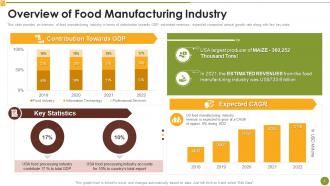
Market Research Report for Food Industry provides a comprehensive overview of food market in the USA. The industry analysis summary showcases the competitive landscape, key trends, and economic indicators related to the food production segment. The PowerPoint deck includes a basic overview of the food manufacturing industry regarding contribution toward GDP, estimated revenues, and the total number of registered plants in the USA. Also, this PPT module includes a comprehensive industry analysis using SWOT, PESTEL, and Porters Five Forces techniques. Additionally, it covers an in-depth market analysis of food production industry sub-segments meat, dairy, grains, fruits, and vegetables. Further, the PPT presentation contains an action plan to adopt Industry 4.0 to overcome the food manufacturing challenges. It also includes details of Industry 4.0 impact on the food manufacturing sector in terms of enhanced surveillance of the food manufacturing ecosystem, better control over complex supply chains, etc., and the possible risks that can hinder the successful adoption of Industry 4.0. Eventually, it also incorporates dashboards to monitor consumer goods sales and supply chain costs. Download it now.
People who downloaded this PowerPoint presentation also viewed the following :
Content of this Powerpoint Presentation
Slide 1: This slide introduces Market Research Report for Food Industry. State Your Company Name and begin.
Slide 2: This is an Agenda slide. State your agendas here.
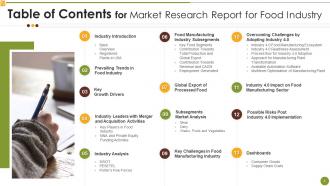
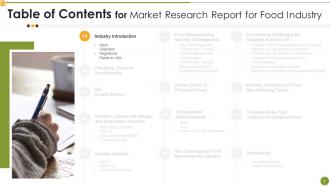
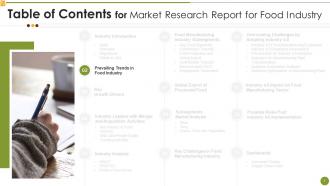
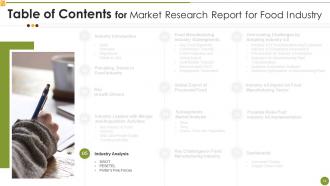
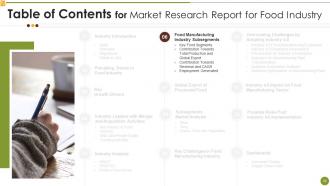
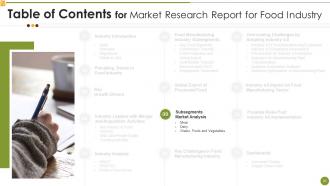
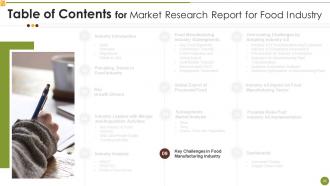
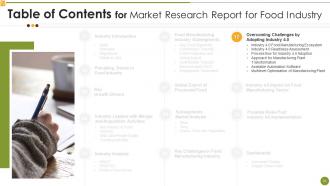
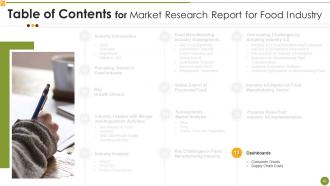
Slide 3: This slide presents Table of Content for the presentation.
Slide 4: This slide highlights title for topics that are to be covered next in the template.
Slide 5: This slide shows Overview of Food Manufacturing Industry.
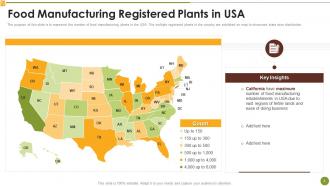
Slide 6: This slide presents Food Manufacturing Registered Plants in USA.
Slide 7: This slide highlights title for topics that are to be covered next in the template.
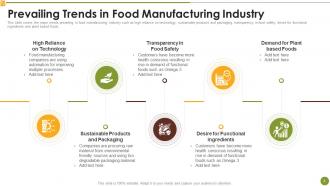
Slide 8: This slide displays Prevailing Trends in Food Manufacturing Industry.
Slide 9: This slide highlights title for topics that are to be covered next in the template.
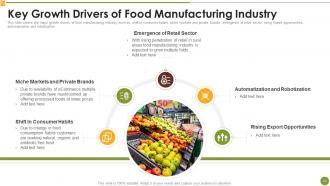
Slide 10: This slide represents Key Growth Drivers of Food Manufacturing Industry.
Slide 11: This slide highlights title for topics that are to be covered next in the template.
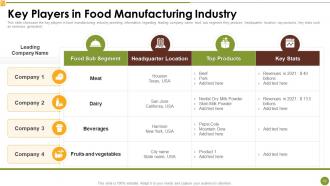
Slide 12: This slide showcases Key Players in Food Manufacturing Industry.
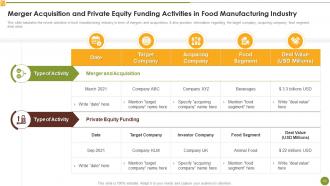
Slide 13: This slide shows Merger Acquisition and Private Equity Funding Activities in Food Manufacturing Industry.
Slide 14: This slide highlights title for topics that are to be covered next in the template.
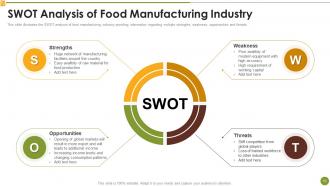
Slide 15: This slide represents SWOT Analysis of Food Manufacturing Industry.
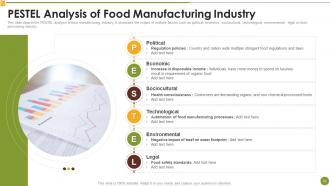
Slide 16: This slide showcases PESTEL Analysis of Food Manufacturing Industry.
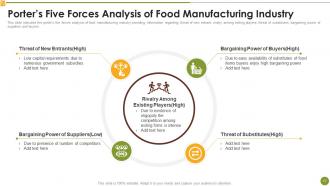
Slide 17: This slide shows Porter’s Five Forces Analysis of Food Manufacturing Industry.
Slide 18: This slide highlights title for topics that are to be covered next in the template.
Slide 19: This slide presents Key Segments of Food Manufacturing Industry.
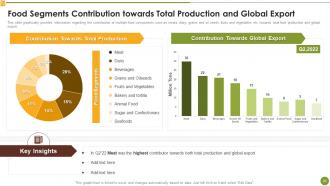
Slide 20: This slide displays Food Segments Contribution towards Total Production and Global Export.
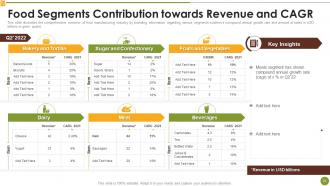
Slide 21: This slide represents Food Segments Contribution towards Revenue and CAGR.
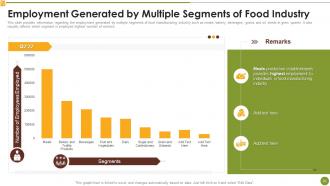
Slide 22: This slide showcases Employment Generated by Multiple Segments of Food Industry.
Slide 23: This slide highlights title for topics that are to be covered next in the template.
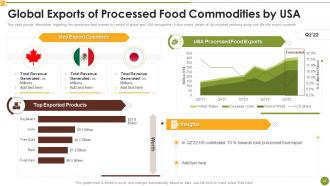
Slide 24: This slide shows Global Exports of Processed Food Commodities by USA.
Slide 25: This slide highlights title for topics that are to be covered next in the template.
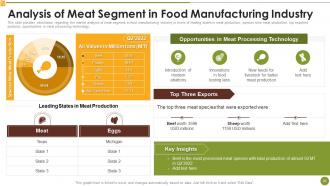
Slide 26: This slide presents Analysis of Meat Segment in Food Manufacturing Industry.
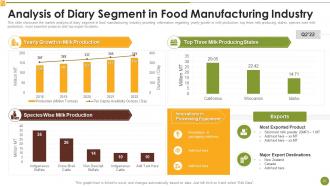
Slide 27: This slide displays Analysis of Diary Segment in Food Manufacturing Industry.
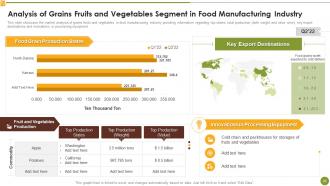
Slide 28: This slide showcase the market analysis of grains fruits and vegetables in food manufacturing industry.
Slide 29: This slide highlights title for topics that are to be covered next in the template.
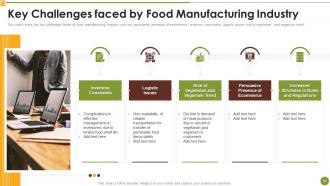
Slide 30: This slide represents Key Challenges faced by Food Manufacturing Industry.
Slide 31: This slide highlights title for topics that are to be covered next in the template.
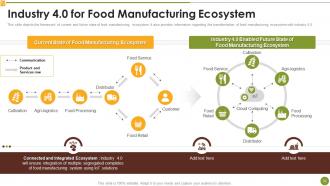
Slide 32: This slide depicts the Framework of Current and Future State of Food Manufacturing Ecosystem.
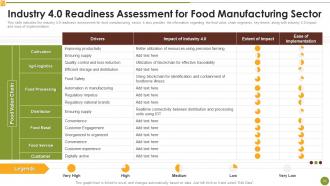
Slide 33: This slide indicates the industry 4.0 readiness assessment for food manufacturing sector.
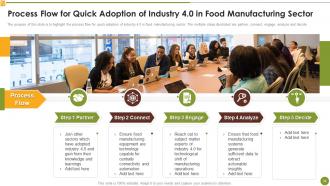
Slide 34: This slide represents Process Flow for Quick Adoption of Industry 4.0 in Food Manufacturing Sector.
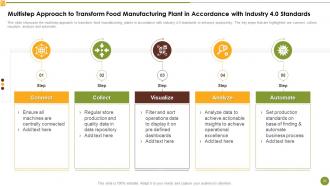
Slide 35: This slide showcase the multistep approach to transform food manufacturing plants.
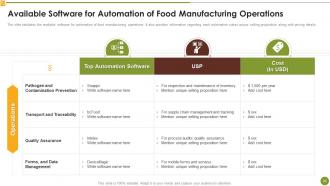
Slide 36: This slide shows Available Software for Automation of Food Manufacturing Operations.
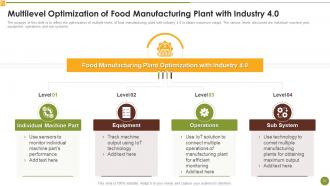
Slide 37: This slide presents Multilevel Optimization of Food Manufacturing Plant with Industry 4.0.
Slide 38: This slide highlights title for topics that are to be covered next in the template.
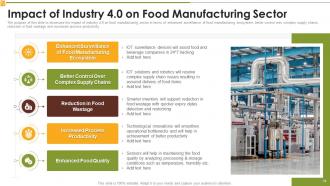
Slide 39: This slide represents Impact of Industry 4.0 on Food Manufacturing Sector.
Slide 40: This slide highlights title for topics that are to be covered next in the template.
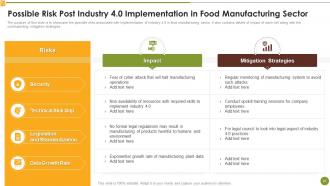
Slide 41: This slide showcases Possible Risk Post Industry 4.0 Implementation in Food Manufacturing Sector.
Slide 42: This slide highlights title for topics that are to be covered next in the template.
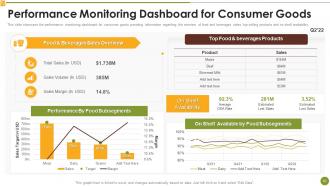
Slide 43: This slide shows Performance Monitoring Dashboard for Consumer Goods.
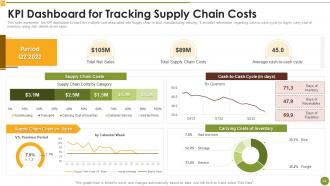
Slide 44: This slide represents the KPI Dashboard to track the Multiple Cost Associated with Supply Chain.
Slide 45: This slide is titled as Additional Slides for moving forward.
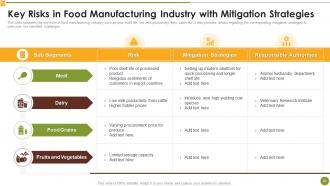
Slide 46: This slide shows Key Risks in Food Manufacturing Industry with Mitigation Strategies.
Slide 47: This slide displays Icons Industry Report for Food Manufacturing Sector.
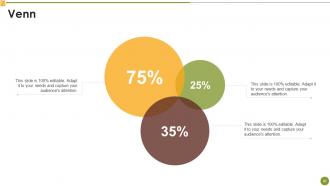
Slide 48: This slide depicts Venn diagram with text boxes.
Slide 49: This slide shows Circular Diagram with additional textboxes.
Slide 50: This slide contains Puzzle with related icons and text.
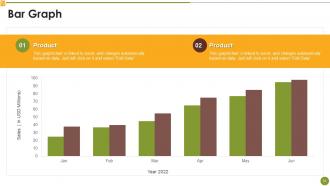
Slide 51: This slide presents Bar chart with two products comparison.
Slide 52: This slide presents Roadmap with additional textboxes.
Slide 53: This is Our Target slide. State your targets here.
Slide 54: This is a Financial slide. Show your finance related stuff here.
Slide 55: This is a Timeline slide. Show data related to time intervals here.
Slide 56: This is About Us slide to show company specifications etc.
Slide 57: This is a Thank You slide with address, contact numbers and email address.
Market Research Report For Food Industry Powerpoint Presentation Slides with all 62 slides:
Use our Market Research Report For Food Industry Powerpoint Presentation Slides to effectively help you save your valuable time. They are readymade to fit into any presentation structure.







FAQs for Market Research Report For Food Industry
People are obsessed with healthy eating and sustainability right now - they want stuff that's good for them without destroying the planet. Plant-based everything is huge. Clean ingredients you can actually pronounce. Less wasteful packaging. Oh, and fancy comfort food too (because apparently regular mac and cheese isn't good enough anymore lol). Here's the thing though - consumers will literally pay more for brands that match their values. I'd dig into how your target audience actually lives and what they can afford. That intersection is where the money is.
Honestly, social listening is where it's at for spotting trends early. Set up Hootsuite or Brandwatch to track mentions of your products and competitors. People are way more honest on social than in surveys - you'll catch real complaints and emerging food trends before they blow up. Instagram and TikTok are perfect for this since food is so visual there. Check what people say about flavors, packaging, dining experiences, all that stuff. I'd pull reports monthly to see patterns by region too. Some of the best product ideas come from random TikTok comments, not gonna lie.
Sensory testing is honestly your best bet for figuring out what people actually think of your food. Get real consumers or trained testers to try it and give feedback on taste, smell, texture - the whole experience. Way better than those surveys where people just guess what they'd like. You can spot problems early and tweak your recipe before dumping money into production. I'd start small with focus groups from your target market - like if you're making energy bars, find actual gym people, not just anyone. Their honest reactions will save you tons of headaches down the road. Trust me on this one.
Honestly, AI tools are pretty amazing for food market research - they'll crunch through tons of consumer data in minutes instead of weeks. You can track social media sentiment, spot trends before they blow up, and find purchasing patterns you'd never catch doing it manually. The consumer segmentation is where it gets really interesting though - algorithms pick up on dietary preferences and lifestyle stuff that regular surveys totally miss. Real-time insights are huge too, so you're not stuck waiting months to adjust your strategy. I'd definitely try some AI social listening tools first, they're usually the easiest entry point.
Honestly, start with the basics - age, income, household size, and where people live. Income's probably the biggest factor since it determines if someone's buying organic everything or shopping the discount aisle. Location matters way more than people think too. Like, what flies in Texas definitely won't work the same way in Vermont, you know? Also look at lifestyle stuff - are they health nuts, do they have allergies, are they always cooking or just hitting up DoorDash every night. I'd map these out against whatever you're selling first, then zoom in on the segments that actually make sense for your product.
Oh man, culture totally runs the show in food research. Religious rules, family traditions, spice tolerance - it all matters way more than people think. Like, what's considered "healthy" varies wildly between cultures, and don't even get me started on meal timing differences. You'll want ethnographic research and culture-specific focus groups instead of boring generic surveys. Even color associations with food can be completely different! I learned this the hard way on a project once. Always run your findings by local cultural experts before you launch anything though.
Honestly, I'd start with focus groups - people actually tell you *why* they hate the flavor or think your packaging looks cheap. Super valuable stuff. Then hit them with online surveys on SurveyMonkey or whatever to get bigger numbers. But here's the thing - in-store sampling is where it's at because shoppers are already in buying mode, you know? Also keep an eye on social media for those random honest reviews people post. Oh, and don't do everything at once. Run a small focus group first to spot the big problems, then survey more people to see if you're right.
Honestly, competitive analysis is like spying but legal lol. You're basically checking what your competitors are doing - their prices, products, how they market stuff. This helps you find gaps in the market you could jump into. Plus you won't make the same dumb mistakes they did (trust me, saves money). I'd pick like 3-4 main competitors and stalk them regularly instead of doing random deep research. Google alerts are your friend here. Oh, and you'll catch trends early which is huge for timing new products right. Check their social accounts monthly too - people overshare everything there.
So first off, get consent and tell people exactly what you'll do with their data. Funding transparency is huge too - if McDonald's is backing your study, people deserve to know that. Don't prey on vulnerable groups like kids or poor communities without giving something back. Cultural stuff around food can be really touchy, so tread carefully there. Always disclose ingredients and allergens if you're testing products. Oh, and definitely get your study approved by an ethics board first - that's non-negotiable. Basically just don't treat people like lab rats, you know?
Focus on eating habits over basic demographics - that's where the real insights are. Survey your current customers about cooking frequency, dietary preferences (keto, vegan, whatever), and what drives their purchases. Income matters since some people splurge on organic while others hunt for deals. Don't ignore location either - regional food preferences are crazy different. Honestly, the whole pumpkin spice phenomenon proves that point perfectly. Create 3-4 customer personas from this data, then test different messages with each group. See what actually clicks before you commit to any big campaigns.
Food data is honestly a nightmare to interpret sometimes. Consumer tastes flip constantly - what everyone loved in January might be completely forgotten by summer. There's so much emotion tied to what people eat too, which makes the data messy. Weather screws everything up, plus you've got supply chain drama and whatever health fad is taking off. Oh, and seasonal stuff will totally mess with your head if you forget about it. I learned this the hard way last year. Always check multiple sources before making any big calls - one study usually doesn't tell the whole story.
Don't just do one taste test and call it done - you'll want to run them at different stages. Hit people early when you're still figuring out the concept, then again after you tweak the formula. Here's the thing though: pair those tastings with actual conversations. Just knowing someone likes the flavor doesn't tell you jack about *why* they like it, and that's where the gold is. Also worth breaking down your results by different groups since a 25-year-old's taste buds are gonna be totally different from their mom's. Then combine everything with your other market research to see the full story.
Track your sales velocity first - basically how fast stuff's flying off shelves versus what you expected. Repeat buyers matter way more than one-offs, obviously. Customer acquisition cost vs lifetime value shows if you're actually making money or just burning cash on ads. Retailers are honestly your best source of intel since they reorder based on real demand, not hype. Market share in your category and social media sentiment give you the bigger picture. Pull weekly reports after launch - the data doesn't lie even when everything else feels chaotic.
Honestly, I'd start with a basic consumer survey - just ask people what sustainability stuff actually matters when they're buying food. Then run some focus groups because people get way more real about what "sustainable" means to them personally when you're face-to-face. Here's the thing though - you gotta check if their actions match what they're saying. Dive into actual purchase data to see if eco-friendly sales are really growing or if it's just virtue signaling. Social media sentiment tracking is clutch for catching trends early. Oh, and definitely compare stated preferences with buying behavior - that gap tells you everything.
Okay so market research basically shows you what people actually want instead of what you're guessing they want. I'd start by checking out competitor products and surveying different age groups about taste preferences. Focus groups are honestly clutch here - way better to test flavors early than waste money on R&D later. You can also scroll through social media to see what flavors people are begging for (or totally hating). Oh, and track those weird food trends that pop up everywhere. Map out what you've got now versus what the data says people want, then just tackle the biggest gaps first. Makes the whole process way less overwhelming.
-
The best collection of PPT templates!! Totally worth the money.
-
You can rely on SlideTeam whenever you run out of designs for your presentation. Thank you so much SlideTeam!