

 0 Comment
 Customer Reviews

The slide deck's been sitting in the shared drive for two days. Nobody's touched it.
Not because the project's stalled. The work is done — services mapped, workflows documented, delivery timelines confirmed. But turning all of that into something a room full of stakeholders can actually follow? That's the part nobody volunteers for.
Service delivery platforms are genuinely complex. There's architecture involved. Dependencies. Middleware, orchestration layers, API handoffs, cloud integrations. Getting any one of those concepts across clearly is hard enough. Getting all of them into a single coherent presentation — without losing the room halfway through the infrastructure slide — is a different problem entirely.
And it's not just technical teams who have to present this stuff. Product managers pitch platform roadmaps. IT leads explain service delivery management decisions to non-technical executives. Managed service providers walk clients through how their cloud service platform actually works. Everyone's got a version of this conversation, and most of them don't go well on the first try.
The deck usually suffers in predictable ways. Too much text. No visual hierarchy. A framework that took weeks to build gets crammed onto two slides. Someone asks a question mid-presentation, and the whole thing derails because nothing's structured to handle follow-ups.
That's not a content problem. It's a structure problem. And structure is exactly what pre-designed templates solve.
SlideTeam's service delivery platform templates exist because this conversation happens constantly—across telecom, IT, cloud, HR, and logistics. The frameworks are already built. The visual logic is already there. You just drop in your specifics and present.
Here's what's in the collection.
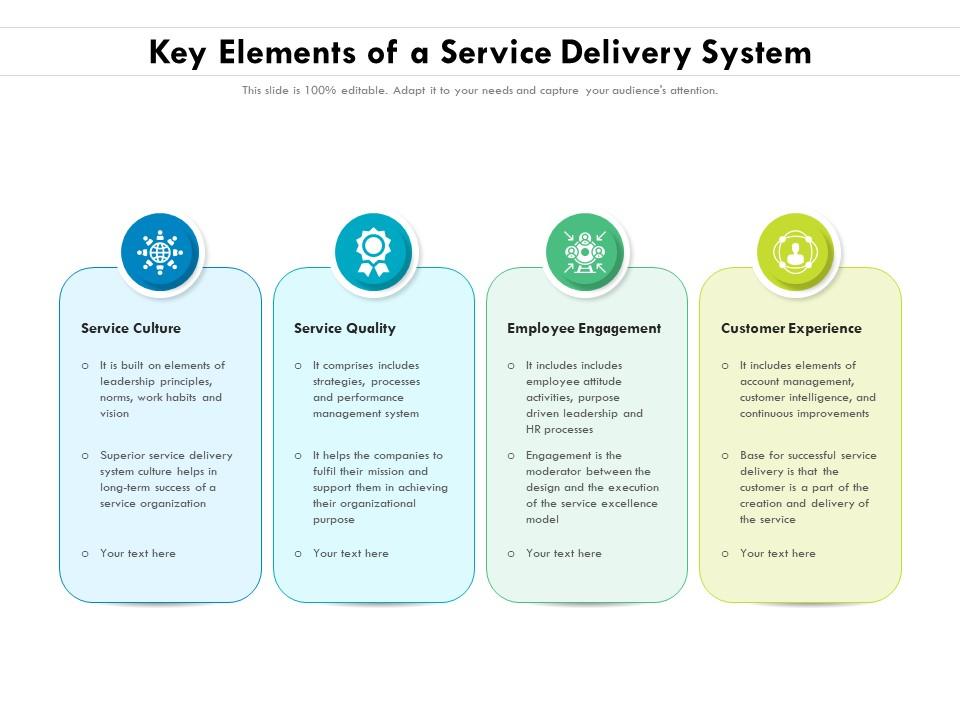
Template 1: Key Elements of a Service Delivery System
A clear service delivery system starts with understanding what holds it together. This PPT template maps the four core elements—Service Culture, Service Quality, and Employee Engagement—into a single coherent visual. Operations leads and service managers reach for this when they need to align teams on what good delivery actually looks like. It works well in internal reviews and onboarding sessions where clarity on foundational service principles matters. The template is 100% editable and customizable.
Download this PowerPoint Template
Template 2: Key Strategies to Improve Service Delivery System
Most service delivery failures trace back to gaps in process, not intent. This slide surfaces the five key improvement levers—Customer, Process, and Service—that operations teams can act on directly. It's built for service managers who need to present a clear path forward without wading into theory. Use this PPT in quarterly reviews or digital service delivery planning sessions to ground the conversation in what can change. The template is 100% editable and customizable.

Download this PowerPoint Template
Template 3: ITMS Roadmap to Enhance Service Delivery PPT Demonstration
IT roadmaps are hard to communicate without a visual anchor. This deck gives IT service management leads a structured way to walk stakeholders through phased ITSM improvements. Whether presenting to a CIO or a project board, the layout keeps timelines and milestones readable. For context, this curated guide to service delivery platform PPT templates offers additional formats worth reviewing alongside this deck. The template is 100% editable and customizable.
[product_image id=1826611]
Template 4: Platform as a Service Simplifying Cloud Application Development PPT Designs
Cloud application development can be hard to explain without losing non-technical stakeholders halfway through. This deck captures PaaS concepts with visual clarity that drives understanding from the first slide. Every layout translates complex cloud architecture into audience-friendly visuals. Customizable color schemes let you align the presentation with your brand identity effortlessly. Use this to anchor Cloud Service Platform discussions, developer briefings, or executive overviews of your cloud adoption journey. Transform your cloud presentations today. Download this dynamic template now and unlock compelling PaaS storytelling.
[product_image id=1590820]
Template 5: Service Delivery Framework Presentation PPT Sample
Good service delivery frameworks only work if everyone understands them. This PPT preset gives practitioners a clean, structured way to present how services flow from intake to fulfilment. It suits service owners presenting to leadership or Managed Service Provider teams onboarding new clients. The layout is simple enough for quick reads but structured enough for detailed walkthroughs. The template is 100% editable and customizable.
[product_image id=1472887]
Template 6: Platform as a Service and Its Role in Development PPT Example
PaaS sits at the intersection of development speed and platform reliability. This deck helps product managers and IT leads articulate the role of Platform as a Service in their development ecosystem. Each slide drives the narrative forward with visuals that translate technical layers into clear audience value. Flexible layouts and bold design elements ensure every concept lands with impact and credibility. Use this for stakeholder briefings, vendor evaluations, or digital transformation roadmap sessions. Elevate your PaaS presentations today. Download this template now and deliver development narratives that truly resonate.
[product_image id=1590818]
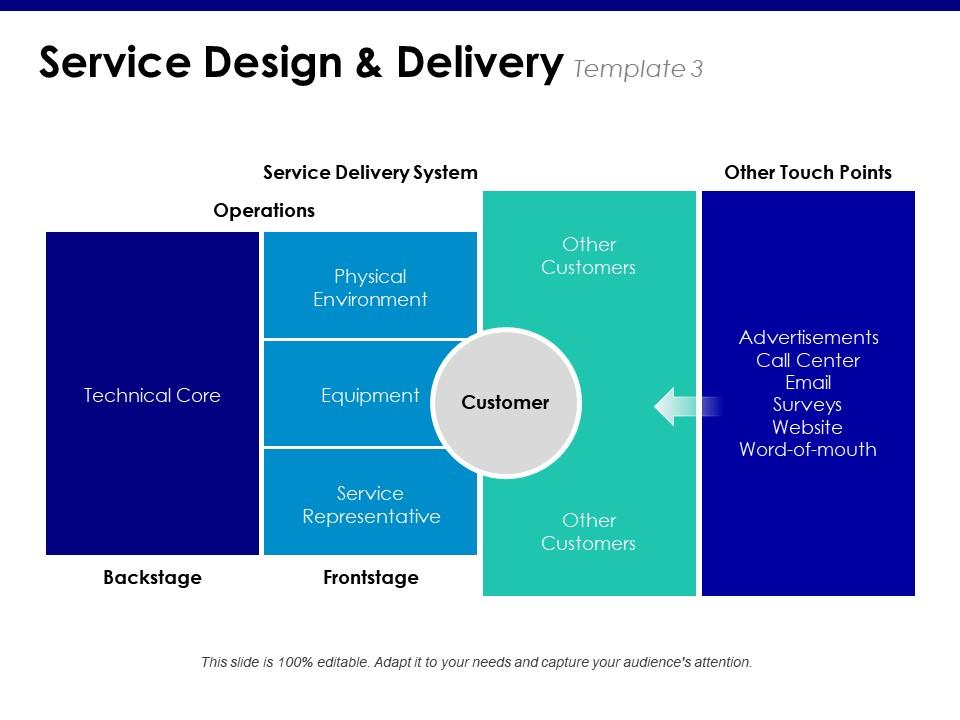
Template 7: Service Design and Delivery System Operations Explained PPT
Operational clarity starts with showing how service design connects to delivery execution. This template captures the full service delivery system operations view in a polished, professional layout. Rich visual backgrounds ensure data and process flows display with immediate clarity. Ample text space lets you document enterprise-specific service logic without crowding the slide. Use this for Service Orchestration Platform reviews, system design walkthroughs, or internal operations briefings. Transform your service design presentations today. Download this template now and deliver operational frameworks with confidence.
Download this PowerPoint Template
Template 8: What's Included in a Platform as a Service Cloud Computing Service Models
PaaS is often described but rarely broken down clearly for mixed audiences. This slide maps exactly what sits inside a Platform as a Service model—infrastructure, middleware, operating system, database, and development tools—across five distinct layers. Cloud architects and IT educators use this when they need to explain platform composition without ambiguity. It's particularly useful in vendor assessments or cloud adoption briefings. The template is 100% editable and customizable.

Download this PowerPoint Template
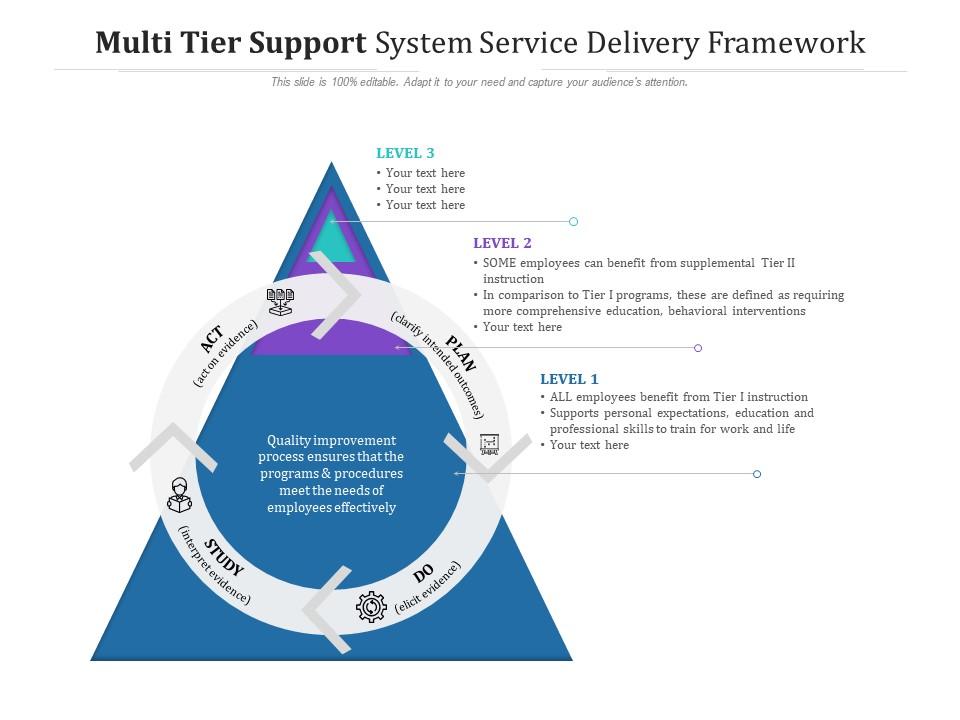
Template 9: Multi-Tier Support System Service Delivery Framework PowerPoint
Multi-tier support structures are difficult to communicate without a clear visual hierarchy. This template maps comprehensive service delivery framework tiers—covering employee skills and support layers—into a structure that audiences can follow immediately. Every layout element drives clarity, ensuring your support model lands with precision and authority. Designed for IT service leads and operations managers, this works across client presentations and internal team briefings alike. Present your service delivery management frameworks with confidence today. Download this template now and make every support tier count.
Download this PowerPoint Template
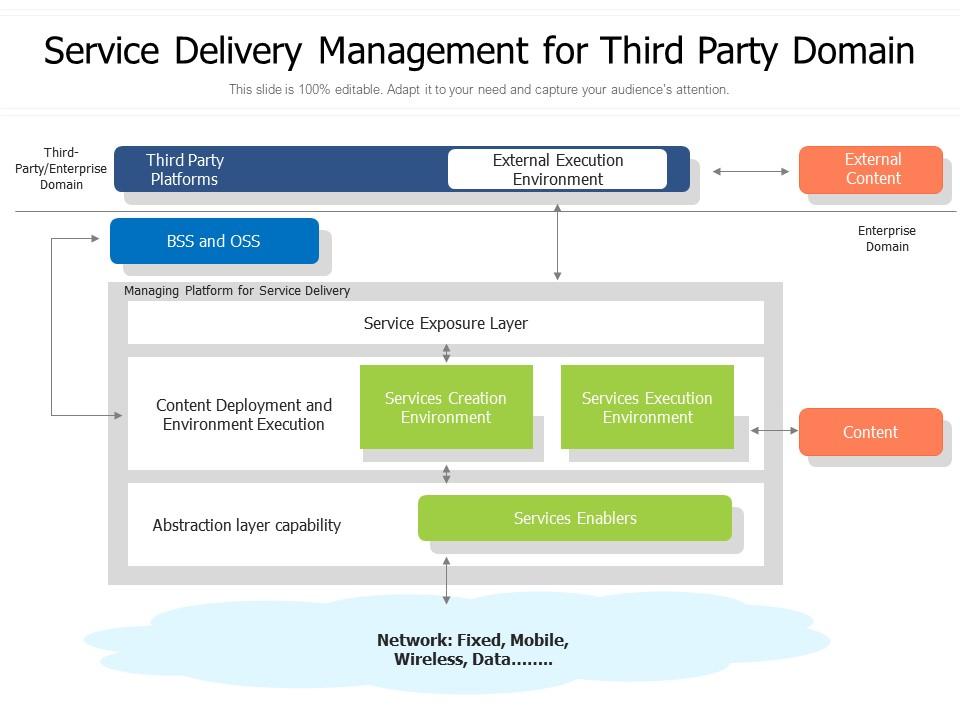
Template 10: Service Delivery Management for Third-Party Domain PPT
Third-party domain management adds real complexity to any service delivery setup. This deck lays out the full ecosystem—Third Party Platforms, External Content, Services Creation Environment, and Services Enablers—in a way that business and technical audiences can both follow. Service fulfillment leads and platform architects use this when presenting BSS OSS Integration points or external dependency maps to stakeholders. It keeps multi-party delivery conversations structured and on track. The template is 100% editable and customizable.
Download this PowerPoint Template
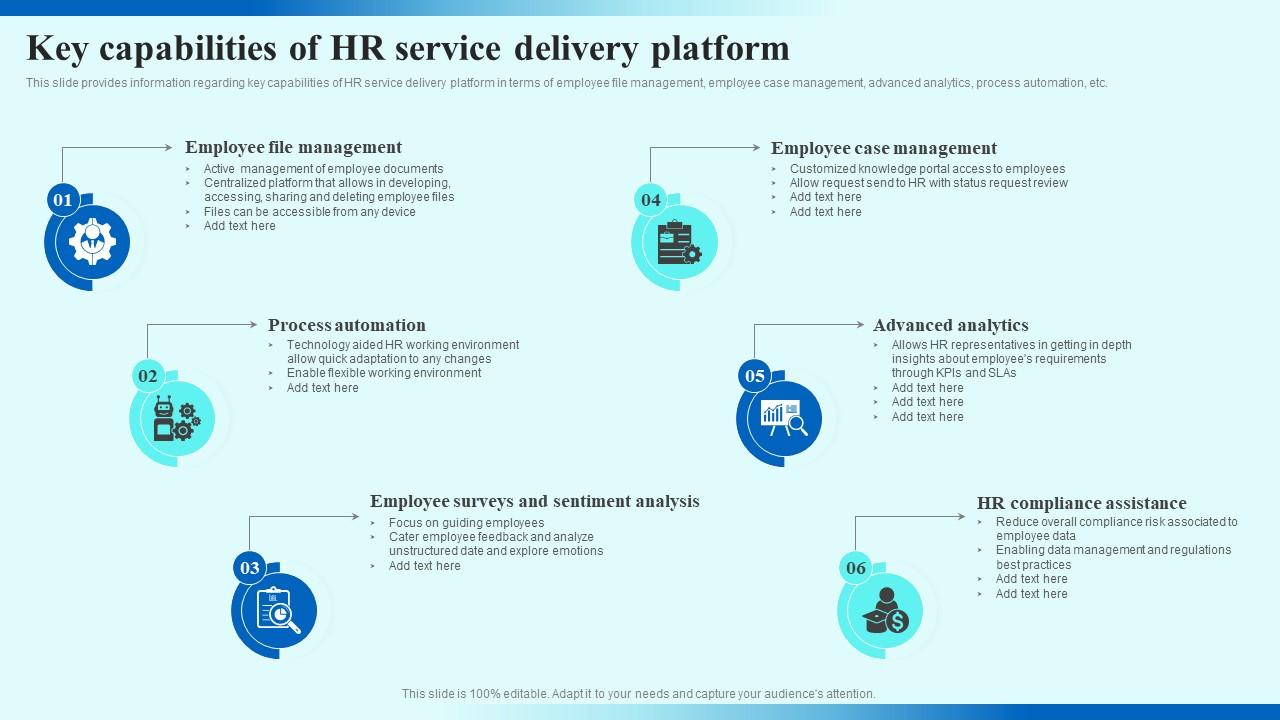
Template 11: Key Capabilities of HR Service Delivery Platform
HR service delivery platforms carry more capability than most teams realize. This template maps six key capabilities—employee file management, case management, advanced analytics, and process automation—into a structured, scannable layout. HR leads and platform owners use this to make the business case for platform investment or to onboard teams to new HR service delivery management systems. Every slide builds a clear picture of platform value without the jargon. Present HR capability frameworks with authority today. Download this template now and turn platform features into stakeholder buy-in.
Download this PowerPoint Template
Template 12: Comparative Analysis of IT Service Delivery Platforms
Choosing between IT service delivery platforms often comes down to specifics most vendors obscure. This PPT maps key features, USPs, pricing, and user ratings—including Jira Service Management—side by side for honest comparison. IT decision-makers and procurement leads reach for this when they need to present a platform shortlist to leadership without bias or gaps. So yeah, it does the analytical heavy lifting in a format executives can actually act on. The template is 100% editable and customizable.
[product_image id=915695]
Template 13: Delivery and Fulfilment Network of Our Business
Delivery and fulfilment networks are only as clear as the visual that explains them. This template maps the full multi-sided platform flow—producers, inbound centres, fulfilment centres, sortation, and customers—into a structure audiences can trace end to end. Operations leads and platform strategists use this to present Managed Service Provider fulfilment logic or Application Delivery Network models to cross-functional teams. Every layout element keeps the supply chain narrative tight and followable. Build fulfilment network presentations that hold attention today. Download this template now and make complex logistics instantly readable.

Download this PowerPoint Template
Template 14: Platforms for Drop Servicing Providers PPT Example
Drop servicing depends on picking the right talent marketplace—and the differences between platforms matter. This template runs a side-by-side comparison of major platforms across cost, registered users, free trials, and services supported. Operations managers and service aggregators use this to make vendor decisions visible and defensible in front of stakeholders. The structured layout keeps the comparison honest and the conclusion clear. Present platform assessments with confidence today. Download this template now and turn marketplace data into decisive recommendations.
[product_image id=1221891]
Template 15: Cloud Offerings for Platform as a Service
Cloud platform decisions carry long-term consequences, so the comparison needs to be airtight. This slide maps five major PaaS cloud offerings—Amazon Web Services, Google Cloud Platform, Microsoft Azure App Service, Red Hat OpenShift, and IBM Cloud Foundry—across key dimensions. Technology managers use this when presenting cloud adoption options to leadership or evaluating platforms for a Content Delivery Network or IoT Service Platform build. Every layout keeps the comparison readable and the recommendation defensible. Transform your cloud platform presentations today. Download this template now and deliver cloud decisions with clarity.
[product_image id=1070988]
Master Service Delivery Presentation with SlideTeam
SlideTeam's PowerPoint templates are the best in the industry for service delivery platform presentations. These content-ready slides save hours of structuring time while delivering professional quality that builds instant credibility with technical and executive audiences alike. From IT Service Management roadmaps to cloud platform comparisons, these ready-made frameworks cover every conversation. Deploy these PowerPoint slides to communicate complex service delivery concepts clearly and drive confident decisions.
FAQs on Service Delivery Platform
What are the core architectural components that define a modern service delivery platform?
A modern service delivery platform rests on four core components: a service orchestration layer, an API management gateway, a middleware integration bus, and a customer-facing service portal. Orchestration handles workflow automation. The API layer manages how services talk to each other. Middleware connects legacy and cloud systems. Together, these components enable end-to-end digital service delivery without manual handoffs.
How does a service delivery platform differ from traditional IT infrastructure management systems?
Traditional IT infrastructure management focuses on keeping hardware and networks running. A service delivery platform goes further—it automates service provisioning, monitors fulfilment in real time, and manages the full service lifecycle. The key difference is intent: infrastructure management is reactive; a service delivery platform is designed to orchestrate and deliver services proactively. IT Service Management tools like Jira sit within this broader platform model.
What role does API management play in optimizing service delivery platform performance?
API management controls how services communicate, authenticate, and scale within a platform. Without it, service delivery breaks down at integration points. An API management platform enforces rate limits, monitors traffic, and routes requests reliably. For enterprises running multi-vendor or hybrid cloud environments, API management is what keeps the entire service orchestration layer functioning without bottlenecks or security gaps.
How can organizations measure the ROI of implementing a service delivery platform?
Measure ROI across three dimensions: time saved on service fulfilment, reduction in manual errors, and customer satisfaction scores. Track provisioning speed before and after implementation. Monitor support ticket volume and resolution times. For B2B environments, measure client retention rates linked to service reliability. These metrics translate platform investment directly into business outcomes finance teams recognize.
What are the key challenges enterprises face when migrating to a cloud-based service delivery platform?
The three most common migration challenges are data integrity during transition, staff retraining, and integration with legacy BSS OSS systems. Cloud migrations often stall because on-premise workflows don't map cleanly to cloud-native processes. Organizations should run a parallel environment during cutover, not a hard switch. Vendor lock-in is also a real risk—prioritize platforms with open API standards.
How does orchestration improve efficiency within a service delivery platform ecosystem?
Orchestration removes the manual coordination between services. Instead of teams triggering each step, a service orchestration platform automates sequencing, error handling, and retries. This cuts provisioning time significantly and reduces human error. For complex environments—like telecom or IoT service platforms—orchestration is what makes scale possible without proportionally scaling headcount.
What security frameworks are best suited for protecting data within a service delivery platform?
Three frameworks apply most directly: Zero Trust Architecture for access control, ISO 27001 for information security management, and GDPR-aligned data governance for platforms handling personal data. Zero Trust is especially relevant for cloud-based platforms where perimeter security is insufficient. Pair these with continuous monitoring and role-based access controls to cover the full threat surface.
How do microservices architecture and service delivery platforms complement each other?
Microservices break applications into small, independently deployable units. A service delivery platform provides the orchestration and API management layer that ties those units into coherent, customer-facing services. Neither works as well alone. Microservices give the platform flexibility and resilience. The platform gives microservices a structured delivery path. Together, they enable faster releases and easier scaling.