

 0 Comment
 Customer Reviews

The process review is scheduled. The data's been collected for weeks.
And nobody's quite sure how to turn it into something the room will actually act on.
That's the real problem with process improvement work—it's not the analysis. Most teams know where the waste lives. They've seen the cycle time data, the defect logs, the rework hours. The knowing isn't the issue. The presenting is.
There's this gap between having a diagnosis and making it land. Between understanding root cause and getting a leadership team to fund the fix. Between knowing your DMAIC phases cold and building a deck that doesn't make people's eyes glaze over at slide three.
And it gets worse when the audience is mixed. Finance wants numbers. Operations wants specifics. The sponsor wants confidence. The frontline team wants to know nobody's blaming them. One slide has to do a lot of work.
Lean Six Sigma methodology is rigorous by design. That's the point. But rigor doesn't automatically become clarity. Someone still has to build the deck—structure the problem definition, visualize the value stream, frame the control plan in a way that sticks after the meeting ends.
That's where the templates come in. Not because building from scratch is impossible, but because the structure already exists. Someone's already figured out what a DMAIC project plan needs to show. What a control chart should communicate. What a business process optimization slide should look like when you've got twelve minutes and a skeptical CFO.
SlideTeam's pre-designed frameworks handle exactly this—the structural work that shouldn't take three days before the real presentation begins. Content-ready slides built around the phases, tools, and outputs that lean process improvement actually uses.
Here's what's in the collection.
Template 1: Lean Six Sigma Framework for Operational Process Improvement
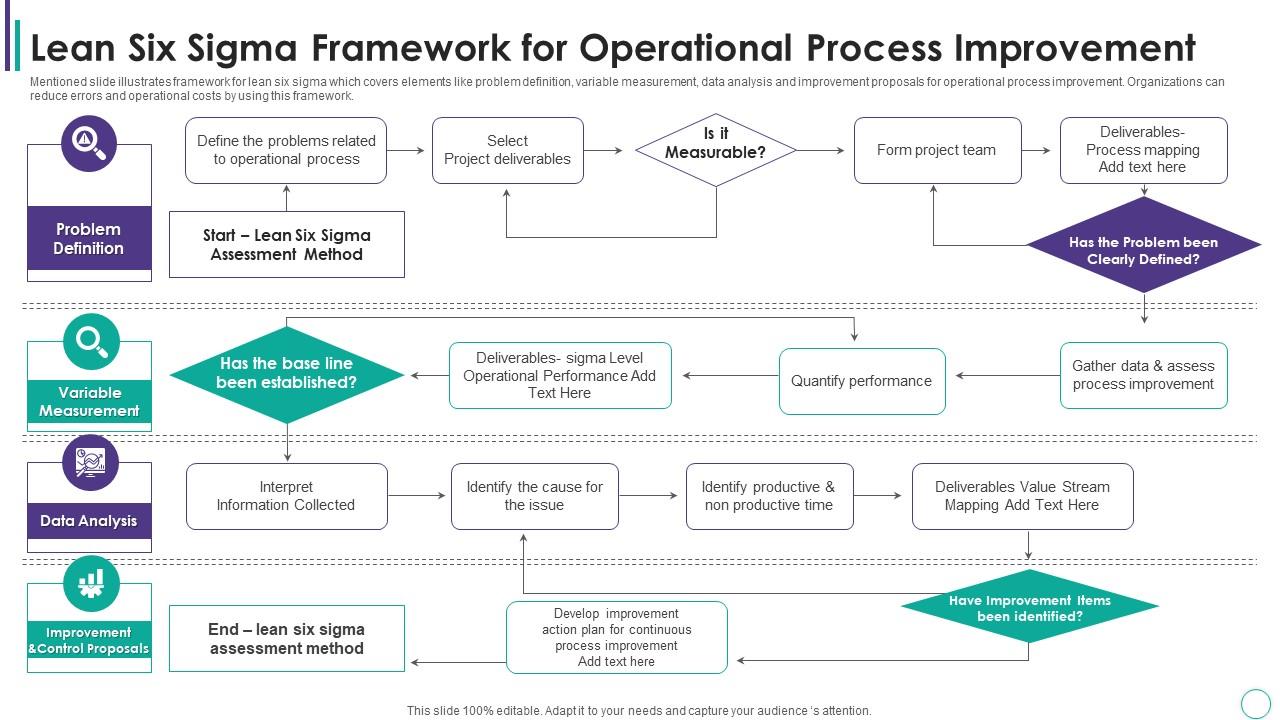
Operational improvement starts with a clear framework everyone can follow. This PPT template covers the four core pillars: problem definition, variable measurement, data analysis, and improvement proposals. Each element connects directly to reducing errors and cutting operational costs. Practitioners in quality and operations management reach for this slide when presenting a structured improvement case. For a broader collection of deployment frameworks, explore these Lean Six Sigma process improvement plan templates. The template is 100% editable and customizable.
Download this PowerPoint Template
Template 2: Project Management Lean Six Sigma DMAIC Process
Measuring project efficiency across five structured phases is what this PPT template is built for. It walks through Define, Measure, Analyze, Improve, and Control — the full Six Sigma DMAIC framework in one cohesive visual. Project managers and process analysts use this slide to track improvement progress and communicate outcomes to stakeholders. It's a practical fit for DMAIC project planning reviews and continuous improvement plan presentations. The template is 100% editable and customizable.

Download this PowerPoint Template
Template 3: Lean Six Sigma Tools for Process Improvement PPT Information
Process improvement work needs the right visual tools to communicate clearly. This PPT preset organizes Lean Six Sigma tools in a way that practitioners — quality leads, process engineers — can present directly to cross-functional teams. It suits sessions where root cause analysis tools and waste reduction techniques need to be explained without ambiguity. Find more Six Sigma and DMAIC templates here for a wider toolkit. The template is 100% editable and customizable.
[product_image id=1542329]
Template 4: PDSA Cycle and Lean Six Sigma Integration Strategies PPT Outline
Integrating PDSA cycles with Lean Six Sigma drives a continuous improvement loop that's hard to argue against. This template captures that integration in a structured, visually compelling format. It empowers quality managers to present iterative improvement plans with confidence and clarity. Built for healthcare, manufacturing, and service teams pursuing Kaizen process improvement, it elevates every continuous improvement presentation. Transform your PDSA and Lean Six Sigma presentations today. Download this dynamic template now and unlock your continuous improvement potential.
[product_image id=1697723]
Template 5: Control Plan for Lean Six Sigma Projects PPT
Sustaining gains after a Lean Six Sigma project is where many teams stumble—this template fixes that. It delivers a structured control plan framework that keeps process performance locked in post-improvement. The clear visual layout helps Black Belt practitioners present monitoring protocols to operations leadership without ambiguity. Use it for project closure reviews, handover decks, or quality assurance briefings that demand precision. Transform your control plan presentations today. Download this dynamic template now and unlock lasting process control.
[product_image id=1755442]
Template 6: Lean Six Sigma Approaches to Process Improvement PPT Example
Real process improvement work demands more than a slide with bullet points. This PPT preset presents Lean Six Sigma approaches in a structured, practitioner-ready format for operations managers and quality professionals. It works well when teams need to compare improvement methods or present a business process optimization case to leadership. So yeah, the visual clarity here does the heavy lifting on complex methodology comparisons. The template is 100% editable and customizable.
[product_image id=1487349]
Template 7: Lean Six Sigma Principles for Customer Focused Process Improvement PPT Outline
Customer-focused improvement work has a specific audience problem: the people who care most aren't always the most technical. This PowerPoint slide bridges that gap, presenting Lean Six Sigma principles in a way that connects process outcomes to customer value. Operations and CX teams use it to align internal improvement goals with external satisfaction metrics. It fits naturally into lean process transformation reviews and customer experience planning sessions. The template is 100% editable and customizable.
[product_image id=1649530]
Template 8: Lean Six Sigma Approach to Process Improvement Planning PPT Slides
Planning a process improvement initiative is harder than executing one — the structure has to hold before the work begins. This PPT template gives improvement leads a ready visual framework for process improvement planning presentations. It covers the approach clearly, so stakeholders understand the path before the first kaizen event is scheduled. See more Lean Six Sigma deployment plan samples here for planning-stage support. The template is 100% editable and customizable.
[product_image id=1542327]
Template 9: Lean Six Sigma Tools and Techniques PPT Outline
Lean Six Sigma tools are only useful if your audience understands what they're looking at. This PowerPoint slide organizes the core tools and techniques into a clear, navigable structure for quality professionals presenting to mixed audiences. It's built for situations where practitioners need to explain statistical process control, value stream mapping, or root cause analysis without losing the room. The template is 100% editable and customizable.
[product_image id=1542328]
Template 10: Lean and Six Sigma for Process Improvement PPT Sample
Combining Lean manufacturing principles with Six Sigma rigor gives teams a dual lens on waste and variation. This template merges both methodologies into a single, coherent presentation framework. It drives clarity for operational leaders presenting integrated improvement cases to senior stakeholders. Built for practitioners who need to show both efficiency and quality gains in one cohesive narrative, it accelerates preparation significantly. Transform your Lean and Six Sigma presentations today. Download this dynamic template now and unlock your integrated improvement story.
[product_image id=1487898]
Template 11: Lean Six Sigma Tools for Process Improvement PPT Demonstration
Demonstrating Lean Six Sigma tools in a presentation requires structure, not just a list of techniques. This PPT template gives process engineers and quality managers a demonstration-ready format for presenting tool applications to project teams. For context, it works particularly well in training sessions or project kickoff reviews where the team needs to align on which tools apply at each DMAIC phase. The template is 100% editable and customizable.
[product_image id=1493710]
Template 12: Control Plan Essentials for Manufacturing Quality Assurance PPT Guidelines
Manufacturing quality assurance depends on control plans that are clear enough for the shop floor and rigorous enough for the boardroom. This PowerPoint slide is built for quality engineers who need to present control plan essentials across both audiences. It covers monitoring protocols, inspection criteria, and response plans in a visually structured format. Explore Six Sigma quality improvement plan templates for additional manufacturing-focused options. The template is 100% editable and customizable.
[product_image id=1755441]
Template 13: Control Plan for Lean Six Sigma Projects PPT Presentation
Control plans for Lean Six Sigma projects need to survive the transition from project team to process owner. This PPT preset gives practitioners a structured format for presenting those plans clearly during project handover. It's built for Black Belt and Green Belt practitioners who need to show stakeholders exactly how gains will be maintained. The visual structure keeps the audience focused on accountability, not ambiguity. The template is 100% editable and customizable.
[product_image id=1682718]
Template 14: Lean Six Sigma Techniques for Business Process Improvement PPT Outline
Business process improvement techniques are easier to present when the structure is already in place. This PowerPoint slide organizes Lean Six Sigma techniques into a clear, audience-ready format for operations and quality professionals. It suits project review meetings, training workshops, and defect reduction strategy presentations where clarity on method matters. Btw, it's one of the cleaner formats for explaining technique selection logic to a non-technical leadership team. The template is 100% editable and customizable.
[product_image id=1762212]
Template 15: Control Plan Essentials for Manufacturing Quality PPT Sample
Manufacturing quality control plans carry real consequences when they're unclear — this slide addresses that directly. This PPT preset gives quality managers a structured, presentation-ready format for control plan essentials in manufacturing contexts. It's built for plant managers and quality leads who present to operations committees or audit teams. See Lean Six Sigma deployment plan templates for related manufacturing planning frameworks. The template is 100% editable and customizable.
[product_image id=1682717]
Template 16: Lean Six Sigma Process Improvement Plan
A Lean Six Sigma process improvement plan has five distinct phases — and each one needs a clear visual anchor. This PowerPoint slide presents all five stages (Define, Measure, Analyze, Improve, Control) in a single, structured view. Process managers use it to walk leadership or project teams through the full improvement cycle without losing flow. It's built for operational efficiency improvement reviews where the audience needs the full picture fast. The template is 100% editable and customizable.
[product_image id=1200853]
Template 17: Lean Six Sigma Process for Business Process Improvement
Delivering a structured Lean Six Sigma process presentation demands specific, measurable outputs at every stage. This template integrates key deliverables—SIPOC diagrams, NVA analysis, and Pareto charts—directly into the five-phase DMAIC flow. Every phase becomes a clear business case, not just a theoretical step. It accelerates operational reviews by connecting methodology to measurable business outcomes at a glance. Built for process engineers and quality managers driving data-driven process optimization, it simplifies complex narratives. Transform your Lean Six Sigma process presentations today. Download this dynamic template now and unlock delivery clarity.
[product_image id=1159650]
Template 18: Lean Six Sigma Process Improvement Strategies PPT Example
Process improvement strategies only land when they're presented with the right balance of structure and clarity. This PPT preset gives operations leads a ready format for presenting Lean Six Sigma improvement strategies to leadership and project sponsors. It's a strong fit for operational efficiency improvement reviews and KPI performance improvement presentations. To be clear, the visual structure here is designed for audiences who need the strategy, not just the tools. The template is 100% editable and customizable.
[product_image id=1852662]
Template 19: Lean Six Sigma for Workflow Optimization PPT Mockup
Workflow optimization is a specific outcome — and this slide is built around presenting it precisely. This PowerPoint slide helps process improvement leads communicate how Lean Six Sigma applies to workflow-level bottlenecks and cycle time reduction. Operations managers and project leads use it when presenting process flow optimization findings to cross-functional teams. It fits naturally into value stream mapping reviews and lean agile process improvement planning sessions. The template is 100% editable and customizable.
[product_image id=1699222]
Template 20: Lean Six Sigma Five Key Principles PPT Example
Five principles drive Lean Six Sigma — and most presentations bury them in paragraph text. This PPT template brings those five key principles into a clean, visual format that practitioners can present to any audience, from frontline teams to executive sponsors. It's built for training sessions, project kickoffs, and lean manufacturing principles overviews where clarity on the foundation matters most. The template is 100% editable and customizable.
[product_image id=1826973]
Elevate Your Process Improvement Presentations with SlideTeam
SlideTeam's PowerPoint templates are the best in the industry for Lean Six Sigma process improvement planning. These content-ready slides give you professional structure across every DMAIC phase — from problem definition to control plans — saving hours of design work. Use these ready-made frameworks to present root cause analysis, operational efficiency improvements, and continuous improvement plans with confidence. Deploy these PPT presets to drive clarity, stakeholder alignment, and measurable results faster.
FAQs on Lean Six Sigma Process Improvement Plan
What are the critical differences between Lean and Six Sigma methodologies, and how does integrating them create a more effective process improvement strategy?
Lean targets waste — non-value-added steps, excess inventory, unnecessary motion. Six Sigma targets variation — defects, inconsistency, process instability. Used separately, each addresses only half the problem. Together, they reduce both waste and defect rates simultaneously. Lean speeds up the process; Six Sigma makes the output reliable. Most mature improvement programs integrate both because fixing speed without fixing quality — or vice versa — rarely holds.
How do you define the scope of a Lean Six Sigma project to avoid scope creep while ensuring meaningful organizational impact?
Start with a clear problem statement tied to a measurable outcome — cost, defect rate, cycle time. Bound the project by a specific process, not a department or a strategy. Use a SIPOC diagram early to draw hard boundaries. If the scope touches more than two or three handoffs, split it. A tight scope with real impact beats a broad scope with diffuse results every time.
Which DMAIC phase is most frequently underestimated by organizations, and what are the consequences of rushing through it?
The Measure phase is the most underestimated. Teams rush it to get to analysis faster. The consequence: the data collected doesn't actually reflect the real process, so the analysis that follows is built on faulty ground. Poor measurement system analysis (MSA) is the most common culprit. Decisions made downstream — including improvement choices — then carry hidden errors the team never catches.
How can a Lean Six Sigma process improvement plan be effectively communicated to frontline employees who are resistant to change?
Don't lead with methodology — lead with the problem the frontline actually feels. Show them the data that reflects their daily pain points, not abstract process maps. Involve them early in the Measure phase so they co-own the findings. Resistance usually comes from fear of blame or job loss. Address those concerns directly, in plain language, before presenting any improvement plan.
What role does value stream mapping play in identifying non-value-added activities during the Define and Measure phases?
Value stream mapping gives the team a visual of every step from input to output, with cycle times and wait times marked clearly. Non-value-added steps become visible immediately — especially delays, rework loops, and unnecessary handoffs. In the Define phase, it confirms the problem scope. In the Measure phase, it shows where to collect data. Without it, teams often analyze the wrong part of the process.
How do you determine an appropriate sigma level target for a specific business process without setting unrealistic benchmarks?
Start with the current sigma level — calculate it from your defect and opportunity data. Then benchmark against industry standards for that process type, not generic Six Sigma targets. A target of 4 sigma is realistic for most manufacturing processes; 6 sigma is reserved for safety-critical work. Set the target based on customer tolerance and the cost of defects, not aspiration.
What are the most common causes of Lean Six Sigma project failure, and how can they be addressed during the planning stage?
The top causes are: weak sponsor support, poorly defined problem statements, skipping the Measure phase, and no control plan post-implementation. Address these at the planning stage by securing an active sponsor, writing a scoped charter, validating your measurement system before analyzing data, and building the control plan into the project timeline from day one — not as an afterthought.
How does the selection of a project sponsor influence the success of a Lean Six Sigma initiative?
The sponsor removes obstacles the team can't — budget barriers, cross-functional resistance, resource gaps. A passive sponsor who only reviews status reports rarely clears those blockers in time. An active sponsor attends key gate reviews and makes decisions quickly. Projects with engaged sponsors close faster and sustain gains longer. Choose the sponsor based on their authority over the process, not just their enthusiasm for the initiative.