


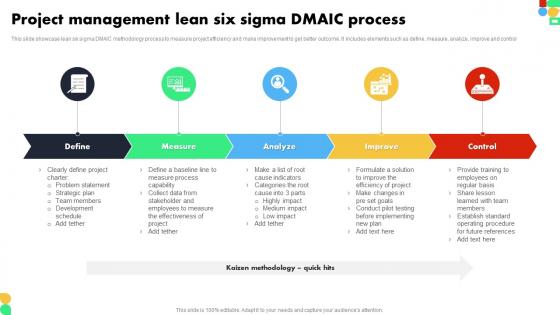
Project Management Lean Six Sigma DMAIC Process




Try Before you Buy Download Free Sample Product
 Impress Your
 Audience
 100%
100% Editable
 Save Hours
 of Time


This slide showcase lean six sigma DMAIC methodology process to measure project efficiency and make improvement to get better outcome. It includes elements such as define, measure, analyze, improve and control.
People who downloaded this PowerPoint presentation also viewed the following :
Project Management Lean Six Sigma DMAIC Process with all 6 slides:
Use our Project Management Lean Six Sigma DMAIC Process to effectively help you save your valuable time. They are readymade to fit into any presentation structure.





FAQs for Project Management Lean Six
DMAIC breaks down into five steps that you gotta do in order: Define your problem first, then Measure to get baseline data, Analyze to find what's actually causing issues, Improve by fixing stuff, and Control to make sure it sticks. You can't really jump around because each step needs the previous one - like, how can you analyze anything without decent measurements, right? It's basically like stacking blocks where each one supports the next. The data gets more focused as you move through each phase. Honestly, most people rush the Define part, but if you nail that problem statement upfront, everything else flows way better.
Honestly, getting leadership on board first is huge - without that you're dead in the water. Train your teams properly on DMAIC but don't let them rush through phases. The Measure phase is where most people want to skip ahead because it's boring, but that's actually where you find the good stuff. Pick projects that aren't too crazy ambitious at first. Short wins, you know? Templates help so teams aren't starting from scratch every time. Set up checkpoints and celebrate the victories - people need to see it's working or they'll lose interest fast.
So DMAIC has different tools for each phase. Define uses project charters, SIPOC diagrams, and voice of customer stuff to figure out what you're actually solving. For Measure, you'll need data collection plans and process maps - basically making sure your data isn't trash. Analyze is honestly the most interesting part: fishbone diagrams, Pareto charts, hypothesis testing, regression analysis. Improve brings in design of experiments and pilot testing. Control finishes with control charts and SOPs to keep things on track. Don't try using every single tool though - pick maybe 2-3 per phase that actually fit your problem. You'll drive yourself crazy otherwise.
DMAIC is basically a five-step framework that keeps you from going in circles when projects get messy. Define what's actually broken, Measure it with real numbers, Analyze why it's happening, Improve with fixes that make sense, then Control so it doesn't break again. Sounds boring but it actually works pretty well. Each step feeds into the next one, which stops you from jumping straight to solutions (guilty of this myself). Even if you just mentally walk through those steps on smaller stuff, it'll help you think more clearly. Way better than the usual "let's try this random thing and see what happens" approach most people default to.
Data analysis runs through every part of DMAIC, honestly. You'll analyze baseline performance in Define, then gather tons of process data during Measure. The fun part is Analyze - that's where you dig into statistical analysis to find what's actually causing problems. Improve means testing your solutions and analyzing those results. Control is just ongoing monitoring to make sure your gains stick. Oh, and definitely map out your data collection plan during Define (learned that one the hard way). Otherwise you'll be scrambling to catch up later.
DMAIC works in basically any industry - you just swap out what you're measuring. Healthcare folks track patient wait times or infection rates. Manufacturing? Defect rates and cycle times. The five steps don't change, but your data totally does. I've watched banks use it for loan processing, even restaurants for getting orders out faster. Honestly, the hardest part is just figuring out what "good" looks like for your customers first. Once you nail that down, the rest follows pretty naturally. Quality means different things everywhere.
Honestly, the biggest headaches are scope creep during Define and crappy data when you're measuring. People always want to skip straight to fixing things without actually understanding what's broken first - drives me nuts. Getting everyone on board is rough too, especially when your solutions cost money or mess with how they do things. Oh, and the Control phase? Total nightmare because nobody wants to stick with new processes once the excitement wears off. Trust me on this - spend way more time than you think getting stakeholders aligned upfront. Also double-check your data quality. You'll thank me later when implementation doesn't completely fall apart.
DMAIC is like having a GPS for Six Sigma projects - Define, Measure, Analyze, Improve, Control. Instead of randomly trying fixes, it makes you actually look at data first. Pretty smart, right? You define the problem, measure what's happening, analyze root causes, then improve and control the process. Honestly, I've seen too many people skip straight to solutions without understanding the real issue. When you mix it with Lean stuff like value stream mapping, you're attacking both waste and quality problems. My old manager swore by this approach - said it saved him from countless wild goose chases. Try starting with Define next time you hit a process snag.
Yeah, each DMAIC phase needs its own metrics since they're doing totally different things. Define should track how clear your project scope is and if stakeholders are aligned. Measure is about your baseline numbers and whether you're collecting data properly. For Analyze, focus on finding root causes and validating your theories. Improve gets exciting - you're measuring if your solutions actually work (this is where you see real progress). Control tracks sustainability through capability indices and control charts. Honestly, pick 2-3 solid metrics per phase that connect to your goals. Don't overcomplicate it.
Yeah totally! DMAIC works great for redesign - just think of your busted process as the problem you're solving. Define what's wrong with it, measure how badly it's performing, then analyze why it sucks. The improve phase is where you redesign (sometimes from scratch, which feels weird but whatever). Control makes sure your new design actually works long-term. Fair warning though - redesign pisses off more people than regular improvements since you're messing with everyone's workflow, so get buy-in upfront or you'll hate your life.
Dude, you absolutely need those stakeholders on board - I can't stress this enough. Map out who controls your process right from the Define phase and keep them looped in. They'll help spot the actual problem (not what you think it is) and open doors to data you'd never get otherwise. Regular check-ins are huge, but actually listen to what they're saying. I've watched so many Six Sigma projects crash because someone thought they could just analyze everything solo, then got confused when nobody cared about their fancy improvements. Your stakeholders are literally what transforms a cool analysis into something that actually moves the needle for the business.
So DMAIC is basically the heavyweight version - you're doing serious statistical analysis at every step instead of just moving fast. PDCA lets you cycle through improvements quickly, which is perfect for small fixes or ongoing tweaks. But DMAIC makes you stop and really dig into root causes with hard data before you can move on. Honestly, it's total overkill for simple stuff. Where DMAIC shines is complex processes or when your boss needs rock-solid proof that changes actually work. If you need bulletproof numbers to justify what you're doing, go with DMAIC. Otherwise PDCA's probably fine.
Leaders have to buy in first - otherwise forget it, nobody else will care. Make it feel safe to mess up when people try the Define-Measure-Analyze stuff. Honestly, most corporate programs die because they feel like flavor-of-the-month nonsense. Show real wins from problems your team actually deals with daily, not some made-up case study. Data-driven thinking shouldn't feel intimidating. Celebrate the small stuff when someone uses DMAIC, even if they're doing it wrong at first. People adopt what works for issues they're already losing sleep over.
Oh man, there's some solid DMAIC examples you can dig into! GE saved millions fixing defects in their aircraft engines - pretty impressive stuff. Motorola created Six Sigma so they've got the classic pager defect cases. Ford did something with paint processes too, though automotive companies are kinda obsessed with this methodology anyway since the savings are so clear. 3M has good ones, Bank of America too. Even hospitals used it for patient wait times which is cool. ASQ's website probably has the best collection, or just search "Six Sigma case studies" for the actual numbers you'll need.
Technology makes DMAIC way less painful. Project management tools help map out stakeholders in the Define phase. For Measure, automated dashboards and data collection software save tons of time. Stats programs like Minitab or R are lifesavers during Analyze - trust me, you don't want to do regression analysis by hand. Simulation tools let you test solutions before rolling them out in Improve. Control gets easier with monitoring dashboards that alert you when KPIs go sideways. Honestly though, just use whatever your team already knows. Learning new software mid-project is a nightmare.
-
Editable templates with innovative design and color combination.
-
SlideTeam is the best in the business. Their templates are engaging and customizable. You can rely on them.