

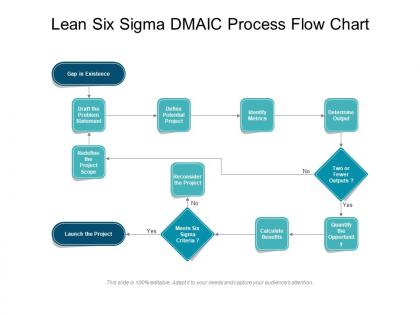
Lean six sigma dmaic process flow chart




Try Before you Buy Download Free Sample Product
 Impress Your
 Audience
 100%
100% Editable
 Save Hours
 of Time


Contribute to any conclave with our Lean Six Sigma DMAIC Process Flow Chart. Your clarity of expression will astound all.
People who downloaded this PowerPoint presentation also viewed the following :
Lean six sigma dmaic process flow chart with all 2 slides:
Acquire astounding clarity of expression with our Lean Six Sigma DMAIC Process Flow Chart. Be appreciated at any conclave.
FAQs for Lean six sigma dmaic
So DMAIC breaks down into five phases you go through in order: Define, Measure, Analyze, Improve, and Control. First you define what's actually wrong and set your project scope. Then measure current performance to get your baseline numbers. Analysis is where you find the real root causes - and trust me, most teams try to speed through this part when they really shouldn't. After that, you develop your improvements and roll them out. Finally, put controls in place so your gains don't disappear. Each phase has deliverables and checkpoints before moving on. Oh, and don't skip ahead even if you think you already know what's broken.
So basically, you're trying to figure out what's actually broken and why anyone should care about fixing it. Surveys and complaint data are your best friends here - plus stakeholder interviews if you can swing it. Voice of Customer stuff is gold because it shows you what users are actually struggling with, not what you think they're struggling with. Start with whatever data you already have sitting around (there's always more than you think). Then map out what you're still missing. Process maps help too, though honestly they can be a pain to create. The whole point is building a rock-solid problem statement everyone can get behind.
So you'll mainly work with process maps, data collection plans, and MSA (measurement system analysis). Control charts, histograms, and capability studies are your go-to statistical tools for baseline performance. Run charts and Pareto charts help spot trends and figure out which issues matter most. Honestly, the data gathering can drag on forever - but you really need solid baseline metrics before changing anything. Map your process first, then decide what data you actually need. Oh, and capability studies are probably more useful than most people think.
Process mapping is your best friend for spotting problems that don't show up in spreadsheets. You'll see bottlenecks and duplicate work way clearer when everything's laid out visually. Honestly, swim lane diagrams are clutch for this - they show exactly where things get passed between departments, and that's usually where stuff falls apart. Look for steps that don't actually add value for customers but still chew up time. I learned this the hard way on a project last year. Once you map it out, the waste becomes super obvious. It's basically like putting on glasses when you didn't realize you needed them.
Dude, root cause analysis is huge in DMAIC - it's literally what makes the Analyze phase work. Think of it this way: you can't just slap fixes on symptoms and call it a day. Use fishbone diagrams, 5 Whys, maybe some stats to actually figure out what's breaking your process. Once you nail down the real culprits, your Improve phase becomes way easier because you're targeting the right stuff. I've seen so many projects fail because people skip this step. Trust me, without digging into root causes first, you'll just be playing whack-a-mole with the same issues forever.
So basically, grab all those solutions from your analysis and plot them on an impact-effort matrix. High impact, low effort = your best friends right now. Those quick wins are gold because they get people excited about the whole thing. After that, move to the high-impact stuff that takes more work. Oh, and don't just wing it with your scoring - actually rate each option on cost, timeline, resources, all that. I know it sounds tedious but trust me, it's way better than picking favorites based on hunches. Start with the easy victories first.
So for Control phase, definitely keep tracking whatever metric you originally fixed - that's your main thing. Process capability stuff like Cpk matters too. Control charts are honestly where it's at - they'll tell you right away if your improvements are actually holding or if things are sliding back. I'd also watch cycle time and defect rates, plus customer satisfaction if that applies to your project. You want both the "what already happened" metrics and the "what might happen next" ones. Oh, and set up some trigger points so your team knows exactly when to jump in and fix something before it gets worse.
Look, stakeholder engagement will make or break your DMAIC project - I can't stress this enough. Get process owners, customers, and leadership involved from day one. They'll give you the real insights during Define and Measure, plus you'll actually need them to implement stuff in the Improve phase. Here's the thing though - I've watched so many projects that looked amazing on paper completely fall apart after six months. Why? Because people were just going through the motions with stakeholder meetings instead of genuinely listening to concerns and letting them help make decisions. Don't create fancy charts that'll just sit in someone's drawer.
You can totally blend Lean into DMAIC - it actually works really well. Start with Define by mapping your customer value streams. When you hit Measure, hunt for those 8 wastes alongside your regular metrics (overproduction, waiting, all that stuff). The Analyze phase is where things get interesting - dig into root causes for waste elimination. Improve becomes about boosting flow efficiency and cutting waste. Then Control keeps everything from sliding back to the old ways. I honestly think this combo beats using either method solo. DMAIC gives you structure while Lean keeps you focused on eliminating the right stuff. Pro tip: map your current value stream during Measure phase first.
Most teams mess up by racing past Define and Measure - they think they already get the problem. Big mistake. You'll waste weeks solving something that wasn't even the real issue. Also, don't try to fix everything at once. Seriously, I've watched so many projects crash because they went too broad right away. Pick something small and focused, especially if you're just starting with DMAIC. Once you nail that first win and show it actually works, then you can go after the bigger stuff. Baby steps first.
So DMAIC is basically your step-by-step guide for actually fixing stuff instead of just talking about it. First you define what's actually broken and matters to your company. Then measure where you're at now - no guessing allowed. The analyze part is where you dig into why things suck, and improve is when you fix it systematically instead of throwing random solutions at the wall. Control keeps everything from falling apart later, which honestly happens way too often. Oh, and each project gives you data to make the next one better. It's pretty straightforward once you get the hang of it.
Honestly, ditch the boring PowerPoint marathon approach - nobody retains that stuff. Give people real problems from their actual jobs to work through the DMAIC steps. Way more effective when they're fixing something that actually bugs them daily. Mix it up with process maps, data work, group talks, whatever keeps people engaged. Don't rush through each phase either. Let teams practice Define before jumping into Measure, you know? Oh, and definitely assign a live project they can tackle while learning. Builds those habits naturally. Just make sure each session ends with concrete next steps or everything fizzles out.
Dude, technology tools are game-changers for DMAIC projects. Statistical software like Minitab or JMP will save your sanity during the Analyze phase - trust me on this one. Project management platforms keep your Define and Improve phases organized. Process mapping tools make flowcharts way less of a headache. Don't sleep on Excel either if money's tight. My old manager swore by it for everything, which was... interesting. Pick tools that match your team's skills and project complexity. The shiniest option isn't always the smartest choice.
GE's got some killer examples - they saved billions fixing aircraft engine defects with DMAIC. Virginia Mason cut patient wait times in half, which is honestly impressive for healthcare. 3M did something similar with their tape production quality. Oh, and American Express streamlined how they handle customer complaints using the same approach. The framework works across basically any industry, which is pretty neat. You should definitely check out the ASQ database - they break down these real implementations so you can see what actually worked and maybe steal some ideas for your own stuff.
Oh man, cultural stuff will totally mess with your DMAIC rollout if you're not careful. Some cultures hate that direct data approach - they want everyone to talk it through first before making changes. Then you've got the hierarchy thing where people just won't speak up or question anything during Define and Measure. I swear, half the time projects die because nobody wants to rock the boat. Short-term vs long-term thinking screws up the Control phase too. My advice? Figure out your facilitation style early and mix up your teams culturally from the start.
No Reviews