

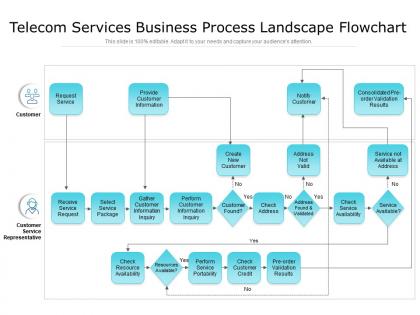
Telecom services business process landscape flowchart




Try Before you Buy Download Free Sample Product
 Impress Your
 Audience
 100%
100% Editable
 Save Hours
 of Time


Be an entertainer extraordinaire with our Telecom Services Business Process Landscape Flowchart. Always conjure up delightful events.
People who downloaded this PowerPoint presentation also viewed the following :
Telecom services business process landscape flowchart with all 2 slides:
Always conjure up delightful events with our Telecom Services Business Process Landscape Flowchart. You will be an entertainer extraordinaire.

FAQs for Telecom services business
Honestly, 5G and edge computing are the big ones right now. Telecom companies aren't just doing connectivity anymore - they're trying to be tech companies with cloud services and IoT stuff. Network slicing is pretty cool actually, lets them create custom virtual networks for different clients. Energy costs are brutal so sustainability is driving a lot of infrastructure choices. AI's handling more network management tasks too, which makes sense since everything's getting so complex. Oh, and everything-as-a-service models are everywhere now. If you're planning anything telecom-related, these trends are basically reshaping how vendors work with clients.
So telecom companies actually have pretty decent security these days. They encrypt your calls and data while it's moving around, plus they have to follow strict regulations like GDPR. Most of the big ones spend serious money on cybersecurity teams - honestly, they'd be screwed if they didn't since hackers love targeting them. Network access is locked down tight, and they're constantly checking for vulnerabilities. If there's ever a breach, they'll let you know. Your data gets anonymized when they use it for analytics stuff. Before switching providers, I'd definitely peek at their privacy policy though - some are way better than others.
Dude, 5G is completely flipping telecom on its head. Companies aren't just doing calls and data anymore - they're jumping into IoT, smart cities, edge computing, all that AR/VR stuff. The latency is insane (in a good way) so now they can actually go head-to-head with Google and Amazon on cloud services. Wild, right? My buddy who works at Verizon says the money's shifting fast. Think industrial automation, self-driving cars, remote surgery - stuff that actually needs lightning-fast connections. If you're planning strategy there, I'd focus on which industries fit your coverage areas best.
Honestly, telecom companies need to get their digital game together if they want happy customers. AI chatbots for quick help, self-service portals so people can handle their own stuff, predictive analytics to catch network problems early - all that matters now. Nobody wants to sit on hold anymore, it's painful. Data analytics can help personalize what you're offering too. Oh, and make sure the experience feels the same whether someone's using your app, website, or actually calling. I'd start by figuring out where customers get most frustrated in their journey - that's where you'll see the biggest wins from going digital.
Ugh, rural telecom is such a pain. Infrastructure costs are insane when you're covering like 50 people across 20 miles. Mountains and forests don't help either - good luck maintaining towers out there. The money just isn't there since rural folks can't spend as much on fancy plans. ROI? What ROI lol. Most companies are bleeding cash on these areas. Smart operators share towers with competitors or hunt for government money to stay afloat. It's really the only way the math works out.
So basically regulatory policy is like the rules that keep telecom companies from screwing you over completely. Price caps on essential stuff, forcing competition in some markets, making them offer discounts for low-income folks. The spectrum auctions and infrastructure sharing get messy quickly though - honestly there's so much bureaucracy involved. Without these rules you'd be paying insane amounts since telecom naturally becomes a monopoly situation. Oh and FCC decisions usually signal what's coming price-wise, so that's worth watching if you're curious.
Dude, churn is killing everyone in telecom right now. Three things that actually work: Get your customer service sorted first - quick responses and people who can fix stuff instead of reading scripts. Use data to spot customers about to bail, then hit them up with deals before they ghost you. Also personalize everything based on what they're doing. Most telecom companies suck at this basic stuff honestly, which is why everyone's bleeding customers. Oh and map out your customer journey to see where people get pissed off most. Fix those spots first.
So basically IoT turns your telecom setup into this hub for all connected stuff - smart homes, fleet tracking, industrial sensors, whatever. You can make money beyond just voice and data by offering managed IoT services where you handle device connectivity and data analytics for businesses. That's honestly where all the growth is right now. The data insights you get are pretty sick too - helps optimize your network and build more targeted services. Oh, and start with IoT verticals that match your current customers. Way easier entry point that way.
Dude, telecom support has gotten crazy good with AI stuff. Most basic questions get handled by chatbots instantly now - no more waiting on hold for simple billing questions. They've got predictive systems that spot network problems before you even lose signal, which is honestly kind of impressive. Smart routing connects you to the right person way faster too. The weirdest part? Some companies can actually predict when you're about to call based on your data usage and network issues. For quick stuff, definitely try their chat first - I was skeptical but it's legitimately faster than calling now.
Honestly, bundles can be pretty solid deals if you actually use everything. You'll usually save money compared to separate bills, plus dealing with one company is way easier when stuff breaks. Companies love them because once you're locked into three services, you're probably not switching anytime soon - who wants that headache? They make more money per customer too. Just don't fall for the trap of bundling services you don't really need. Like, do you even watch cable anymore? I made that mistake once and paid for premium channels I used maybe twice. Really depends on your situation though.
So here's the weird thing about network sharing - it actually creates MORE competition, not less. Smaller companies can jump into markets without spending billions on towers and fiber. Pretty counterintuitive, right? But once everyone's got decent network access, the real fight moves to stuff like customer service, pricing, and who's got the coolest features. Honestly, I think that's better for consumers anyway. When you're sizing up competitors now, don't get hung up on their network size. Focus on what they're actually offering customers - that's where the real differences show up.
Dude, WhatsApp and Netflix are absolutely destroying telecom companies right now. People still pay for data plans, but they're completely skipping expensive voice calls and texting. Why would you pay per text when WhatsApp is free? Telecom carriers are scrambling to reinvent themselves as just internet providers instead of full-service companies. Those fat profit margins from calls and SMS? Gone. Network quality is becoming everything now - that and maybe throwing in some bundle deals to keep customers happy. It's wild how fast this shift happened honestly.
Honestly, telecom companies are getting really serious about going green lately. Verizon and AT&T both want net-zero emissions by like 2030-2040, which is wild considering where they were just a few years back. They're pouring billions into renewable energy and making 5G way more efficient. Some are even using AI to cut power usage at cell towers - pretty smart actually. Oh, and they've got e-waste recycling programs now too. If you're picking a telecom partner, definitely grill them about their sustainability numbers. It's not just good PR anymore, it'll probably save money down the road.
Nigeria, Vietnam, Indonesia - that's where the action is. Mobile adoption is going crazy in those markets. India's still huge for data services too since everyone's upgrading to smartphones. Latin America? Eh, growth there but nothing spectacular. Here's what's cool though - people are skipping landlines entirely and jumping straight to smartphones. Rural infrastructure is finally catching up too. Oh, and definitely look at places where mobile money is exploding alongside regular telecom. Those customers aren't going anywhere once they're hooked.
So basically, you can spot network congestion before it actually hits by analyzing the data patterns. Pretty cool stuff. Your customer data shows when people are binge-watching Netflix or which cell towers get crushed during concerts. I'd start with network optimization since it's usually the easiest way to prove it works to your boss. Plus you can predict when equipment's about to fail, catch customers who might bail early, and create custom plans based on how people actually use their phones. Oh, and maintenance scheduling becomes way less of a headache too.
No Reviews