

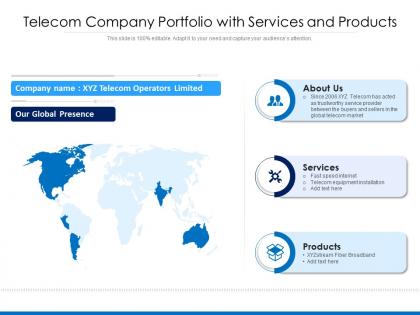
Telecom company portfolio with services and products




Try Before you Buy Download Free Sample Product
 Impress Your
 Audience
 100%
100% Editable
 Save Hours
 of Time


Our Telecom Company Portfolio With Services And Products are topically designed to provide an attractive backdrop to any subject. Use them to look like a presentation pro.
People who downloaded this PowerPoint presentation also viewed the following :
Telecom company portfolio with services and products with all 2 slides:
Use our Telecom Company Portfolio With Services And Products to effectively help you save your valuable time. They are readymade to fit into any presentation structure.

FAQs for Telecom company portfolio with
Hey! So for telecom investing, you'll want three main things. First, diversify your revenue - mix the boring stuff like broadband with newer 5G and IoT plays. Don't chase just fiber even though everyone's obsessed with it right now. Second, look for companies with scalable infrastructure spread across different regions. Geographic diversity saves you when one market tanks. Customer retention is huge too since people switch carriers way easier now. I'd focus on companies with solid enterprise contracts - those business customers stick around longer than your average consumer who jumps ship for a better deal.
Honestly, start by figuring out who your customers actually are - business folks want rock-solid service and decent support, while regular people just want cheap plans with lots of data. Bundle stuff together instead of having a million confusing options (seriously, I've seen companies with like 50 different plans and nobody knows what's what). Three to five clear tiers per group max. The real trick is digging into your usage data to spot who's about to bail before they actually do. Oh, and definitely audit what you're offering now against how people actually use their service - you'd be surprised how off most companies are.
Honestly, tech innovation is what's completely reshaping telecom portfolios right now. 5G, edge computing, AI network management - you've gotta constantly evaluate this stuff because it decides which assets become gold or garbage. Timing's the killer though. Jump in too early and you're hemorrhaging cash on unproven tech. Wait too long? You're scrambling while competitors already own the market share. I'd set aside dedicated innovation budgets and do regular roadmap reviews. It's brutal out there if you're not staying ahead of the curve.
Pull your customer lifetime value data first - that's your goldmine. Map it against what services you're actually offering and you'll spot the money makers vs the dead weight real quick. Usage patterns and churn rates by segment tell the whole story honestly. Don't sleep on geographic performance either, telecom's so location-heavy it's crazy. Network utilization metrics show if you're throwing money at infrastructure that doesn't need it. The numbers don't lie - you'll see exactly what to kill off and where to go all-in.
You need both financial and operational metrics to really understand what's happening. Start with ARPU, CAC, and churn rate - those are your core numbers. Network stuff matters just as much though. Call drop rates and data speeds will make or break you because customers bolt fast when service is garbage. Market share by segment gives you the bigger picture, plus ROIC shows if you're actually being smart with capital. The tricky part? You're constantly juggling short-term profits against those massive network investments. Set up a monthly dashboard so you can catch problems before they get expensive - learned that one the hard way.
Dude, regulatory changes will totally flip your telecom strategy upside down. They control what tech you can use, your pricing, expansion plans - basically everything. Net neutrality, spectrum auctions, privacy laws... all of it hits your investment choices hard. Honestly, some of these policy shifts happen so fast it's ridiculous. Your assets can gain or lose value literally overnight depending on what regulators decide. You'll want to buddy up with regulatory teams and watch policy news like a hawk. It's just as crucial as tracking market data, maybe more so these days.
So there's basically three ways to go about this. Bundling extra services with what you already offer is probably your best bet - stuff like cloud storage, cybersecurity, IoT solutions. Way easier since your customers already trust you. You could also branch out into related tech markets. Smart home devices, enterprise software, that kind of thing. Third option is buying up companies in similar industries to expand vertically. Honestly though, I'd start with the bundling approach first. Just ask your existing customers what else they need and either build it yourself or find partners who can deliver it. That's where the quick wins are.
So customer segmentation pretty much controls how you build your whole telecom lineup. Different groups need totally different stuff - enterprise clients want rock-solid SLAs and premium support, while regular consumers just want decent mobile service without breaking the bank. Small businesses fall somewhere in between, which makes things tricky sometimes. Your pricing, features, and service tiers all have to match what each segment actually uses and can afford. Makes way more sense than trying to cram everyone into the same boring package, you know?
Dude, telecom portfolio management is brutal right now. You're stuck pouring money into 5G and fiber while still paying off legacy stuff - the timelines don't even match up. Regulators keep changing rules that mess with your whole strategy, and customers want everything yesterday. The worst part? You can't pivot fast like tech companies since everything needs massive upfront capital. Honestly feels like you're always playing catch-up. Best bet is building wiggle room into your plans and having backup scenarios ready. Trust me, something will definitely go sideways when you least expect it.
Honestly, you've got to be ruthless about cutting services that aren't pulling their weight. Bundle stuff that makes sense together - 5G with edge computing, IoT packages, whatever keeps customers from jumping ship easily. I'd definitely push into cybersecurity and cloud services too, since that's where the real money is moving. Those old cash cows? Yeah, they won't last forever, so don't get too cozy. The smart companies are already pivoting hard toward enterprise solutions and platform models. Start by actually looking at what's making you money versus all the legacy stuff that's just... there.
Honestly, partnerships are a game-changer for telecom expansion. Instead of dumping millions into building everything from scratch, you can piggyback on someone else's infrastructure and customer relationships. Rural coverage is a perfect example - why spend forever setting that up when some regional company already owns that space? The trick is finding partners where it's actually win-win, not just you taking advantage. I'd start by figuring out where your biggest gaps are, then hunt for companies that complement what you're already doing. Way smarter than the solo route, trust me.
Look for telecom companies investing in energy-efficient 5G networks and renewable power sources. Device refurbishment programs are huge too - way better than just trashing old phones. The ESG data in telecom is honestly kind of messy, but you can spot the real leaders pretty easily. Companies with science-based carbon targets and transparent reporting are your best bet. I'd start by checking what you already own for sustainability metrics, then gradually move toward carriers actually hitting their reduction goals. Oh, and don't sleep on e-waste recycling initiatives - that's becoming a big differentiator.
5G's still the main driver - tons of infrastructure money flowing there. Edge computing is forcing telecoms to spread out their networks instead of keeping everything centralized. AI integration? Everyone's winging it honestly, nobody really knows what they're doing yet. Smaller companies are getting crushed by how much capital you need now. IoT is exploding though - smart cities, connected cars, all that jazz. Oh and there's this whole sustainability push happening too. I'd focus on companies that aren't just doing basic voice/data anymore and actually have solid 5G plays.
Look, pricing can totally make or break your telecom portfolio. Get it competitive while keeping decent margins? You'll pull in more customers and keep them around longer - that's what drives up your valuation. Premium pricing works if your service is actually worth it, but don't race to the bottom on price because that kills profits fast. Honestly, bundling different services together usually works way better than selling stuff separately. Value-based pricing is your friend here - people need to feel like they're getting a fair deal. Tiered options give you room to catch different types of customers too.
Honestly, just listen to what people are actually saying about your service. When everyone's complaining about dead zones in certain neighborhoods, boom - there's your network upgrade priority list. Run surveys to figure out what features matter most (spoiler: it's probably not the fancy stuff you think). Social media is where the real tea gets spilled about telecom problems, so monitor that religiously. Here's the thing though - you've got to actually fix what they're griping about. Nothing builds loyalty like customers seeing you took their feedback seriously. Set up regular collection methods and make sure complaints reach your product teams fast.
-
Unique research projects to present in meeting.
-
Wonderful templates design to use in business meetings.
-
Unique and attractive product design.